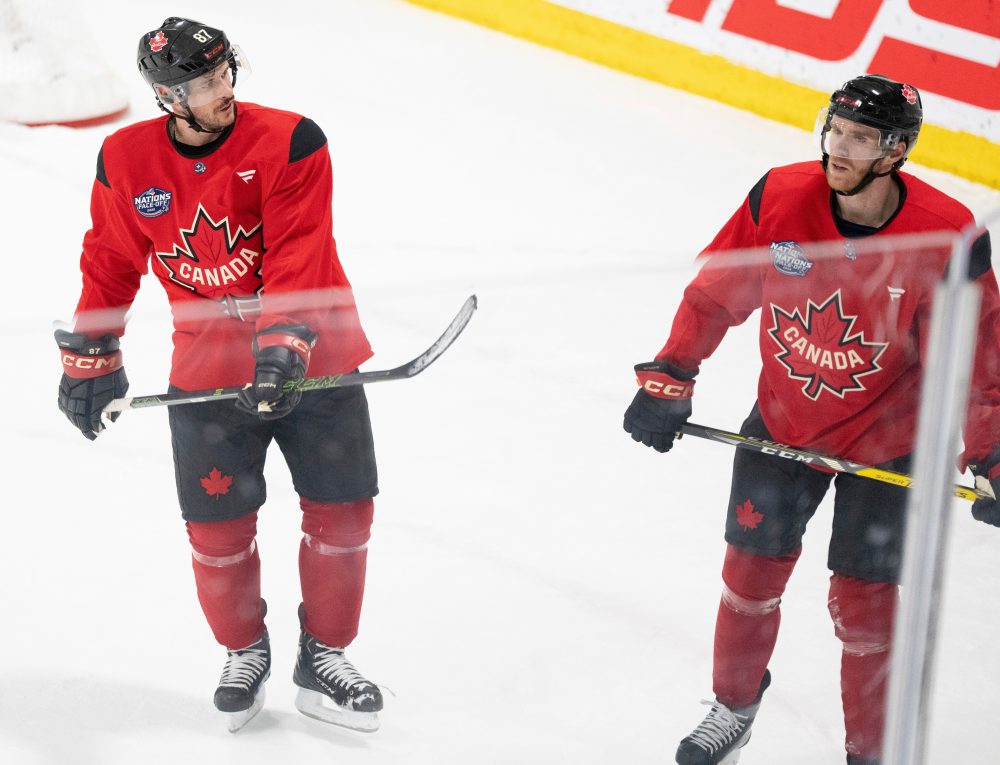

MILAN (AP) — When Sidney Crosby netted the golden goal that delivered Olympic gold to Canada on home soil in Vancouver 2010, he cemented his place in hockey lore. Since the 2014 Sochi Games, he has worn the captain’s armband every time he’s donned the maple leaf.
The three-time Stanley Cup champion and two-time Olympic gold medalist was long considered the planet’s premier hockey talent. However, that crown has now shifted to Connor McDavid, who currently skates alongside Crosby at the Milan Olympics. While Crosby expressed willingness to pass the captaincy to McDavid, Hockey Canada opted to retain their veteran leader for the NHL’s Olympic comeback.
“He moves between management and coaches and players with great ease,” Canada general manager Doug Armstrong said. “He’s as good a leader as I’ve been around and I’ve seen.”
The inevitable passing of the torch from jersey number 87 to 97 may happen sooner than anticipated due to Crosby’s Olympic injury. Should Crosby be sidelined for Friday’s semifinal matchup, Olympic regulations mandate someone must wear the captain’s “C” — and that responsibility will likely fall to McDavid, Canada’s heir apparent.
“Those two, it’s Sid and then Connor who’s kind of filling in his shoes and kind of taking on that role,” said Macklin Celebrini, Canada’s youngest player at 19. “They’re different in the way that they carry themselves, but both of them are awesome people and awesome teammates.”
These Milan Games mark the third Olympic appearance for the 38-year-old Crosby. For the 29-year-old McDavid, it represents his debut on this stage — a consequence of the twelve-year NHL Olympic absence that occurred during his prime years.
McDavid has seized this long-awaited chance, topping the tournament scoring charts with 11 points and positioning himself as a potential MVP candidate should Canada capture gold as they did under Crosby and Drew Doughty’s leadership in 2010 and 2014.
“He’s doing everything,” Crosby said. “Whether it’s with the puck without the puck, (being) physical, he’s leading by example in every possible way. He’s poised, and guys have taken some runs out of him. He just continues to play. I think he’s (got) a lot of focus that way. He’s been leading the way.”
Drew Doughty, Canada’s second-eldest player at 36, has watched McDavid eliminate his Los Angeles Kings from the playoffs in each of the last four seasons while playing for Edmonton. This gave him a close-up view of McDavid’s excellence during hockey’s most intense moments.
Now he’s witnessing it again, but this time as a teammate rather than an opponent.
“I don’t know if he’s playing better or what, but it’s obviously on a bigger stage,” Doughty said. “For him to be able to handle that pressure and play the way he’s playing, it’s pretty special.”
Crosby, pursuing his third Olympic championship, had accumulated six points across three contests before departing the fourth game with what appeared to be a right knee problem. Despite leaving the quarterfinal against Czechia and being unable to return, he rallied the team during the second intermission, spurring Canada’s comeback from a late deficit to secure an overtime victory.
“We didn’t want this to be Sid’s last game at this Olympics, so it was big motivator for the guys coming out,” coach Jon Cooper said, boiling down Crosby’s message to, “Go get it, boys.”
“There was a lot more than that. But he’s a true leader. And they don’t want this to be the end of the tournament for him.”
Whether Crosby will suit up for Friday’s semifinal against Finland remains unclear. Cooper indicated Crosby hasn’t been eliminated from consideration for that contest or the remainder of the Olympics.
“If he can play, he’s definitely going to,” Cooper said after practice Thursday.
While Celebrini preferred not to imagine competing without Crosby, Canada’s coaching staff must prepare for that possibility. McDavid captains Edmonton and has exhibited leadership qualities throughout these Olympic Games.
“He’s a great leader for us,” goaltender Jordan Binnington said. “He wants the puck. He wants to make a difference. He’s excited to play. He brings great energy, and he’s had a lot of big goals, contributed to a lot of big goals for us.”
Cooper has observed Canada’s leadership dynamics evolve since the 4 Nations Face-Off a year earlier, when players deferred to Crosby, Doughty and Brad Marchand — veteran voices willing to speak up. That dynamic has transformed, with McDavid assuming greater leadership responsibilities this tournament.
“He’s much more — not that he wasn’t comfortable — but I think there was a lot of uncertainty especially because we hadn’t seen best on best and this group hadn’t been together for so long,” Cooper said. “In this tournament, he’s been fabulous.”
McDavid’s leadership style differs from Crosby’s more vocal approach, and despite his individual achievements, he has yet to claim a Stanley Cup. Throughout his career, he has absorbed valuable lessons from Crosby about effective leadership.
“Everybody here watches him and is trying to learn off him,” McDavid said. “Sid is just himself, and it doesn’t need to be anything more or less. I think everybody’s different in their own way.”
Doughty characterized Crosby as “the guy that showed all the young guys, young players growing up, what it means to be Canadian, what it means to be a Canadian hockey player.” He believes McDavid is prepared to carry that responsibility forward.
“I can’t say enough good things about him,” Doughty said. “Great guy off the ice, fun to hang around, and then when it’s game time, he’s dialed in and ready to go. And he puts that jersey on and he’s the best player on the ice every night. It’s crazy.”