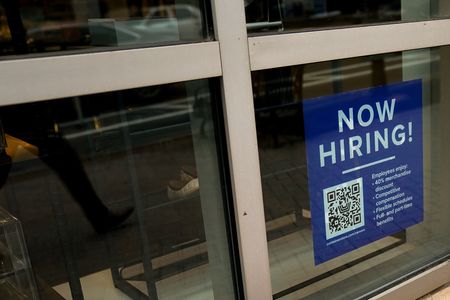

Employment experts anticipate that the United States added jobs at a more measured pace during May, following two consecutive months of robust hiring activity, though the rate would likely continue reflecting steady labor market conditions.
Economic analysts expected the Labor Department’s highly anticipated employment data released Friday to show that the ongoing Middle East conflict, which has driven up inflation through rising oil costs, has not yet significantly affected employment trends.
Government financial support through tax and tariff refund programs has strengthened business earnings and enabled companies to avoid widespread workforce reductions, according to analysts.
Companies have remained hesitant to expand their workforce while navigating uncertainty, initially from sweeping tariffs implemented last year and currently from the U.S.-Israeli conflict with Iran. Minimal job cuts are stabilizing the employment market, maintaining what analysts describe as a “slow-hire, slow-fire” balance that allows the Federal Reserve flexibility to maintain current interest rates while observing inflation effects from the conflict.
“I’m a bit surprised that things have held up as long as they have, but there’s a couple of things that are playing out, tariff and tax refunds, those two factors, at least so far, have been sufficient to offset the higher gasoline and fuel prices,” stated Brian Bethune, an economics professor at Boston College.
“Tariff refunds, which are playing out probably to the tune of $150 to $200 billion, support corporate profits, so corporations are not really under severe pressure. The environment remains positive, although not terrific.”
Employment outside of farming sectors likely grew by 85,000 positions last month following an increase of 115,000 in April, according to a Reuters economist survey. Projections for employment growth varied from 50,000 to 125,000. Job numbers jumped by 185,000 in March. May’s expected increase would exceed the monthly average of 76,000 recorded this year.
Analysts anticipated minimal adjustments to previous employment figures after the Bureau of Labor Statistics updated its “birth-death” calculation method used to estimate job changes from business openings and closures during specific periods.
Economic experts calculated that the economy requires between zero and 50,000 new positions monthly to match working-age population growth. This threshold has decreased due to immigration restrictions that have reduced available workers, limiting unemployment rate increases.
The jobless rate was projected to remain at 4.3% for three consecutive months, though some economists thought it might increase to 4.4%, which wouldn’t alter the stable labor market outlook. The workforce has decreased by approximately 500,000 since February, and recovery was possible, potentially raising unemployment figures.
Financial markets anticipate the central bank will maintain its primary overnight interest rate between 3.50%-3.75% through next year. The Supreme Court eliminated the tariffs in February and various companies have requested refunds. Business earnings rose by $40.4 billion during the first quarter and have increased since the second quarter of 2025.
The Middle East situation, now in its fourth month, has increased gasoline costs by over 40%. Price increases reached their fastest rate in three years during April, according to last week’s government data.
Considering oil market volatility, recruitment remains limited, and historically minimal layoffs contribute significantly to employment growth. The Fed’s Beige Book report Wednesday observed that “hiring remained selective and primarily focused on critical roles or attrition replacement” during May.
“The stability is going to persist, but we’re not betting on a strong rebound,” explained Stephen Douglass, chief economist at NISA Investment Advisors. “The risk is tilted toward the unemployment rate creeping higher over the next 12 months or so, and that will be enough to get the Fed to deliver a few more cuts after the war is resolved conclusively.”
The expected employment growth slowdown last month would reflect diminishing benefits from good weather conditions in April. A work stoppage by 4,000 Harvard Graduate Students Union members was also anticipated to limit job increases. Transportation sector losses following federal restrictions on commercial driving permits for non-citizens were likely, with analyst estimates around 10,000 monthly.
Additional federal workforce reductions are expected. The administration launched an extensive effort last year to reduce government employment as part of restructuring plans. However, some agencies have recently begun rebuilding their staff numbers.
Economists disagreed on when Spirit Airlines’ bankruptcy would appear in employment statistics. The healthcare field was expected to continue supporting job numbers due to population aging. Growth was anticipated in leisure and hospitality sectors, partially connected to early preparations for soccer World Cup events.
Economists at JPMorgan observed that recent hiring acceleration focused on industries employing significant numbers of non-citizens and believed this trend could continue.
“Although immigration enforcement remains high, it is not in the headlines as much these days, and immigrants at risk of deportation could have become more focused on finding work given limited savings,” they noted.