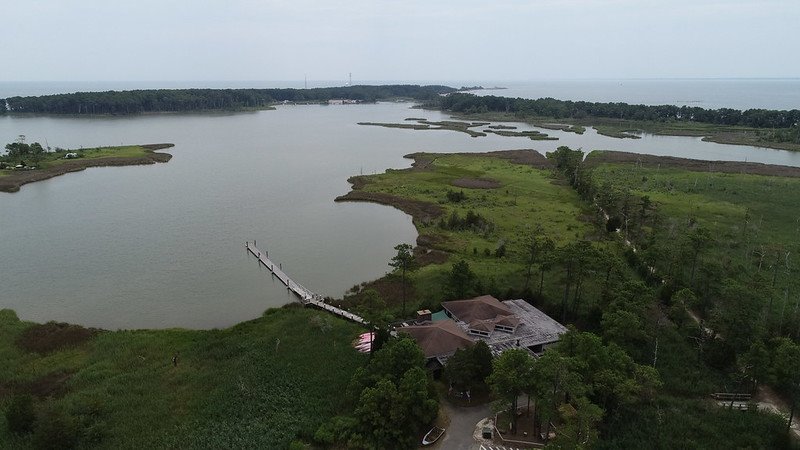

A major climate adaptation initiative is coming to Point Lookout State Park in St. Mary’s County, Maryland, with $1.25 million in state funding allocated for comprehensive upgrades designed to combat rising sea levels and frequent flooding.
The Maryland Department of Natural Resources announced the multi-year renovation project will construct a natural living shoreline and permanently close two campground sections that experience constant tidal flooding. The initiative represents the first climate resilience project funded through Maryland’s Great Maryland Outdoors Act, passed in 2022 with $5 million designated for environmental protection efforts.
“The Great Maryland Outdoors Act is building a more resilient future for Maryland State Parks,” said Department of Natural Resources Secretary Josh Kurtz. “The work at Point Lookout and other projects supported by this funding will use nature-based solutions to support our climate adaptation goals while also building community resilience to ensure our parks are accessible to the public for generations to come.”
The comprehensive plan includes establishing a living shoreline system to combat erosion and enhance the park’s natural defenses against rising waters. Two camping areas – Green’s Point Loop and Lanier Loop – will be permanently shuttered due to persistent nuisance flooding, with these sites transformed into picnic facilities for registered campers or restored to their original marsh habitat.
Situated at the southern tip of St. Mary’s County where the Potomac River meets the Chesapeake Bay, Point Lookout faces significant environmental challenges. Scientific projections indicate water levels could climb between 1.5 and 2.5 feet within the next 25 to 50 years, making the park particularly vulnerable to climate impacts.
The Alliance for the Chesapeake Bay has been selected as the nonprofit partner to oversee the project through a competitive application process. The organization will handle technical support, project management, and community outreach efforts.
“The Alliance is eager to collaborate with the Maryland Park Service and Maryland Department of Natural Resources on this important coastal resilience project,” stated Laura Todd, Associate Green Infrastructure Program Director for the Alliance for the Chesapeake Bay. “The upcoming ecological restoration and outreach efforts at Point Lookout will enhance natural resources for the benefit of Chesapeake Bay fish, wildlife, and the many visitors to the park.”
The park’s campground has remained closed since 2021 for critical water and sanitation system repairs, with reopening scheduled for spring 2026. When facilities resume operations, campers will have access to Tulip Loop offering full hookups, mixed-use sites at Malone and Hoffman’s Loops, and the six-site Conoy Loop designed for families and groups.
The living shoreline component will involve strategic placement of sand, installation of marsh vegetation and shrubs, and construction of structures to encourage oyster reef development. Educational signage will be installed to highlight the importance of marsh ecosystems in the face of climate change.
“Support for initiatives such as this is incredibly important to our park system,” noted Jonas Williams, Director of Planning for the Maryland Park Service. “With support from the Great Maryland Outdoors Act, we can ensure Point Lookout State Park is more resilient for future generations.”
Design work is scheduled to commence in early 2026, followed by on-site construction. University of Maryland landscape architecture students have already contributed conceptual designs for the restoration effort.
Additional climate protection work is simultaneously underway at Point Lookout through DNR’s Grants Gateway program, which is funding a living shoreline along the park’s causeway – the sole access route to the facility and historic sites including the Point Lookout Lighthouse and Civil War prisoner-of-war camp location.
Three additional climate adaptation projects funded by the Great Maryland Outdoors Act are expected to launch in 2026, addressing flooding challenges across various landscape types and demonstrating nature-based solutions for infrastructure, habitat, and public safety protection.
“Climate change is reshaping Maryland now — bold adaptation on our state lands is showing how nature-based practices can strengthen Maryland’s resilience,” said Jackie Specht, DNR’s Resilient Systems Officer. “Great Maryland Outdoors Act projects, such as the one in Point Lookout, will protect important areas and serve as models for future action.”