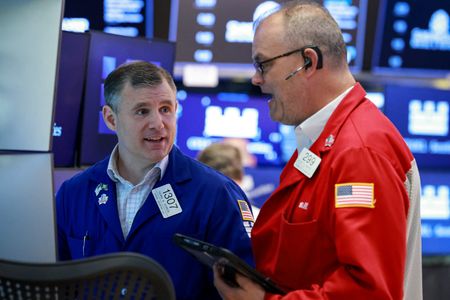

Stock markets surged Thursday as traders seized on hopeful developments regarding potential peace in the Middle East, driving share prices up while sending oil costs down. Technology companies faced pressure from artificial intelligence worries, but other market sectors provided strong support as investors await Friday’s jobs report.
Market analyst Jamie McGeever examined the U.S. employment situation ahead of the payroll numbers, noting that while the job market cannot be described as robust and some recent figures raise concerns, overall data trends suggest improvement and indicate a positive shift may be underway.
Wall Street demonstrated remarkable strength Thursday. The Nasdaq recovered from opening losses of more than 1% to finish unchanged, while the S&P 500 also staged an impressive comeback. The Dow avoided any downturn entirely, accelerating throughout the session to close 1.7% higher at a fresh record.
Market activity showed widespread buying across most sectors. Only two S&P 500 segments declined: technology fell 1.4% and consumer staples dropped 0.1%. Nine sectors posted gains, with financial companies leading at 2.7% higher and healthcare advancing 3%. Individual standouts included Blackstone gaining 7.5% and Humana rising 6.8%, while Broadcom tumbled 12.6% and Micron Technology fell 7.7%.
Currency markets saw the dollar weaken slightly, with the USD/JPY pair hovering near 160.00. Bitcoin dropped 2% to reach a four-month low. Bond yields decreased 2-4 basis points as the yield curve steepened. Oil prices declined 3%.
Traders continue purchasing during market dips regardless of geopolitical tensions, AI developments, or economic news. Financial conditions remain at their most accommodating levels in years, with volatility measures near yearly lows. Three-month euro/dollar implied volatility fell below 5% this week for the first time since 2021, reflecting calm market conditions.
Private credit markets faced renewed scrutiny as withdrawal requests increased. Investors in Blackstone’s main $79 billion private credit fund requested to withdraw 10% of shares in the second quarter, up from 7.9% in the first quarter. The firm limited withdrawals to 5%. Similarly, Cliffwater reported Tuesday that investors in its $31 billion fund attempted to redeem 17% of shares in Q2, also capped at 5%.
Bitcoin reached a four-month low around $61,000 Thursday, losing half its value since peaking above $126,000 in October and declining 20% over two weeks. The selloff accelerated after Michael Saylor’s Strategy, the largest corporate bitcoin holder, announced its first sale since 2022.
However, some analysts remain optimistic. Geoff Kendrick at Standard Chartered, a prominent cryptocurrency supporter, maintains his prediction of $100,000 by year-end. “When we look back at the end of 2026 with bitcoin at $100k we will say this was the buying zone we all wanted,” he stated.
Friday’s market focus includes potential Middle East developments, central bank communications from New Zealand and Australia officials, economic data from Japan, Taiwan, and South Korea, India’s interest rate decision and GDP figures, revised eurozone GDP numbers, Bank of England speeches, Canadian employment data, and U.S. nonfarm payrolls.