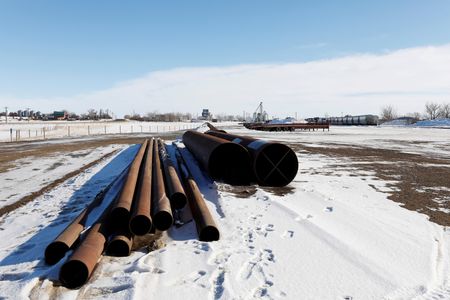

A major cross-border oil pipeline project is on the verge of securing enough industry backing to proceed with construction, according to four industry sources with knowledge of the development.
The pipeline, which would stretch from Alberta, Canada to Wyoming, represents a collaboration between Canadian firm South Bow Corp and American partner Bridger Pipeline. If completed, the infrastructure project would boost Canadian crude oil exports to the United States by more than 12%, providing crucial transportation capacity that Canada has long needed.
President Donald Trump provided a significant boost to the project last Thursday when he signed an executive order approving a cross-border permit. This development comes after President Joe Biden canceled the permit for the Keystone XL oil pipeline in 2021, which had been the most recent major cross-border pipeline proposal.
Though the new pipeline follows a different path through the United States compared to the scrapped Keystone XL project, South Bow’s section would utilize approximately 93 miles of already-constructed Canadian pipeline infrastructure that remains unused. This existing pipeline would then link to Bridger’s planned Montana pipeline, which would stretch roughly 645 miles to reach Guernsey, Wyoming.
Industry sources indicate that oil companies have already pledged to transport at least 400,000 barrels daily, representing approximately 72% of the pipeline’s planned initial capacity of 550,000 barrels per day. According to regulatory documents filed by Bridger, the project could eventually handle up to 1.13 million barrels daily.
Canada currently ranks as the world’s fourth-largest oil producer, generating about 5.5 million barrels per day as of late January, according to the nation’s energy regulatory agency. Production could reach 6.1 million barrels daily by 2030.
The pipeline developers are working to secure long-term shipping agreements for approximately 450,000 barrels per day, according to two sources. This would meet the typical industry standard of 80% initial capacity commitments that pipeline operators generally require before beginning construction.
Major oil companies that have committed to using the pipeline include Cenovus Energy and Canadian Natural Resources Ltd, according to one source. Additional participants include Tamarack Valley, Whitecap Resources, and Strathcona Resources.
The sources requested anonymity because shipping commitment details remain confidential.
South Bow declined to discuss specific capacity commitments, stating that the project remains in preliminary phases and depends on continued commercial negotiations, stakeholder discussions, regulatory approval processes, and ongoing evaluation.
Bridger also declined to provide comment. However, in March regulatory filings, the company indicated the project was being developed based on identified market demand and that commercial negotiations were continuing.
Cenovus, Canadian Natural Resources, Tamarack, and Strathcona all declined to discuss their commitment levels.
Whitecap CEO Grant Fagerheim noted that oil industry participation in the pipeline discussions has been positive and appears to have sufficient support to meet minimum project requirements. He emphasized that support from the U.S. administration was extremely beneficial, though the company provided no additional details about commitments.
The commitment levels demonstrate Canadian oil producers’ strong desire for additional transportation capacity for the country’s oil production, which has been constrained for years by insufficient pipeline infrastructure.
Competing pipeline companies are also pursuing capacity expansions on existing systems.
Enbridge approved expansions last fall for its Mainline and Flanagan South pipelines, which will enable an additional 150,000 barrels per day of Canadian heavy crude to reach the U.S. Midwest and Gulf Coast.
This additional capacity should become operational in 2027, and Enbridge is also evaluating commercial interest in a second Mainline expansion phase, which could begin service in 2028 and add another 250,000 barrels per day of capacity.
The Trans Mountain pipeline, which runs from Alberta to Canada’s Pacific coast for shipment to the U.S. West Coast and Asian markets, is also planning multiple improvements that could increase capacity by 360,000 barrels per day.
Bridger’s current plan involves constructing a pipeline from Montana to Guernsey, Wyoming, following routes alongside existing pipeline infrastructure, which could simplify the permitting process.
However, analysts note that Guernsey does not serve as a final destination for crude oil, meaning additional connections would be necessary to reach major refining centers like Cushing, Oklahoma, Patoka, Illinois, and the U.S. Gulf Coast.
AJ O’Donnell, an analyst with Tudor Pickering, Holt & Co., described the project as offering one of the most cost-effective options for shippers seeking to increase oil transportation from Western Canada by decade’s end.
“While uncertainty remains around the final economics, we believe this represents the most logical approach to adding incremental oil egress capacity through the end of the decade,” O’Donnell stated in a research note.
“Our view is that additional egress is needed regardless of the geopolitical backdrop.”