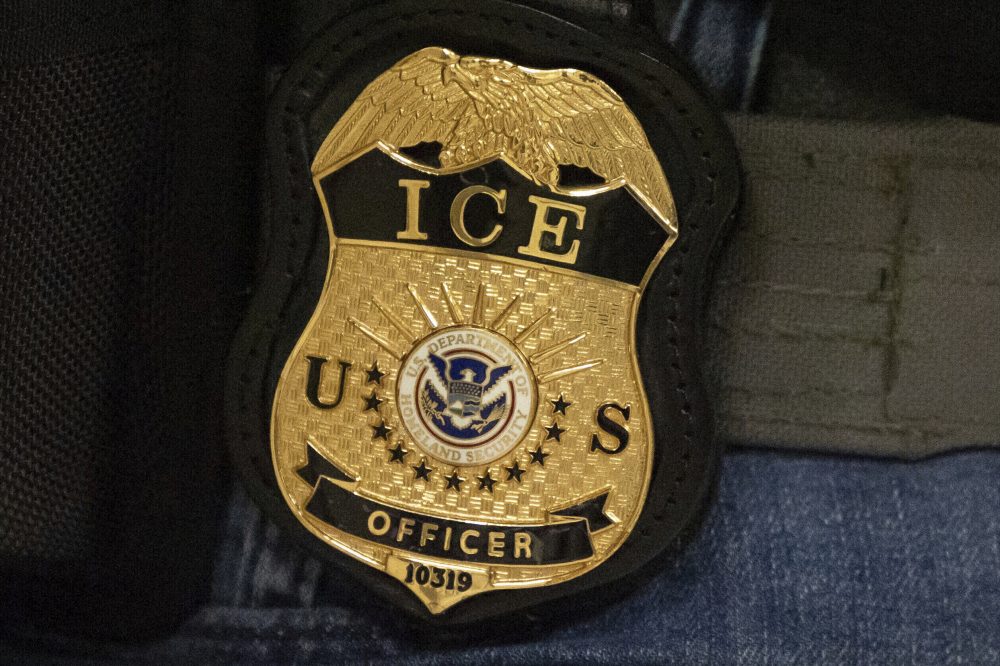

WASHINGTON — A shooting incident in Maine involving an Immigration and Customs Enforcement officer is raising fresh questions about how the agency screens and trains the thousands of new officers it has brought on board in recent months.
Family members of the officer involved, identified as David Brouillette, told The Associated Press that he had battled serious mental health problems since he was a young child and, in their view, should never have been hired to carry a firearm and enforce immigration law on American streets.
The exact details of how Brouillette came to be hired by the agency remain unclear. However, the information that has come to light about his background is drawing renewed scrutiny to ICE’s aggressive recruitment campaign and the broader immigration enforcement push by the Trump administration.
ICE has been dramatically growing its workforce, backed by billions of dollars in congressional funding. In January, the Department of Homeland Security announced it had brought on 12,000 new officers and agents since the hiring surge began, with many already deployed in the field. That total covers both deportation officers and agents working for Homeland Security Investigations, a separate division that operates under ICE.
The agency has stated that most of its new hires come from law enforcement or military backgrounds. However, an earlier Associated Press investigation found mounting evidence that some applicants with troubling histories were either not thoroughly checked before being hired or were brought on despite red flags in their past.
At the time, Homeland Security declined to answer questions about individual hiring decisions but maintained that the agency conducts thorough vetting. The department has also pushed back against suggestions that it has softened its standards.
During a congressional hearing in February, ICE’s former acting director, Todd Lyons, defended the hiring campaign, which attracted more than 220,000 applications. “This expansion of a well-trained and well-vetted workforce will help further ICE’s ability to execute the president’s and secretary’s bold agenda,” he said.
The standard vetting process involves reviewing criminal histories and credit scores, as well as background investigations that can include interviews with former employers and other contacts — a process that can take several weeks. ICE also offered signing bonuses of up to $50,000, dropped the college degree requirement, and lowered the minimum hiring age to 18.
An internal memo, first reported by Reuters in February, instructed ICE supervisors to refer any concerning information about newly hired employees — such as prior firings or forced resignations — to an internal affairs unit for review.
The Department of Homeland Security’s inspector general announced plans last August to audit ICE’s hiring and training procedures, but no results have been made public.
Current job postings for deportation officer positions list several requirements: applicants must be U.S. citizens, pass a background investigation and drug test, complete a physical fitness test, and be able to obtain a security clearance. Anyone with a domestic violence conviction is automatically disqualified because the job requires carrying a firearm. Applicants may also be required to undergo a polygraph exam, and any false statements on an application can result in a job offer being rescinded or, if already employed, termination or criminal charges.
Claire Trickler-McNulty, who served as an ICE official under multiple administrations, described the deportation officer hiring process as similar to other federal government jobs. After an initial application review, candidates who receive a tentative job offer then go through a background check. For positions requiring a security clearance, applicants must disclose drug use, police interactions, group affiliations, mental health history, prior addresses, and employment history.
“You want to make sure the person is appropriate for a public trust position,” she said.
Trickler-McNulty said she has concerns about reports that the agency shortened its training program while trying to rapidly hire thousands of new officers. ICE overhauled its training curriculum as part of an effort to quickly bring on an additional 10,000 deportation officers after receiving a large infusion of congressional funding last summer. At the time, the agency had roughly 6,500 deportation officers, leading to accusations of corner-cutting — which both ICE and Homeland Security have consistently denied.
Ryan Schwank, a former ICE attorney who oversaw training for new deportation officers, told the AP that the agency reduced both the overall training hours and the passing standards for graduation. Homeland Security has denied those claims.
Standard training for new deportation officer candidates involves a 50-day immigration law enforcement program, according to job postings. In June, Homeland Security Secretary Markwayne Mullin announced the agency would be increasing training time for new officers starting this month, extending it from 42 days to 72 days.