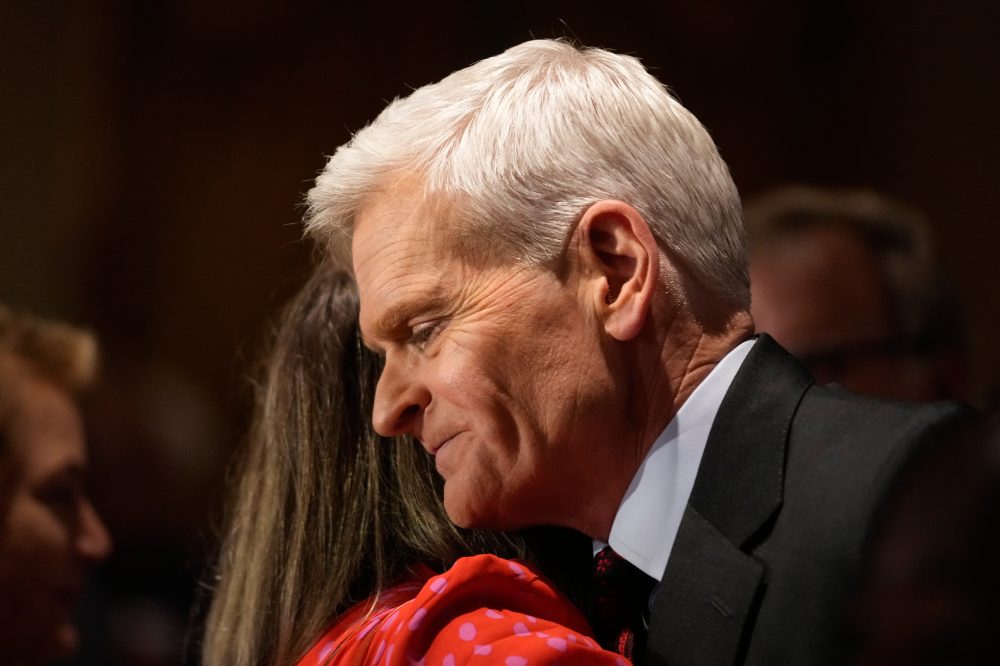

A Louisiana voter’s harsh assessment of Senator Bill Cassidy following this weekend’s Republican primary painted a vivid picture of political desperation. Charles Wandfluh, 57, from a New Orleans suburb, compared the incumbent’s campaign efforts to a frantic animal.
“He’s just a squirrel running around the tree, chasing nuts to find whatever he can get to benefit him,” Wandfluh explained after casting his ballot.
Cassidy’s political maneuvering ultimately failed on Saturday, as his third-place primary finish highlighted how difficult it has become for Republicans to survive politically without Trump’s blessing. Despite having more campaign funds than his competitors, Cassidy couldn’t even secure a spot in the runoff election.
The senator’s political journey during the Trump era was marked by notable contradictions. Though trained as a physician, he chose to support Robert F. Kennedy Jr.’s nomination for health secretary despite Kennedy’s well-known opposition to vaccines, leading to inevitable conflicts once Kennedy assumed the role.
Most significantly, Cassidy never recovered from his decision to vote for Trump’s conviction during the impeachment proceedings related to the January 6th Capitol attack five years ago. His subsequent efforts to demonstrate loyalty to Trump’s policy priorities failed to win back Republican voters’ trust.
“He was trying to portray himself side by side with Trump, like he has worked with Trump on this and that,” Wandfluh said. “I’m like, ‘You voted to impeach the guy!’”
The June 27th runoff will feature U.S. Representative Julia Letlow, who received Trump’s endorsement, against state Treasurer John Fleming, a former Trump administration member. Letlow led Saturday’s voting.
“There is no greater endorsement than the endorsement of President Trump,” Letlow declared. “We’ll always be singing that from the mountaintops.”
Trump celebrated the results on social media, calling it a “great victory speech tonight by Julia!!!” He also delivered a final blow to Cassidy’s political career, criticizing the senator’s lack of appreciation for past support.
“His disloyalty to the man who got him elected is now a part of legend, and it’s nice to see that his political career is OVER!” Trump posted.
South Carolina Senator Lindsey Graham, who previously clashed with Trump but has since become a loyal supporter, offered no sympathy for Cassidy’s defeat.
“What’s the headline? Trump’s strong. Those who try to destroy Trump politically, stand in the way of his agenda, are going to lose,” Graham stated Sunday on NBC’s “Meet the Press.” “You can disagree with President Trump, but if you try to destroy him, you’re going to lose. Because this is the party of Donald Trump.”
Graham’s own history with Trump includes calling him a “kook” who was “unfit for office” and initially saying “enough is enough” after January 6th. However, unlike Cassidy and six other Republican senators, Graham didn’t vote to convict during the impeachment trial.
Of the seven Republicans who voted for conviction, four chose not to seek reelection: Richard Burr of North Carolina, Mitt Romney of Utah, Ben Sasse of Nebraska and Pat Toomey of Pennsylvania.
Alaska’s Lisa Murkowski successfully won reelection in 2022 while Trump was out of office, and she continues to criticize him. Maine’s Susan Collins faces Trump’s criticism but hasn’t encountered a primary challenger as she seeks a sixth term this November. Her position remains important for Republican congressional control, representing a state that Democratic candidate Kamala Harris won in the recent presidential election.
Trump’s continued influence over the party is remarkable considering his lame-duck status—constitutional limits prevent a third term despite his occasional suggestions otherwise—and challenging poll numbers. He faces ongoing inflation concerns, economic dissatisfaction, and an unpopular conflict with Iran, yet Republicans largely remain aligned with his leadership.
As Trump moves through the second half of his current term, he appears to be completing a comprehensive party transformation that began ten years ago, with his desire for political revenge showing no signs of diminishing.
This month, he successfully removed five Indiana state senators who opposed his redistricting proposal. Tuesday’s Kentucky primary features his support for a challenger against U.S. Representative Thomas Massie, who angered Trump by opposing his major tax legislation due to national debt concerns, advocating for Jeffrey Epstein file releases, and opposing the Iran military action.
Trump even suggested targeting U.S. Representative Lauren Boebert of Colorado over her Massie support during the weekend.
“Even though I long ago endorsed Boebert, if the right person came along, it would be my Honor to withdraw that Endorsement, and endorse a good and proper alternative,” Trump stated, though Colorado’s candidate filing deadline passed months ago.
Following his loss, Cassidy spoke to supporters in Baton Rouge about Trump’s influence without directly naming him.
“Our country is not about one individual. It is about the welfare of all Americans, and it is about our Constitution,” the senator said. “And it is the welfare of my people, and my state, and my country, and our Constitution to which I am loyal.”
However, Trump’s role remained central for many Republican voters.
Mark Schulingkanp, 46, who works in shipping, supported Letlow specifically to avoid the tensions that characterized Cassidy’s Trump relationship.
“Getting federal dollars into the state is the most important thing to me, to help people with jobs,” he explained. “Clearly having a senator that the president doesn’t like could cause a challenge or impede federal dollars coming to the state for roads, bridges, so many different programs.”
Jeanelle Chachere, a 66-year-old nurse, called Cassidy a “phony” and voted for Letlow based solely on Trump’s endorsement.
“I’m going by what he says because I like what he does,” she said.
Cassidy’s political predicament was further complicated by losing support from some quarters for accommodating Trump’s wishes.
Mark Workman, a 75-year-old retired physician, voted for Fleming to protest Cassidy’s support for Kennedy’s confirmation.
“If Cassidy had stood up and blocked RFK, I would definitely have supported him because that would have been a strong, ballsy move,” Workman said. “He had the ability to stop him and he was too weak to do that.”