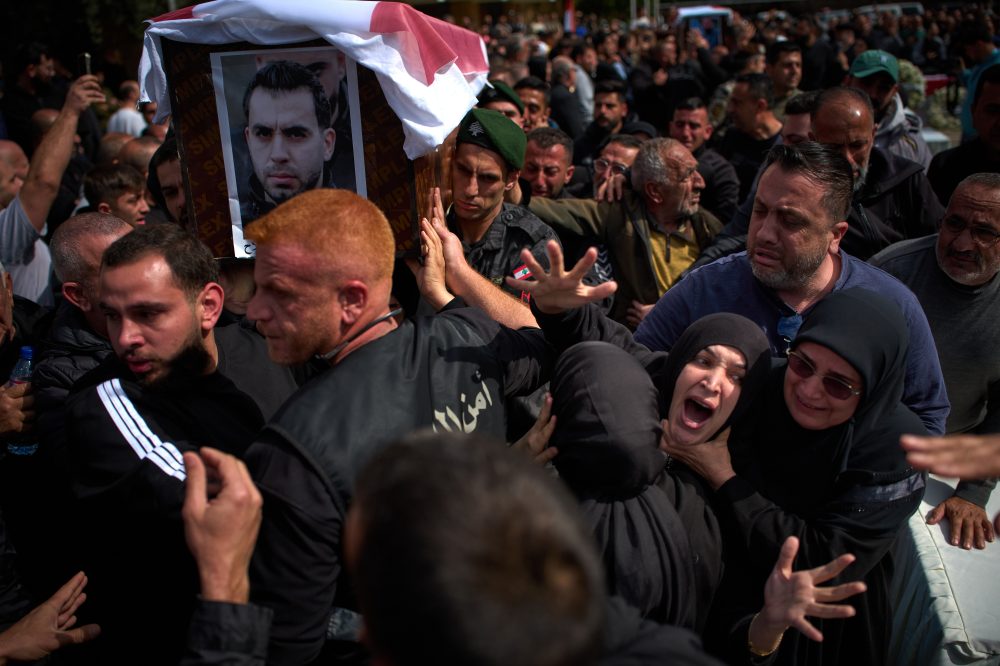

SIDON, Lebanon — Mourning families gathered Saturday to lay to rest 13 Lebanese state security officers who died in an Israeli airstrike on their headquarters in Nabatiyeh the previous day. The emotional funeral services featured grieving widows dressed in black and children crying for their deceased fathers and uncles, while uniformed colleagues openly wept for their fallen comrades.
These heartbreaking scenes have become commonplace throughout Lebanon over the past week as Israeli forces have escalated their military campaign targeting what they describe as Iran-supported Hezbollah facilities and fighters.
The ongoing conflict between Israel and Hezbollah, occurring alongside broader U.S.-Israeli operations against Iran, has resulted in over 2,000 Lebanese deaths and thousands of additional injuries.
Friday’s simultaneous loss of numerous state security personnel has particularly devastated the community, occurring just 48 hours after Israeli bombardments in Beirut and surrounding areas claimed more than 350 lives in what ranks among Lebanon’s most catastrophic single-day bombing events.
“We just want protection,” said Adam Tarhini, a 20-year-old computer science student, whose father, Hassan Tarhini, was among the 13 killed in Friday’s attack. “Israel wants to take our land and everything we have.”
The mounting anguish and fury come as Lebanon and Israel, nations without formal diplomatic ties, gear up for direct negotiations in the United States next week — their first such discussions in decades.
These upcoming Washington discussions have sparked street demonstrations and increased pressure on Lebanese Prime Minister Nawaf Salam, who has insisted on a ceasefire as a prerequisite for any negotiations.
Israeli officials maintain the discussions will center on dismantling the Lebanese militant organization Hezbollah and will not result in a cessation of hostilities.
On Saturday, Salam announced he was delaying his scheduled Washington visit, referencing “the current internal situation.” His decision to remain in Lebanon should not impact the upcoming U.S. negotiations — initial sessions next week are anticipated to occur at the ambassadorial level.
However, his statement that he would stay in Beirut to “preserve the security and unity of the Lebanese people” highlighted the challenging position Lebanon’s government faces as it attempts to end Israeli attacks without directly challenging the superior military capabilities of either Israel or Hezbollah.
“This leaves the Lebanese government in a very difficult position,” said David Wood, a senior analyst for the International Crisis Group.
“It will want to strike some kind of new arrangement with Israel to bring an end to this round of conflict, but at the same time not make such sweeping political concessions as to potentially provoke internal trouble in Lebanon,” Wood said.
The fatal airstrike hit the state security building moments after 14 officers had completed what became their final assignment — relocating prisoners from the southern location to a more secure facility in the coastal city of Sidon. Only one officer survived the attack and is receiving treatment for serious burns.
The youngest victim was 25-year-old Khalil al-Miqdad, who had married just three days before his death. His new wife, Amani, moved through the crowd of mourners in shock, holding a joyful photograph from their recent wedding celebration.
“They killed Khalil. They killed my love,” she said, her anguish erupting into a shriek.
When asked to comment on the incident, Israeli military officials stated they had targeted Hezbollah militant infrastructure in Nabitiyeh on Friday and were “aware of reports regarding harm to Lebanese security personnel.” They indicated an investigation into the matter was underway.
On Saturday, relatives of the deceased officers threw themselves onto the temporary concrete block burial sites positioned on a hillside overlooking the Shiite village of Haret Saida, near Sidon. Medical personnel carried away several mourners who collapsed from overwhelming grief.
Like many residents in their community, families were too afraid to return home for burial ceremonies as Israeli forces advanced further into Lebanese territory. Israeli military actions and widespread evacuation directives have displaced more than one million Lebanese citizens.
Local residents reported that even Nabatiyeh’s primary cemetery was attacked several weeks ago, forcing them to use these temporary burial grounds in cities like Sidon, where many displaced persons have sought shelter.
Both the mourners in Sidon and demonstrators in Beirut on Saturday hold their government nearly as responsible as Israel for the recent civilian and government worker casualties.
They point to the state’s inability to safeguard its citizens as justification for why Lebanon requires Hezbollah to counter Israel’s invasion and what they believe are Israeli plans for extended occupation of Lebanese land.
The financially struggling Lebanese military, maintaining neutrality in the Israeli-Hezbollah conflict, has retreated from multiple southern positions as Israel intensifies its invasion. Despite this neutral stance, Israeli strikes have killed four Lebanese soldiers this week.
While Ali Akbar Velayati, a senior Iranian official, cautioned against the risks of “ignoring the unparalleled role” of Hezbollah’s military branch, demonstrators set fire to the prime minister’s image in central Beirut.
“No one wants negotiations with people who killed our friends, our colleagues, our family,” said Abbas Saleh, a 26-year-old rescue worker from Nabitiyeh who attended the officers’ funerals, rejecting the concept of the Lebanese government establishing normal relations with Israel or negotiating Hezbollah’s disarmament.
The Israeli army is being “held back by people who are defending the land,” he said — meaning Hezbollah.