
BEIRUT — A deal between Lebanon and Israel was presented as a path toward lasting peace, but inside Lebanon, it is reopening old wounds and stoking fears of political gridlock — or worse, a return to civil war.
Brokered by the United States, the agreement envisions Israeli forces withdrawing from Lebanon and eventually a formal peace between two nations that have technically remained at war for nearly 80 years since Israel’s founding. However, the deal makes a full Israeli pullout contingent on Hezbollah being disarmed — a condition that has enraged the Iran-backed militant group.
Lebanon’s Western-supported government and Hezbollah have traded sharp words, and the group’s backers have taken to the streets, blocking major roads in protest. One Hezbollah lawmaker warned that attempting to force the group to give up its weapons would push the country into civil war.
The standoff has stirred painful memories of Lebanon’s brutal 1975–1990 civil war and more recent street clashes in 2008 between Hezbollah fighters and pro-government forces. It has also cast serious doubt on whether the U.S.-brokered framework can move forward at all.
Any renewed conflict between the United States and Iran would further cloud the deal’s future and increase the chances of fighting breaking out again between Israel and Hezbollah.
The agreement is expected to be front and center when Lebanese President Joseph Aoun visits the White House on July 21.
Lebanon’s political landscape has been split for more than two decades — one side backed by Western nations, the other supported by Iran and led by Hezbollah. Both camps view the outcome of this new agreement as a matter of survival.
The latest round of fighting between Israel and Hezbollah began in March, triggered by a joint U.S.-Israel military operation launched against Iran just days before. Hezbollah joined the conflict without the Lebanese government’s approval and has tried to tie the end of its fight against Israel to the outcome of broader U.S.-Iran negotiations. The Lebanese government, seeking to limit Iran’s sway, worked to keep the two issues separate and pursue a direct ceasefire with Israel.
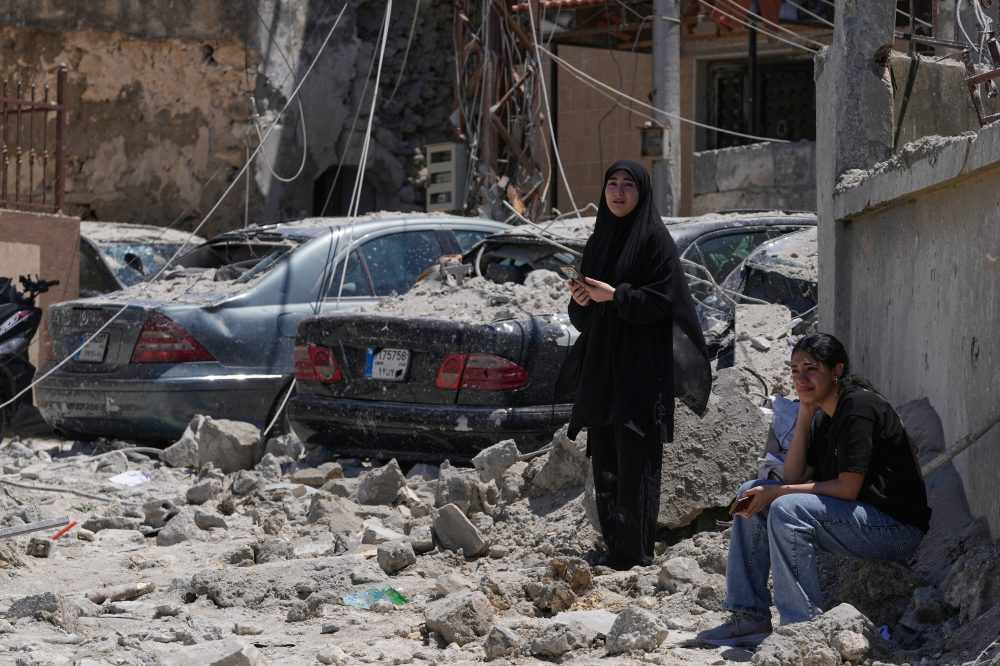
Hezbollah’s camp celebrated when the Iran-U.S. ceasefire deal explicitly called for an end to fighting in Lebanon as well. The resulting truce significantly reduced the violence, but Israeli troops still occupy large portions of southern Lebanon, and hundreds of thousands of people remain displaced from communities that have been nearly entirely destroyed.
The ceasefire’s connection to the U.S.-Iran deal was widely interpreted as a win for Hezbollah and a boost to Iran’s grip on Lebanon.
But the mood shifted when Lebanon and Israel unveiled their June 26 “framework agreement” in Washington. That deal tied an Israeli military withdrawal directly to Hezbollah being disarmed across all of Lebanon.
Lebanese government officials praised the agreement as a step toward freeing occupied southern territories and letting displaced residents return home. Hezbollah and its allies, however, accused the government of signing off on an indefinite Israeli occupation, pointing to the lack of any withdrawal timeline.
Hezbollah supporters blocked roads in Beirut and burned banners carrying the phrase “Lebanon First” — widely viewed as a jab at the Iran-backed group. Hezbollah’s leader, Naim Kassem, called the deal a “humiliation” and declared the group would not abide by it.
Hezbollah legislator Hassan Fadlallah went even further, warning that the government “will not be able to enforce the agreement signed in Washington unless they go, with American support, to civil war.”
That kind of language brought back memories of May 2008, when the government’s decision to dismantle Hezbollah’s communications network led the group to deploy gunmen in Beirut and elsewhere, sparking violent clashes with pro-government fighters. The government ultimately backed down. Now, Hezbollah is demanding that the government revoke its March 2 declaration that labeled the group’s military and security operations illegal.
Lebanese Prime Minister Nawaf Salam has defended the agreement, saying it will restore the government’s authority across the entire country. He has pushed back firmly against Hezbollah’s warnings.
“I am not looking for a confrontation with Hezbollah but neither myself nor anyone in the government will accept to be blackmailed by Hezbollah,” Salam said in a recent interview with local LBC TV.
For now, the war of words has not turned physical — largely because the deal itself is stuck. Lebanon and Israel have agreed to set up two “pilot zones” where Israeli forces would hand control over to the Lebanese army after clearing out any Hezbollah presence. Prime Minister Salam has suggested implementation could begin soon, but little has actually happened on the ground.
“There is no schedule for the withdrawal or anything else,” said a Lebanese military official who spoke anonymously because he was not authorized to make public statements. The official said the army has received no information about when or how the Israeli pullback would unfold.
The initial pilot zones named by Lebanese and Israeli officials include the towns of Froun, Ghandouriyeh, and Zawtar — areas where Israeli troops were largely not present to begin with, raising questions about what a withdrawal would even look like there. The Lebanese military official said the army had pushed for larger pilot zones that included areas actually under Israeli control.
An Israeli military official, speaking anonymously under briefing rules, said the army is still awaiting direction from political leadership on the timing of any withdrawal.
Lebanon’s history is marked by political violence, but its sectarian power-sharing system — divided among Shiite and Sunni Muslims, Christians, and Druze — has also been prone to paralysis. Parliament Speaker Nabih Berri, a Hezbollah ally, has warned the deal “will not pass, and it will not be implemented in its current form.”
Wissam Lahham, a constitutional law professor at St. Joseph University in Beirut, noted that under Lebanon’s constitution, a treaty does not become legally binding until it is ratified by a two-thirds majority of the Cabinet — a vote that has not been scheduled. He also said it remains unclear whether parliamentary approval would be required, adding another potential hurdle.
In a speech Wednesday, Hezbollah leader Kassem sent a blunt message to the government: “Ultimately, not a single clause of the framework agreement will be approved, and there will be nothing you can do about it.”
Michael Young, senior editor at the Malcolm H. Kerr Carnegie Middle East Center in Beirut, said the Lebanese government was right “in principle” to try to keep Lebanon’s situation separate from the Iran negotiations on sovereignty grounds — but that the approach was not realistic.
“You cannot reach any kind of solution with regard to Hezbollah unless Iran is on board,” he said. “The Iranians will not give up on Hezbollah, and at the same time the Lebanese are not willing to enter into an armed conflict with Hezbollah.”