
TYRE, Lebanon (AP) — Military operations by Israeli forces continued throughout Tuesday night and Wednesday morning in southern Lebanon, occurring just 24 hours after Lebanese and Israeli representatives participated in their first direct diplomatic meeting in Washington. Plumes of smoke could be seen rising above the coastal community of Tyre, demonstrating how precarious current peace negotiations remain.
While Israeli military operations in Beirut have decreased following last week’s devastating 10-minute assault that resulted in more than 350 deaths nationwide, communities throughout southern Lebanon continue experiencing regular bombardments.
Israeli military commanders have repeatedly issued evacuation orders for large portions of southern Lebanon, yet thousands of residents have chosen to remain, either due to reluctance to abandon their properties or lack of alternative shelter options.
Many displaced families previously considered Tyre a safer alternative to areas near the Israeli border where the heaviest combat occurs. However, local residents now report feeling unsafe throughout the region as Israel continues operations against the Iranian-supported Hezbollah organization.
Throughout the community, evidence of recent bombardments was apparent in damaged structures, piles of concrete debris, and streets covered with wreckage. Local residents moved carefully along roadways surrounded by destruction.
An Israeli unmanned aircraft targeted a vehicle during overnight hours just several hundred meters from Tyre’s downtown area. The intended target remained unclear, though eyewitnesses reported the attack resulted in the death of a young woman who had been seated outside her residence.
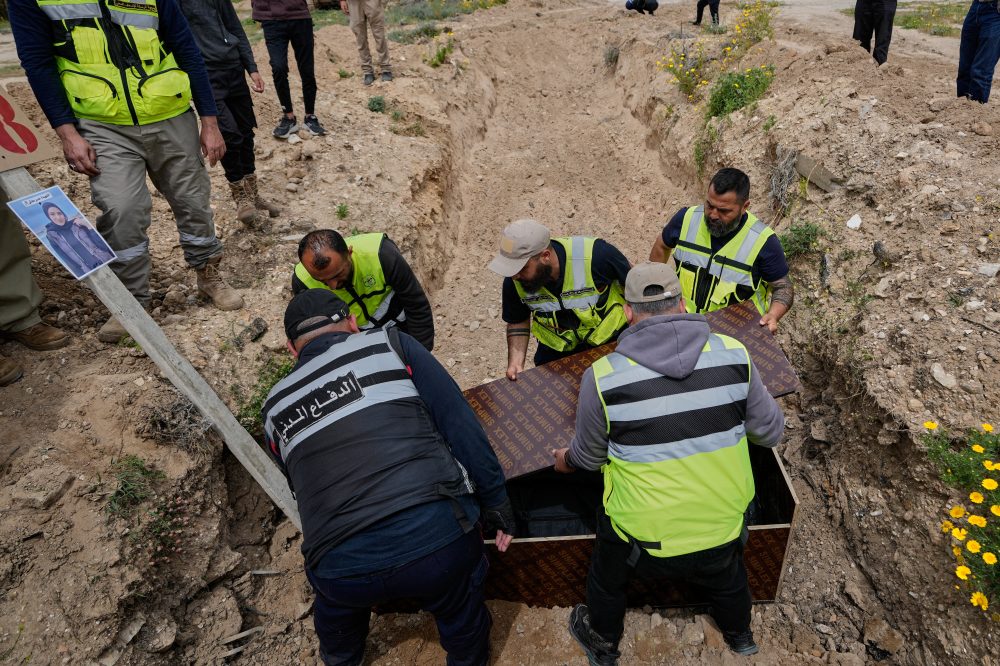
Community members gathered Wednesday for the burial of the victim, 19-year-old Ghadir Baalbaki, at a temporary burial ground established for war casualties. Many families cannot transport deceased relatives to their original communities located closer to active combat zones.
“We prayed maghrib (the Islamic evening prayer) and went and sat outside. We were sitting for 10 minutes before the strike hit us,” said Mariam Hamoud, Baalbaki’s aunt. “I hugged Ghadir because I thought she had fainted. I kept trying to wake her up.”
Her father, Mohammed Baalbaki, stood beside the grave in tears.
“We cannot adapt to life without her,” he said. “Since this tragedy took place yesterday we have been suffering.”
The current conflict between Israel and Hezbollah intensified when Hezbollah launched multiple rockets toward northern Israel, occurring days after the United States and Israel began their military campaign against Iran. Israel responded with comprehensive aerial operations and ground forces deployment.
Lebanese health officials report that Israeli military operations have resulted in over 2,000 deaths, while more than one million Lebanese citizens have been forced from their homes.
Tuesday’s Washington discussions represented an unusual direct meeting between Lebanese and Israeli representatives. However, Hezbollah has expressed opposition to these negotiations, considering them a surrender to Israeli demands while bombardments of their country continue.
The Lebanese government, which has criticized Hezbollah for involving the nation in another conflict, maintains that diplomatic discussions offer the only path to ending the violence.