
BEIRUT (AP) — Several months after being forced from her home by conflict, Soubhiye Zeiter begins each day with the same ritual: brewing a large cup of coffee and enjoying a few peaceful minutes at a flower-adorned small table outside her tent in Beirut.
However, the tranquility ends quickly once her coffee is ready.
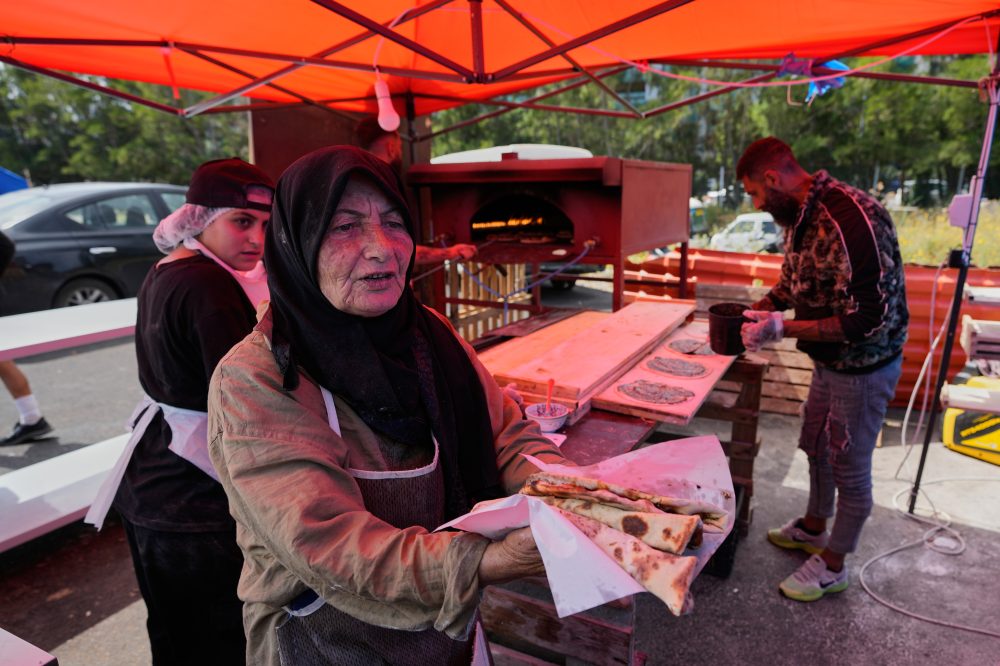
Before the morning progresses far, dozens of people have already formed lines outside Zeiter’s modest bakery operation in a tent camp located in Lebanon’s capital city, eager for her mana’eesh — the beloved Lebanese flatbread served for breakfast with toppings of cheese, meat or za’atar, a seasoning made from thyme and herbs. Kids dart between waiting customers, volunteers hurry trays of dough to and from ovens, and the 63-year-old Zeiter acknowledges almost every passerby, frequently inviting them to sit and share coffee.
Called Om Mohammed by many — an Arabic term meaning Mohammed’s mother — this grandmother evacuated her residence in Beirut’s southern suburbs along with 15 family members when the conflict between Israel and Hezbollah began. She had been residing just south of the capital when Israeli forces issued evacuation orders for the extensive neighborhoods before launching intensive air attacks.
The continuing conflict between Israel and the Hezbollah militant organization has forced more than one million residents to leave their homes in this small nation during months of border clashes. Numerous families abandoned villages in southern Lebanon and Beirut’s southern neighborhoods, finding refuge in schools, government buildings and tent camps throughout Beirut and the wider country.
Upon arriving at the tent camp situated between the Mediterranean Sea and the capital’s upscale downtown area, Zeiter initially visited a nearby location where relief supplies were being given out. However, after learning she would need to wait in line for hours and still might receive nothing, she chose instead to prepare meals for her family and others requiring assistance.
She started using her personal saj — a traditional circular metal cooking surface common throughout Lebanon — preparing approximately 200 mana’eesh daily and distributing them at no cost. As news of her efforts spread, more individuals arrived each morning, with some contributing ingredients. Eventually the waiting lines grew beyond what she could handle by herself.
Today, her small section of the camp resembles a community bakery. Individuals who learned about her work contributed a larger gas-operated oven that operates from early morning through late evening. Dough passes through a rolling machine. Volunteers wrap bread as fast as it emerges hot from ovens. The aroma of thyme and baking dough floats through rows of blue tents.
“We can’t keep up,” Zeiter said, laughing as people continued arriving at the stand. “We bake 3,000 to 3,500 mana’eesh daily and people still come and ask for more.”
What began as one woman preparing food for displaced children has evolved into a community project sustained almost completely by donations. She has gained recognition as somewhat of a local celebrity in her community, with the Beirut governor even stopping by to share coffee with her during an afternoon visit to tour the location.
“People started donating gas, some donated flour or za’atar, some brought oil, cheese, sometimes people brought meat, some brought yeast,” she said. “Whatever I need for this bakery, people are helping me out.”
For Zeiter, the bakery represents more than just providing food. She explains that she wants the tent camp to feel less like a place of grief and more like the communities people were compelled to abandon. During the day, she beckons to people walking by, encourages them to sit together, and attempts to recreate the type of environment she recalls from home.
“We’re all displaced. If I lost my home or got displaced that doesn’t mean that I have to lose my morale,” she said, wishing people even when scarred by war to love and care for each other. “Displacement shouldn’t change us.”
Despite the success of her community project, the sounds of drones flying overhead in the capital and reports of continuing Israeli attacks in southern Lebanon serve as stark reminders that life has been altered. She attempts to engage in activities from happier times, such as playing with her grandchildren and her small white dog, Bella.
Most significantly, she makes sure to prepare an additional pot of coffee — because she dislikes drinking coffee by herself — so she can welcome anyone passing her tent who wants to sit briefly. The flowers are important as well.
“What I love the most, in order to bring back memories, is to have flowers on the table or next to me when I drink coffee,” she said, her eyes filling with tears. “I feel like it makes up for things a little.”