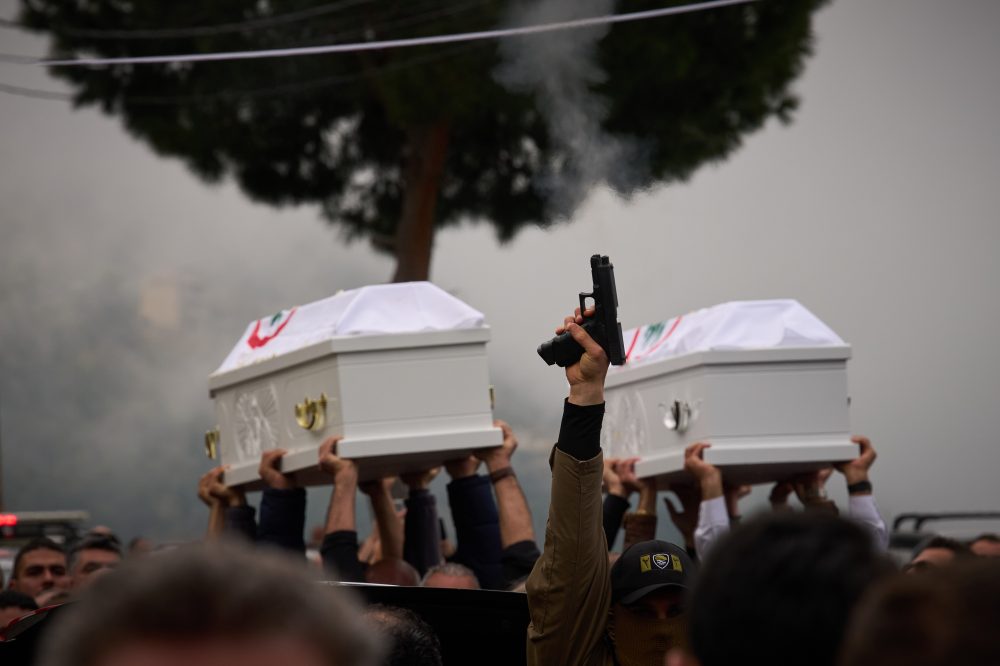

YAHSHOUSH, Lebanon — The sound of church bells mixed with gunfire rang through the mountainous valley Tuesday as hundreds of mourners attended funeral services for a Lebanese Christian political leader and his wife, both victims of an Israeli airstrike this past weekend.
The deaths have intensified political divisions within Lebanon, a nation already fractured by the escalating conflict between Israel and the Iranian-supported Hezbollah militia — part of the broader regional conflict spreading across the Middle East.
Pierre Mouawad, his spouse, and a family visitor died Sunday when an Israeli strike hit an apartment unit located above their residence in Ain Saadeh, a town situated east of Beirut. Israeli military officials stated they were attempting to eliminate a Hezbollah fighter, though details surrounding the attack remain murky.
Mouawad served with the regional chapter of the Lebanese Forces, a Christian political organization widely recognized as Hezbollah’s most vocal political adversary. The party has spent years demanding the militant group’s disarmament and recently accused Hezbollah of pulling Lebanon into another conflict by launching rockets toward Israel in support of Iran, their primary ally and financial backer.
The Lebanese Forces maintains four cabinet positions in Lebanon’s government and controls the largest parliamentary bloc.
Lebanon’s Health Ministry reports that 1,530 individuals have died in Israeli attacks since the Israel-Hezbollah conflict reignited last month in the small Mediterranean nation. Over one million residents have fled their homes, primarily from southern Lebanon and Beirut’s southern neighborhoods, areas where Hezbollah maintains strong support and control.
As fighting continues and Israeli troops enter Lebanese territory, hostility has increased in Christian, Sunni, and Druze communities toward displaced Shiite residents, who represent Hezbollah’s primary support base.
Host community residents worry that Hezbollah fighters might be concealed among the Shiite civilians who have relocated to their neighborhoods.
The caskets containing Mouawad and his wife, covered with the white Lebanese Forces banner, were carried into St. Simon Church on a mountainside in Yahshoush, located north of Beirut.
Church bells, gunshots, and political music from speakers created a cacophony as government officials, local residents, and party supporters gathered in large numbers for the memorial service.
“They died because Hezbollah dragged us into a war,” declared Lebanese Forces parliamentarian Pierre Bou Assi, describing the conflict as “an Iranian decision with Hezbollah’s implementation.”
“Nobody among all the Lebanese asked them to start this war,” he stated.
While Lebanon’s military announced it is examining the incident, and the government banned Hezbollah’s armed operations and Iranian Revolutionary Guard presence in Lebanon last month, the Ain Saadeh attack has worsened existing tensions.
Many Lebanese citizens who believed they would avoid the war’s impact due to their lack of Hezbollah connections have been shocked as Israeli strikes have hit Hezbollah operatives and Iranian Guard members renting apartments or hotel rooms in their communities.
The property owner of the apartment above the Mouawads, the local mayor, and Lebanese military investigators all confirmed the unit was vacant.
However, the victims’ family members and Mouawad’s political party insist someone — the strike’s intended target — was residing in that apartment, endangering nearby residents.
“If that person had died, it would have been better for us,” said Raymond Mouawad, Pierre’s brother. “Instead, my brother died while he escaped.”