
PHOENIX (AP) — Sandra Ramirez felt immediate regret as she watched news coverage of immigration enforcement raids targeting migrants throughout the past year, realizing her decision to vote for Donald Trump in 2024 had been wrong.
“There are a lot of people who are being harassed for the color of their skin, and that’s not right,” said Ramirez, who broke from her Democrat-voting family to cast a ballot for Trump.
“I’ll never go Republican again,” she said.
Trump successfully attracted Latino voters such as Ramirez in the 2024 election cycle, securing backing that contributed to his return to the White House for a second presidency.
With Republicans preparing for upcoming midterm elections this fall and planning for the 2028 presidential race, political observers are closely watching whether the party can maintain this crucial voter base or if the current administration’s extensive immigration enforcement efforts and an economy struggling with elevated costs will push Latino voters back to the Democratic Party.
Warning signs are emerging, as new data from the Pew Research Center indicates Trump’s standing among this voting bloc is declining rapidly.
While Latino voters have traditionally favored the Democratic Party, they moved notably toward Trump during the 2024 campaign. Though a majority continued backing Democrat Kamala Harris for president, Trump achieved substantial progress: 43% of Latino voters nationwide chose him, up from 35% in the 2020 presidential race, a shift partly linked to economic worries.
Trump began his second presidency with commitments to intensify immigration enforcement, a pledge that has resulted in detention operations targeting Latino migrants in residential areas, job sites, and educational facilities, among other locations. Data from an AP-NORC poll reveals that over half of Latino adults know someone affected by the Trump administration’s intensive immigration policies.
More than a year into Trump’s second presidency, surveys indicate substantial erosion in his support among Latinos who backed him in 2024, though a majority continues to approve of his performance.
A Pew Research Center survey from April found that presidential approval among non-Latino voters decreased from 95% to 79% between February of last year and April of 2026. However, among Latino voters who supported Trump, the decline was sharper: 66% endorsed his job performance in April versus 93% at his second term’s start.
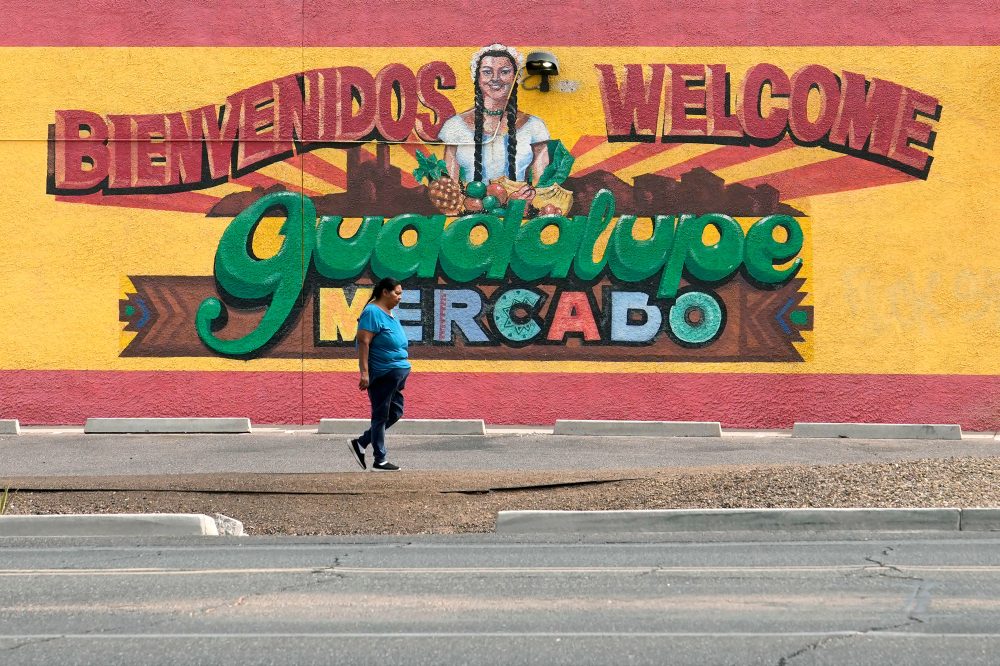
This nationwide decline could be decisive in competitive elections within swing counties such as Maricopa, the country’s largest battleground county, which includes Phoenix and surrounding areas. One-third of Maricopa County’s population is Latino, with 25% of them being immigrants, data from the Latino Data Hub at the University of California, Los Angeles shows.
Arizona, which experienced a modest rise in Latino backing for Trump in 2024, has remained central to immigration policy debates for years. Maricopa County Sheriff Joe Arpaio led prominent enforcement actions in Latino communities, and later, the state experienced significant migrant arrivals during the Biden presidency.
During a pleasant afternoon in south Phoenix’s primarily Latino community, a vendor at a local street festival offered shirts featuring designs like “Lowriders Sunday” while car enthusiasts cleaned their Chevrolets. The adjacent Catholic church’s parking area was packed with worshippers attending Spanish-language Sunday services.
Albert Rodriguez, a Phoenix tattoo artist, said he previously backed Trump. However, his perspective changed after witnessing how the administration conducted enforcement activities in Chicago, Minneapolis and Los Angeles.
He said the president promised to go after immigrants who were criminals, but instead Immigration and Customs Enforcement agents have been “hitting the paleta man,” referring to ordinary people trying to make a living from selling frozen treats.
“Big time, I regret it,” Rodriguez said of his 2024 vote for Trump.
Phoenix resident Ronnie Martinez, an Army veteran, backs Trump’s effort to stem crossings at the southern border.
“The border is only a hop, skip and a jump to our south. And I don’t want illegal alien criminals coming from Guatemala, Venezuela, Central America,” he said.
He didn’t like some of the images he’d seen of ICE arresting people in front of their children. But he was also sympathetic to ICE officers, who he said were doing the best they could in difficult situations, and he blamed Democratic officials who weren’t cooperating with immigration enforcement. He also cited economic initiatives as a reason for his continued support for the president, including the removal of taxes on tips and overtime.
Guadalupe Alaffa, another Phoenix resident, blamed President Joe Biden’s policies for prompting Trump’s immigration crackdown.
“He left that damn border wide open,” said Alaffa.
The expanding political power of Latino voters represents one of multiple elements that have weakened the GOP’s long-standing control in Arizona, positioning the state as central to both congressional and presidential contests. Both Arizona senators are currently Democrats, as are the state’s top three executive officials.
Recapturing some Latino voters who switched to Trump will be essential for the reelection campaigns of Gov. Katie Hobbs, Secretary of State Adrian Fontes and Attorney General Kris Mayes, all Democrats initially elected in 2022.
Maricopa County Democrats have gained from more than ten years of political outreach among Latinos organizing against strict immigration enforcement policies. The Republican-controlled Legislature in 2010 passed a state law known as SB1070, which required police to check the immigration status of anyone they suspected of being in the country illegally.
During the same period, Sheriff Arpaio was establishing a national reputation among conservatives through immigration operations in predominantly Latino communities.
Some activists view the current nationwide immigration enforcement as a continuation of what Latinos in Arizona experienced under Arpaio.
“We were the lab where they implemented a lot of this with Sheriff Joe and now it’s all over the United States,” said Salvador Reza, a longtime activist in Phoenix who advocates for the rights of day laborers.
For more than twenty years, Arpaio won repeated elections while his department faced allegations of racially profiling Latino drivers and conducting sweeps in Latino neighborhoods and day labor areas. Deputies often stopped residents for traffic violations and turned noncitizens over to ICE, according to rights groups.
In 2013, a federal judge ruled his office had illegally profiled and detained Latinos, and a 2011 Justice Department report found widespread discrimination. After losing reelection in 2016, Arpaio was convicted of criminal contempt for defying court orders. He was later pardoned by Trump.
The GOP faces the possibility of losing some Latino voters that Trump attracted, said former Republican Gov. Jan Brewer, who signed the controversial 2010 bill. She pointed to economic issues as a potential factor in declining support.
“With the inflation and the cost of living and the gasoline and the wars, I don’t know if they can afford to be a Trump Republican,” Brewer said.
Earl Wilcox, a longtime activist and restaurant owner in Phoenix, said between affordability issues and immigration enforcement, he believes Latino support for Trump is waning. Wilcox’s restaurant hosted Biden in 2024 when he launched an initiative meant to rally Latino support for the Democratic ticket.
“I don’t think the Republican Party will have the support it did the second time around,” Wilcox said, “and I think it started with the raids.”