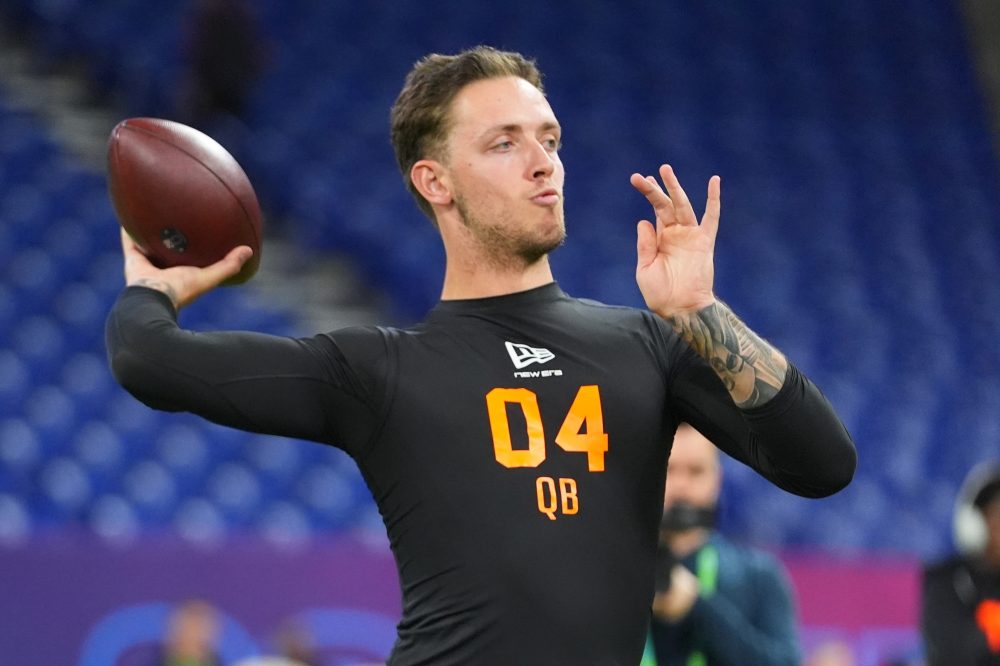

TEMPE, Ariz. — When the Arizona Cardinals selected Carson Beck with the 65th overall pick in the third round, it marked another chapter in the ongoing story of quarterbacks chosen later in the NFL draft who must overcome significant odds to find success.
Beck, age 24, experienced a lengthy six-year college career marked by both achievements and setbacks, including a serious elbow injury that sidelined him for several months. Despite questions about his draft stock, the quarterback remains focused on making the most of his chance.
“Everybody’s got to run their own race,” Beck said. “It looks different for everyone regardless of the opinions that others have of that race or that journey.”
Beck joins a group of quarterbacks from this draft class hoping to defy expectations, including Drew Allar, who went to the Steelers, and Cade Klubnik, selected by the Jets. These players face steep challenges in reaching NFL stardom after being chosen in rounds three and four.
History does provide some encouragement for late-round quarterback selections.
The most notable success story remains seven-time Super Bowl winner Tom Brady, chosen by the New England Patriots in the sixth round of the 2000 draft before achieving legendary status. More recent examples include Dallas quarterback Dak Prescott, a fourth-round selection, and San Francisco’s Brock Purdy, who was taken in the seventh round.
However, such success stories are becoming increasingly rare.
Last season saw only three quarterbacks drafted in the third round or later — Prescott, Purdy and Jacoby Brissett — make nine or more starts. This represents a significant decline from 17 such quarterbacks in 2001 and 10 in 2017.
While some might attribute this trend to improved quarterback evaluation, ESPN NFL draft analyst Matt Miller offers a different perspective.
“I’ve had this conversation with agents before — the round you’re drafted in stays with you a long time,” Miller said. “You’re given a lot more opportunity based on that first-round moniker over fifth or sixth round. I wouldn’t say teams are better, I think teams are stubborn about wanting to admit they’re wrong on a quarterback.”
Miller points to recent high draft picks like C.J. Stroud, Anthony Richardson, Kenny Pickett and Bryce Young, who have received extended opportunities to develop due to the significant investment made in them. The results have been mixed.
“There’s pressure to stick with those guys,” Miller said.
Despite the challenges, later-round quarterbacks can still succeed, and Miller believes extensive college experience serves as a strong predictor of future success. Purdy accumulated 46 starts across four seasons at Iowa State, while Prescott made nearly 30 starts for Mississippi State in Southeastern Conference play.
Both players benefited from fortunate circumstances. Purdy entered the lineup in 2022 when injuries struck Trey Lance and Jimmy Garoppolo, finishing with a perfect 5-0 record as a starter. Prescott claimed the starting role in 2016 after injuries to Tony Romo and Kellan Moore.
The crucial factor was their preparedness to capitalize on unexpected opportunities.
“You have the experience factor to come in, make plays and perform at a high level,” Miller said. “That’s not to say that experience can cover up a lack of tools — the tools have to be there.”
Miller views Beck’s situation with the Cardinals as particularly promising. Arizona has veteran options in Brissett and Gardner Minshew, but neither carries a substantial contract or long-term commitment.
First-year coach Mike LaFleur dismisses concerns about Beck’s third-round selection, noting the quarterback’s 43 starts over three seasons at Georgia and Miami.
“Part of our job in this building is to say, ‘Hey, take all that away and develop them at the pace that they can develop,’” LaFleur said. “Let’s make sure we have great urgency in the way we coach them. They need to match that urgency back, because the clock starts now for all these guys.
“No one really cares. You’ve got to put the best 53 on the roster and the best 22 out there from a starting standpoint.”
The Steelers selected Allar from Penn State with the 76th overall pick in the third round. Pittsburgh hopes the physically talented but unpolished prospect can develop under first-year coach Mike McCarthy, who brings extensive experience working with skilled quarterbacks.
Allar enters his professional career not as an immediate franchise solution but as a development project. Unless injuries create openings, he will likely spend his rookie season third or fourth on the depth chart, learning from McCarthy and four-time NFL MVP Aaron Rodgers, who returned to Pittsburgh on a one-year contract.
“Right now it’s just really focusing on the fundamentals and not really caring about where I am at in terms of depth-chart stuff,” Allar said.
At 22 years old, Klubnik brings substantial college experience after appearing in 49 games across four seasons at Clemson, throwing for over 10,000 yards. The New York Jets selected him in the fourth round at 110th overall.
Klubnik has an opportunity to compete for the backup position behind Geno Smith, depending on whether the Jets add a veteran quarterback. New York’s quarterback depth chart remains thin beyond Smith, with Klubnik joined by Brady Cook and Bailey Zappe.
“He’s a really smart kid. Not kid, but he’s a really smart man,” Jets coach Aaron Glenn said of Klubnik. “I don’t think he’s swimming as much as you probably think he is and that’s a lot because of the way the coaches are actually teaching them.
“But, listen, we’re going to push the envelope with that player and see exactly where he’s at and how he’s going to be able to operate with our offense.”