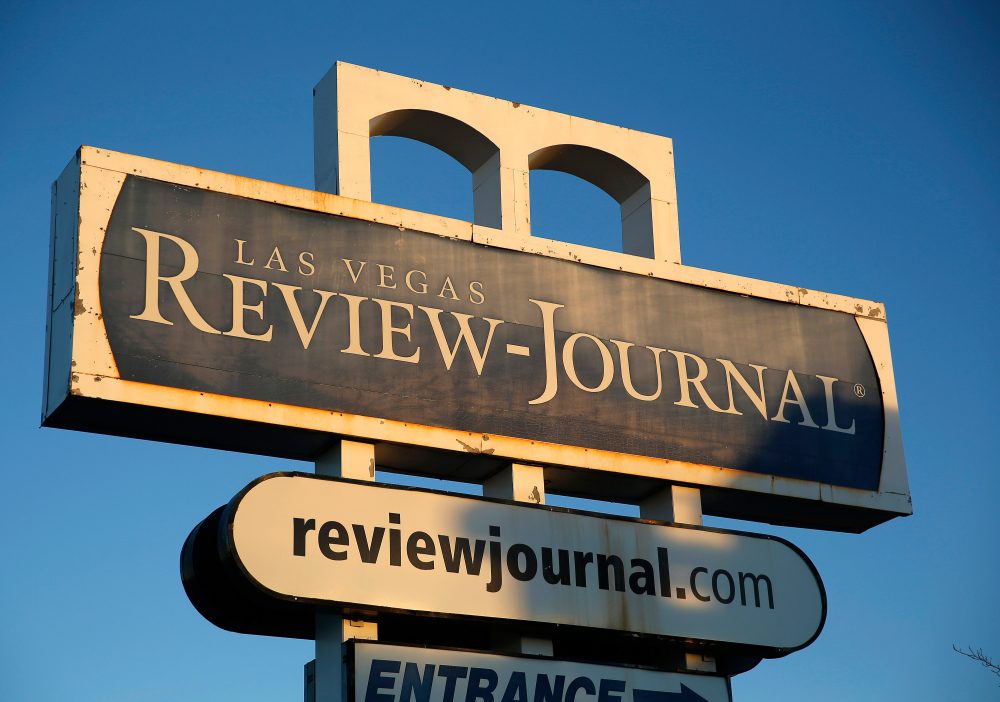

LAS VEGAS (AP) — A historic chapter in American journalism closed Friday as the Las Vegas Review-Journal ceased printing the Las Vegas Sun, terminating the country’s final joint operating agreement between rival newspapers after decades of collaboration.
In an editorial announcement, the Review-Journal informed readers they would no longer discover a printed Las Vegas Sun section included with their newspaper. The editorial acknowledged that the Sun continues operating its website, maintains hundreds of thousands of social media followers, and remains free to produce its own print edition.
“We encourage them to do so. The Review-Journal competes with countless sources of news and entertainment, but we would welcome one more. We just don’t want to foot the bill. It is time the Sun stood up on its own two feet,” the editorial stated, though it did not reveal specific financial details.
Both newspapers were scheduled to appear in court Friday, where Sun representatives hoped a judge would mandate immediate resumption of printing services, according to attorney Leif Reid in an email statement. He noted this marked the first day in 76 years without a printed Sun edition.
“This does irreparable harm to our community, as no one benefits when a local newspaper is prevented from being published,” Reid commented.
The uncommon joint operating agreement mandated that the Sun be included as a daily insert within the Review-Journal, while both organizations maintained editorial independence through separate newsrooms and websites.
A trial court previously determined the agreement was invalid because a 2005 modification never received approval from the U.S. attorney general. In February, the U.S. Supreme Court refused to consider the Sun’s appeal.
The Review-Journal editorial characterized the Supreme Court ruling as a definitive win, stating that suspending Sun publication Friday resulted from “6½ years of litigation between the newspapers, precipitated by the Sun.”
These partnerships between competing publications have disappeared as part of the “long, slow goodbye of newspapers as we knew them,” explained news industry analyst Ken Doctor. The Detroit Free Press and Detroit News concluded their 40-year arrangement last year, with USA Today Co., owner of the Free Press, recently announcing plans to acquire the Detroit News.
The Sun launched in 1950 after the Review-Journal declined to negotiate with International Typographical Union typesetters. The union established its own publication and secured financial support from businessman Hank Greenspun, whose family continues to own the newspaper.
Operating since 1909, initially as the Clark County Review, the Review-Journal belongs to the Adelson family, casino industry leaders and major Republican Party contributors, and remains Nevada’s largest daily newspaper.
The Review-Journal’s editorial stance tends conservative, while the Sun leans liberal. The 1970 legislation signed by President Richard Nixon, known as the Newspaper Preservation Act, aimed to reduce newspaper expenses while preserving competition and editorial diversity in cities where newspapers faced financial difficulties.
The publications first established their joint operating agreement in 1989 when the Sun faced financial hardship. This arrangement transformed the Sun into a weekday afternoon paper and weekend morning section within the Review-Journal, while the Review-Journal managed production, distribution, and advertising. The Review-Journal also collected all revenue and paid monthly fees to cover the Sun’s news and editorial operations.
The 2005 amendment restructured the Sun as a daily morning insert in the Review-Journal.
Review-Journal ownership attempted to terminate the agreement in 2019, prompting Sun ownership to file suit claiming the termination violated antitrust regulations.
The 1970 legislation permitting such agreements emerged when news sources were limited and concerns about media monopolies were greater.
Las Vegas and Nevada overall now feature more robust, independent news organizations compared to many other regions, noted Stephen Bates, a journalism and media professor at the University of Nevada, Las Vegas.
While the Sun maintains an online presence, it has argued in court that eliminating its print edition could complicate staff recruitment, reduce readership, and potentially force closure.
Genelle Belmas, a University of Kansas journalism professor specializing in media law, expressed disappointment about the potential end of America’s final joint operating agreement. During Las Vegas visits, she appreciated obtaining the Review-Journal with the Sun included, providing contrasting perspectives in one publication. Online news sources enable consumers to remain in echo chambers more easily, she observed.
“Every local news outlet we lose — and that includes big towns, small towns, whatever — is a loss of perspective and a loss of a potential alternative view,” Belmas stated.