
AL BASOUTA, Syria (AP) — Eight years ago, Abdul Rahman Omar was forced to abandon his home in Syria’s Afrin district when Turkish military forces launched an operation targeting Kurdish fighters throughout the region.
Today, Omar is part of hundreds of Kurdish families who have made their way back to Afrin. He participated alongside his community in marking Nowruz, the traditional spring celebration, for the first time since coming back from displacement and since Syria’s government officially recognized the festival as a national holiday.
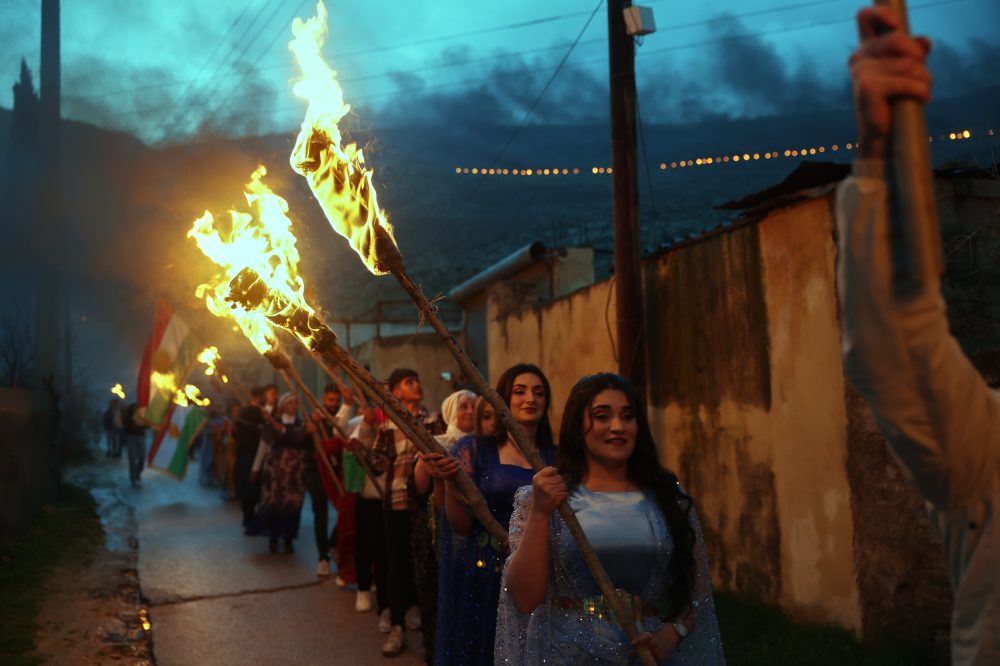
The term Nowruz comes from Farsi and means “new year.” This 3,000-year-old celebration has Persian origins and is observed by Kurdish communities across Syria, Turkey, Iraq, and Iran. The festival features vibrant public gatherings and torch-lit marches that wind through mountainous terrain. With roots in Zoroastrianism, the ancient holiday brings together people of various faiths, including Zoroastrians, Muslims, Christians, Jews, and members of the Baha’i community, as well as millions living in diaspora communities worldwide.
On Friday evening, Omar participated in traditional line dancing with other young community members, moving to rhythmic music before climbing into the hills surrounding al-Basouta village. The group carried torches and Kurdish banners, using flames to create the word “raperin,” which translates to “uprising” in the Kurdish language.
Turkish military forces, working alongside Syrian opposition groups, captured Afrin in 2018 during a Turkey-supported campaign that drove out fighters from the Kurdish-led Syrian Democratic Forces along with thousands of Kurdish residents.
The Turkish government views the SDF as a terrorist entity due to its connections with the Kurdistan Workers’ Party, known as the PKK, a separatist movement that conducted a multi-decade insurgency within Turkey. Currently, peace negotiations are taking place.
Kurdish residents who stayed in Afrin reported facing discrimination and violations of their human rights. Many who fled found themselves unable or too frightened to return, as Arab Syrian families displaced by the nation’s civil conflict had moved into their former residences.
During his displacement, Omar lived in Aleppo city’s Sheikh Maqsoud district. This area became a conflict zone in January when government troops clashed with the SDF, which had established a semi-independent territory in northeastern Syria during the civil war that started in 2011.
The Aleppo conflict, combined with a government campaign that captured much of the SDF’s former territory, led to an arrangement integrating the Kurdish-led forces into Syria’s national military and placing key northeastern institutions back under central government authority.
The government also committed to helping displaced Kurdish families return to Afrin, including a group of 400 families who departed from SDF-controlled Hassakeh province this month.
Omar described his return as emotionally complex.
“When a person is away from his home for eight years, of course he misses and longs for it,” he said. However, the community he found upon returning differed significantly from his memories. Many former friends and neighbors who left Syria have not come back.
“There’s a feeling of emptiness, but at the same time, you’ve returned to your own house, you’ve seen the atmosphere of your own village and your memories come back,” he said.
Angelia Hajima, a young Kurdish woman who joined the mountain procession, praised Masoud Barzani, leader of the Kurdistan Democratic Party — the leading Kurdish political organization in Iraq — for helping negotiate the agreement between the SDF and Damascus that enabled the displaced to return.
“I hope that everyone can go back to their homeland now,” she said.
While conducting ceasefire talks with the SDF in January, Syria’s interim President Ahmad al-Sharaa issued an order expanding Kurdish rights. This action was interpreted as an effort to win support from the country’s Kurdish population, many of whom remain suspicious of his administration.
The order established Kurdish as an official language alongside Arabic and designated Nowruz as a national celebration. It also restored citizenship to tens of thousands of Kurds in northeastern Hassakeh province who had been stripped of their status during a 1962 population count.
Throughout the five-decade Assad family rule in Syria, which concluded when former President Bashar Assad was removed in December 2024, Kurdish communities faced marginalization and were prohibited from publicly celebrating Nowruz.
Omar remembered how Kurds previously had to light Nowruz torches in secret and sometimes faced pursuit by security personnel for these activities.
“This is the first time I go to the mountain and light the flame and I’m not afraid,” he said. “Of course it’s a feeling of joy that I, as a Kurd, am celebrating my holiday and speaking in my own tongue without being afraid.”