
North Korea announced Monday that it conducted another ballistic missile test featuring cluster bomb warheads, marking the second such weapons trial this month as the isolated nation works to strengthen its ability to overcome American and South Korean defense systems.
The announcement from North Korea’s state-run Korean Central News Agency appears connected to the multiple missile launches that South Korea, Japan, and the United States tracked Sunday from North Korea’s eastern coastline.
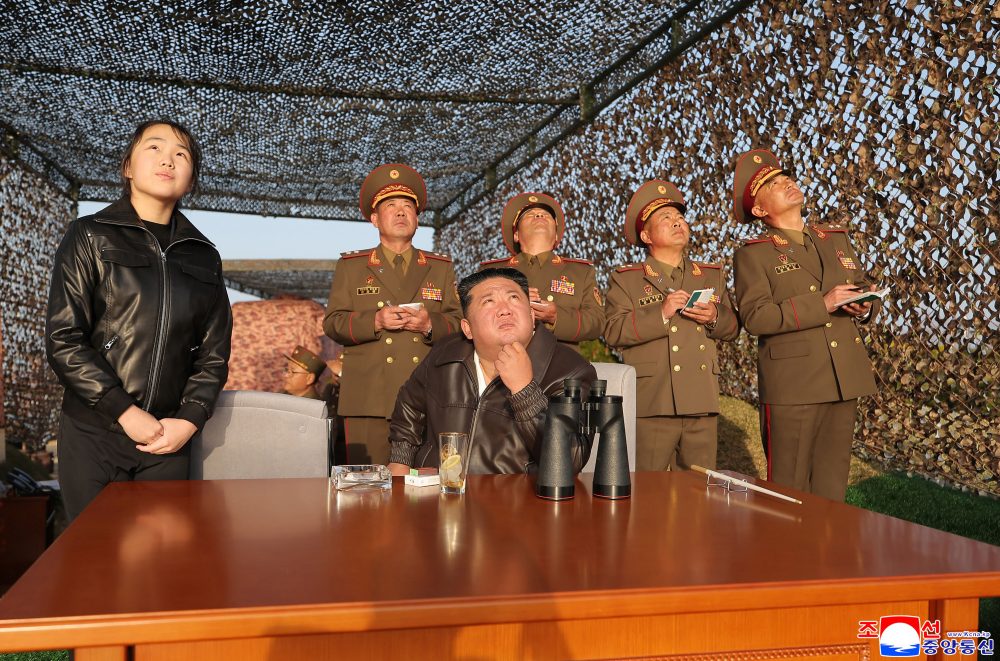
State media photographs depicted North Korean leader Kim Jong Un alongside his teenage daughter, both dressed in black leather jackets, observing from a shoreline vantage point as a missile flew across the water with gray smoke trailing behind it. Intelligence officials from South Korea recently suggested that the daughter, believed to be named Kim Ju Ae, may be positioned as Kim’s potential successor.
According to KCNA, Kim supervised the firing of five enhanced Hwasong-11 Ra surface-to-surface ballistic missiles equipped with cluster bomb warheads and fragmentation mine warheads.
The weapons successfully struck their island target, with Kim expressing approval of the test results. “It is of weighty significance in military actions to boost the high-density striking capability,” Kim stated, as reported by KCNA.
Earlier this month, North Korea conducted trials of Hwasong-11 Ka surface-to-surface ballistic missiles with cluster bomb capabilities that officials claimed “can reduce to ashes any target covering an area of 6.5-7 hectares (16 to 17.2 acres).”
While North Korea has previously experimented with cluster bomb warheads, analysts suggest the ongoing Iran conflict may have motivated North Korea to showcase its cluster munitions capabilities and speed up development of more advanced versions.
The devastating potential of cluster munitions has been demonstrated in current conflicts, with Israel alleging that Iran has deployed such weapons to overwhelm the nation’s strained air defense systems. These warheads explode at high elevations, releasing numerous smaller explosive devices across extensive areas that prove challenging to intercept.
Although more than 120 nations have agreed to an international agreement prohibiting cluster munitions, North Korea, Iran, Israel, and the United States have not joined this treaty.
Since Kim’s nuclear negotiations with former U.S. President Donald Trump collapsed in 2019, North Korea has been working to grow its nuclear weapons stockpile and develop sophisticated military technology. This includes multi-warhead nuclear missiles, hypersonic weapons, and submarine-launched ballistic missiles, which would significantly improve North Korea’s chances of overcoming U.S. and South Korean missile defense systems.
Trump has repeatedly indicated his interest in resuming diplomatic talks with Kim, while the North Korean leader has recently suggested openness to dialogue with Trump but called on Washington to abandon demands for North Korea’s nuclear disarmament as a condition for negotiations.
Trump is scheduled to visit Beijing for a rescheduled meeting with Xi Jinping in May. Some experts believe North Korea’s recent weapons testing may be designed to strengthen its bargaining position in potential future negotiations with the U.S., as the Trump-Xi summit could create diplomatic opportunities with Pyongyang.