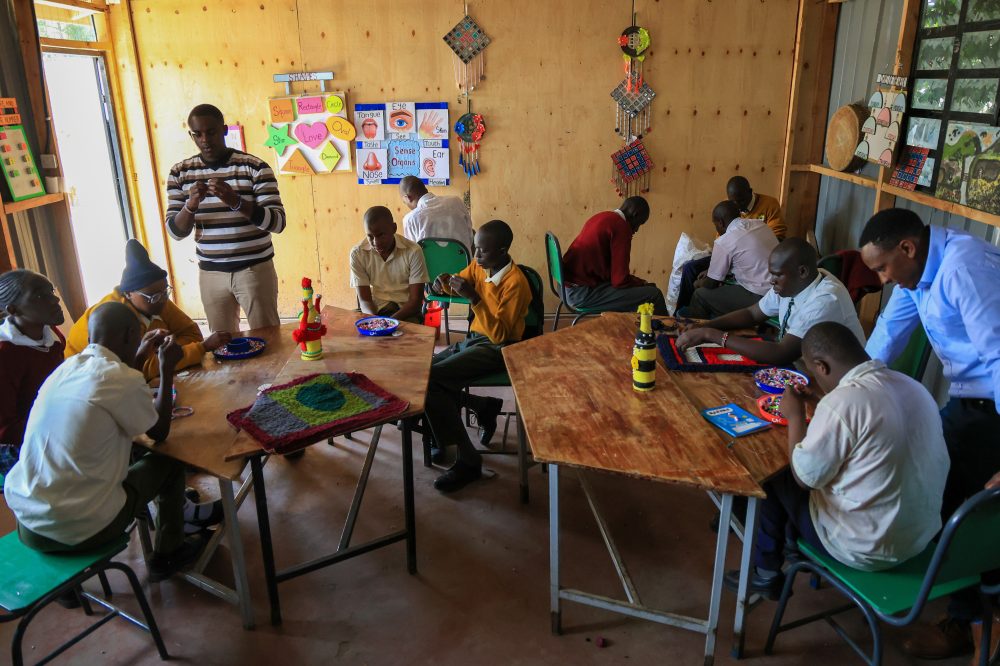

KITENGELA, Kenya — In the classrooms of an innovative Kenyan institution, traditional teaching methods have been completely transformed. Rare Gem Talent School has revolutionized education by replacing standard lectures with interactive, sensory-based instruction specifically designed for students living with dyslexia.
While Kenya has made significant strides in expanding educational opportunities, children with learning differences often struggle to keep pace in conventional settings. Rare Gem represents one of only a few educational facilities nationwide that caters specifically to youngsters facing dyslexia and similar learning obstacles, requiring only minor adjustments to standard academic programs.
Research shows dyslexia impacts approximately 10% of all students and creates significant barriers to developing reading skills. Without proper support, this condition could sideline enormous numbers of young people throughout Kenya and the broader African continent.
Student Jason Malak Atati experienced firsthand the difference specialized instruction can make. “Teachers didn’t understand me,” he explained about his previous educational experience. “This school is much better.”
Dennis Omari, who specializes in teaching students with special needs, explained that dyslexic children typically struggle with fundamental literacy skills, often confusing letters such as ‘b’ and ‘p’ or even numbers like ‘9.’ “The early signs to look out for are if children have issues with phonological awareness — not able to listen to exact sounds in a particular language — and when kids fail to read,” Omari noted.
The school tackles these obstacles through what Omari describes as a comprehensive sensory-based teaching strategy, with instructors focusing on different learning preferences. Methods include visual techniques like assigning specific colors to represent different sounds, audio approaches such as teaching spelling through musical patterns, and hands-on activities using physical objects to demonstrate how words are built.
Dorothy Kioko, an instructor at the facility, emphasized the personalized nature of their teaching philosophy. “You teach step by step until the learner gets what you’re teaching, not a lecture method where the teacher stands in front,” she said. “You have to have additional knowledge on how to handle them with patience.”
The institution was established in 2012 by the Dyslexia Organisation Kenya, beginning operations with fewer than 10 pupils. Currently, the school serves approximately 210 students, primarily those with dyslexia, while also supporting children with additional learning differences including autism.
Phyllis Munyi, who founded Rare Gem after witnessing her own son’s struggles with unaddressed dyslexia, stressed the importance of early intervention. “If they are identified early and intervention given early, they improve their skills and learn to identify their talents — and they complete school,” she stated.
Families pay tuition costs of $180 per semester, which falls below fees charged by elite private institutions but remains considerably more expensive than government-funded schools that serve most Kenyan students.
According to Munyi, the primary obstacles preventing children from accessing specialized education like that offered at Rare Gem include social stigma and insufficient awareness, particularly among parents. Additionally, many students arrive having endured harassment at their former schools.
Geoffrey Karani, a Rare Gem graduate who now works as an art instructor there, recalled his own difficult experiences. “In other, normal schools, there was a lot of discrimination, a lot of bullying,” he shared. Karani views mentoring as essential to his current role. “I’m not only teaching, I’m showing kids that I’ve been on the same journey,” he explained.
Kenya has achieved remarkable progress in educational expansion over recent decades, with primary school enrollment climbing from 5.9 million students in 2002 to 10.2 million in 2023—growth that has exceeded population increases.
However, educational opportunities for students with disabilities continue to lag significantly. Despite 11.4% of Kenyan children having special needs, only 250,000 such students participate in the nation’s educational system, according to data from So They Can, a nonprofit organization working to expand educational access across Africa.
Rare Gem potentially demonstrates how to broaden educational access without requiring extensive curriculum overhauls. Rather than creating entirely new academic content, the school adapts Kenya’s standard curriculum to better serve students with dyslexia and other learning challenges, Munyi explained. She emphasized: “The curriculum was not designed as a standalone … nor is it limited to dyslexia.”