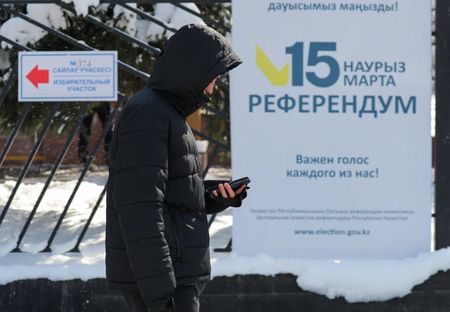

Citizens of Kazakhstan head to the polls this Sunday to decide on constitutional amendments that opposition voices claim might enable President Kassym-Jomart Tokayev to extend his leadership of Central Asia’s biggest economy past his scheduled 2029 departure.
The 72-year-old president, a seasoned diplomat who has successfully balanced relationships with Russia, the United States, and China, has described the referendum as “a truly historic moment” that will shift Kazakhstan—a major energy and mining nation—from what he calls a “super-presidential” structure toward better separation of governmental powers.
However, political observers argue the proposed amendments still concentrate excessive authority in the presidency.
Political analyst Dosym Satpayev explained that the draft “[s]ignificantly increases the powers of the head of state and does not create a system of checks and balances.”
The constitutional changes would combine parliament’s dual chambers into a single body and bring back the vice-president role, eliminated in 1996, with the president selecting this position.
Under current rules, Kazakh presidents serve one seven-year term—a restriction Tokayev implemented in 2022.
While Tokayev has stated he plans to leave office in 2029, some political watchers suggest a new constitution might reset his term limitations, mirroring strategies employed by other former Soviet leaders, including Russian President Vladimir Putin.
Addressing widespread speculation in Kazakhstan about Tokayev potentially pursuing the UN secretary-general position this year, Satpayev noted the vice-presidency would enable Tokayev to choose his replacement before departing early.
A diplomatic source from Kazakhstan informed Reuters that Tokayev, who led the UN’s Geneva operations from 2011-2013, is weighing both a secretary-general bid and a potential second presidential campaign.
Tokayev has publicly denied interest in returning to the United Nations.
Government-sanctioned polling organizations report strong public support for the constitutional amendments, with limited visible opposition.
This vote occurs during challenging times for Kazakhstan, whose economy remains tightly connected to Russia’s and has experienced negative effects from the Ukraine conflict.
While economic expansion has picked up pace, inflation has also risen, reaching 11.7% in February, with interest rates climbing to a historic 18%. New tax increases have added to public frustration.
At an Almaty marketplace, horsemeat vendor Asya Tuligenova—selling the traditional Kazakh specialty—explained that merchants are absorbing increased expenses rather than burdening customers.
“We’re kind of afraid. If we raise prices, it will be difficult for our regular customers,” she said.
Tuligenova declined to reveal her voting intentions for Sunday.