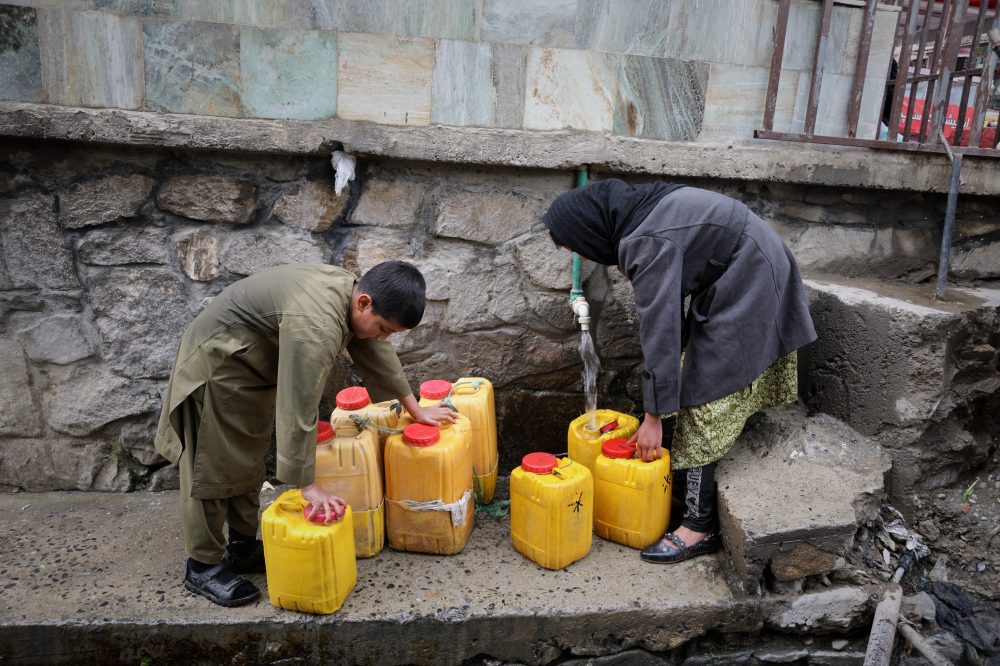

KABUL, Afghanistan — Frustration boiled over for residents in one of Afghanistan’s capital city’s most impoverished areas as they face a mounting water emergency.
In the muddy streets of Kabul’s Deh Mazang district, 52-year-old Marofa expressed her anger while adjusting her headscarf to show her graying hair. “You see this hair? Even I with my white hair, I have to carry water,” said Marofa, who uses only one name like many Afghans. “These containers are heavy. We have no strength left in our backs, no strength left in our legs.”
A local mosque provides free water from its well, but the liquid is yellowish and salty, making it unsuitable for drinking despite requiring manual transport. Clean water arrives via three-wheeled motorcycles for purchase, but many residents cannot afford the cost.
“We have no money for food. How can we get water?” demanded 90-year-old Wali Mohammad, another neighborhood resident expressing his frustration.
Both residents explained that several months following the Taliban’s return to power in Afghanistan during 2021, new leadership severed pipes that some community members had installed to channel water from a shared well directly to their residences.
“They cut off our water. They are powerful and they don’t even give us a reason why,” Mohammad stated.
However, 32-year-old neighborhood resident Najibullah Rahimi offered a different perspective, explaining that the residential pipes caused the well’s water levels to decline significantly, leaving residents at higher elevations completely without access. “So the government came and cut the pipes.”
Located within a mountainous valley of the Hindu Kush range at high elevation, Kabul is experiencing rapid water depletion. The city’s inhabitants depend primarily on underground water sources accessed through wells. However, these underground reserves have been declining at a concerning pace, with some wells requiring excavation to depths of 150 meters (approximately 500 feet) to locate water.
A report released in April 2025 by humanitarian organization Mercy Corps revealed that Kabul’s underground water reserves had decreased by 25-30 meters (roughly 80-100 feet) during the previous ten years. These underground reserves store vast quantities of water beneath the earth’s surface. Water accumulates in them gradually over extended periods as rainfall slowly penetrates downward. Excessive extraction from these reserves, combined with climate variations reducing water input, results in depletion.
“Without large-scale changes to Kabul’s water management dynamics, the city faces an unprecedented humanitarian disaster within the coming decade, and likely much sooner,” the report warned.
Environmental changes, primarily resulting from fossil fuel combustion, have contributed to the problem. Recurring dry periods have decreased snowfall, whose slow melting process typically refills underground water sources. Instead, Kabul experiences more intense, brief rainfall events that create flooding but fail to adequately reach underground reserves.
Environmental shifts have intensified what has been a developing emergency for years, according to Najibullah Sadid, a water resources and environmental specialist based in Germany with the Afghanistan Water and Environment Professionals Network.
“Even without climate change Kabul would have seen this crisis, with the enormous, unprecedented increase in population and urbanization,” Sadid explained.
The metropolitan area has expanded by more than 100% over the last twenty years. Kabul experienced a significant influx of Afghan nationals returning from neighboring nations after the Taliban’s initial removal in 2001. The city is witnessing another wave currently, as Pakistan and Iran initiated Afghan deportations in 2023. Growing from approximately 2.5 million residents in 2001, Kabul now houses an estimated 6 million people.
In certain areas, surface-level underground water sources have completely dried up, Sadid noted. Recent precipitation provides minimal benefit since Kabul has become so heavily developed that little natural, unpaved terrain remains where water can seep through.
“Even if it is raining every day, it will not impact groundwater levels anymore, because there is no place to impact the groundwater,” Sadid explained.
Poor water resource management has worsened the situation, he noted, specifically criticizing beverage manufacturers and greenhouse operations that consume substantial amounts of underground water.
Government officials recognize the severity of the situation.
“The water situation in Kabul city is in a critical state,” stated Ministry of Water and Energy spokesman Qari Matiullah Abid. “The main reasons are that the population has increased significantly, rainfall has decreased and consumption has increased.”
He indicated the government is implementing measures. Officials have established limitations on underground water extraction by beverage manufacturers, agricultural producers and other commercial operations. Water monitoring devices have been installed and usage limits imposed on enterprises including vehicle washing facilities and large structures, with those exceeding limits instructed to relocate outside Kabul.
To assist in refilling underground water supplies, small temporary barriers across waterways have been built in Kabul’s 14 districts, and thousands of drainage wells designed to handle storm runoff have been excavated, Abid reported.
He also referenced the completion of Kabul’s Shah wa Arous Dam, officially opened in 2024 and engineered to contain 10 million cubic meters (353 million cubic feet) of water, plus the extraction of millions of tons of sediment from the Qargha Dam, expanding the reservoir’s storage capacity.
However, these measures remain insufficient.
Two significant projects that could substantially reduce the emergency have experienced postponements.
One involves a approximately 200-kilometer (124-mile) water pipeline from the Panjshir River located north of Kabul, while the other is a proposed dam and water storage facility called the Shah Toot Dam situated about 30 kilometers (18 miles) southwest of the metropolitan area. Combined, these projects could supply water for roughly 4 million residents, according to the Mercy Corps analysis.
“A combination of both would be a sustainable solution for the future,” Sadid stated. While dam construction would require multiple years, the pipeline could be finished in relatively less time, he noted.
Shafiullah Zahid, Kabul Zone Director for Afghanistan’s Urban Water Supply and Sewage state corporation, confirmed the Panjshir pipeline’s approximately $130 million budget has received approval. The initial assessment, finished under the former government, “has been completely revised, and now another review is needed,” he stated. Following that completion, “practical work can begin.”
The Shah Toot Dam, announced months prior to the Taliban takeover, was planned as a collaborative Afghan-Indian initiative. It has also encountered funding obstacles. Should construction commence, completion would require six to seven years, Zahid indicated.
However, Sadid criticized Afghanistan’s leadership, both current and former, for emphasizing other infrastructure development over essential water initiatives.
“Numerous roads are being built, flyovers are being built with a lot of money. But there is no priority for water projects,” he stated. “They are just doing the projects which are eye-catching and not the projects which are fundamental to the people’s health and people’s fundamental rights. Water is essential. Water is more important than roads.”