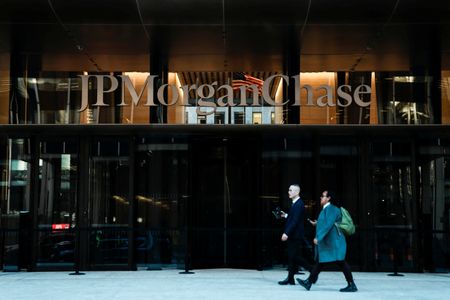

JPMorgan and several other major American banks are nearing an agreement to help provide funding under Japan’s $550 billion U.S. investment commitment, according to two people with knowledge of ongoing discussions between the lenders and the Japanese government.
The financing arrangement would assist Tokyo in following through on promises made to U.S. President Donald Trump. Japanese banks have been hesitant to take on a larger role because their funding is primarily in yen, and converting large sums into U.S. dollars for major, long-term infrastructure projects carries significant costs.
Japan has so far announced two rounds of projects totaling more than $100 billion under the investment agreement — a deal reached in July 2025 that secured U.S. tariffs of 15% on Japanese goods. Trump had previously threatened to impose tariffs as high as 25% on most Japanese exports.
The Japanese government is eager to demonstrate progress on its commitments, the sources said. Earlier this year, Trump threatened to raise tariffs on imports from South Korea, claiming that country had not honored its side of a trade agreement, though he later backed away from that threat.
Washington has also sent Prime Minister Sanae Takaichi’s government a list of potential additional projects under the investment framework, according to one of the sources and two others, who asked not to be named because the discussions are confidential.
Reuters was unable to determine how much funding U.S. banks might provide or which specific projects would be involved. It also remains unclear whether the U.S. government played any role in the conversations about which American banks might participate.
JPMorgan did not respond when contacted for comment.
Japan’s Ministry of Economy, Trade and Industry issued a statement saying no decisions have been made regarding U.S. bank participation and that any such decisions would ultimately rest with the banks themselves. The ministry also stated that the Japanese government has not yet identified a third round of candidate projects, and that bilateral discussions are ongoing.
The U.S. Department of Commerce did not provide a response outside of regular business hours.
Despite the scale of the overall investment pledge, financing secured so far remains a small fraction of what is needed. Only $2.2 billion has been committed for the first group of investments, which were announced in February. That funding flows to special-purpose companies created to oversee individual projects.
Roughly one-third of that amount is being provided by the state-backed Japan Bank for International Cooperation. The remaining two-thirds is being co-financed by Japan’s three major banking groups: Mitsubishi UFJ Financial Group, Sumitomo Mitsui Financial Group, and Mizuho Financial Group.
Those three lenders have told the Japanese government that even with government loan guarantees in place, raising long-term dollar funding is costly and limits their capacity to lend in other areas, according to separate sources.
Japanese banks typically must issue dollar-denominated bonds, borrow in wholesale markets, or use currency swap arrangements to obtain U.S. dollars — all of which come with added expenses. Those costs are further compounded by the wide gap between U.S. and Japanese interest rates and the expense of hedging against currency fluctuations.
Prime Minister Takaichi’s government has been exploring ways to help domestic banks access U.S. dollars to fund American projects. One option being considered involves tapping dollars held in Japan’s foreign exchange reserves, according to a report by Kyodo news agency.
The three major Japanese banks declined to comment on whether they might provide additional financing.
The first round of projects, announced in February, includes an oil export facility in Texas, an industrial diamond plant in Georgia, and a natural gas-fired power plant in Ohio. A second round, announced in March, includes plans to build small modular nuclear reactors by GE Vernova Hitachi in Tennessee and Alabama, along with natural gas-fired power facilities in Pennsylvania and Texas.
While the involvement of large U.S. banks would help move the financing forward, sources cautioned that considerable risks remain. Infrastructure projects can take decades to generate returns and for loans to be fully repaid.