
TOKYO (AP) — Japan’s parliament was poised to pass legislation Friday that could threaten the survival of its 1,500-year-old imperial institution by cementing a rule that only men may serve as emperor — a move drawing sharp criticism as the royal family continues to shrink and age.
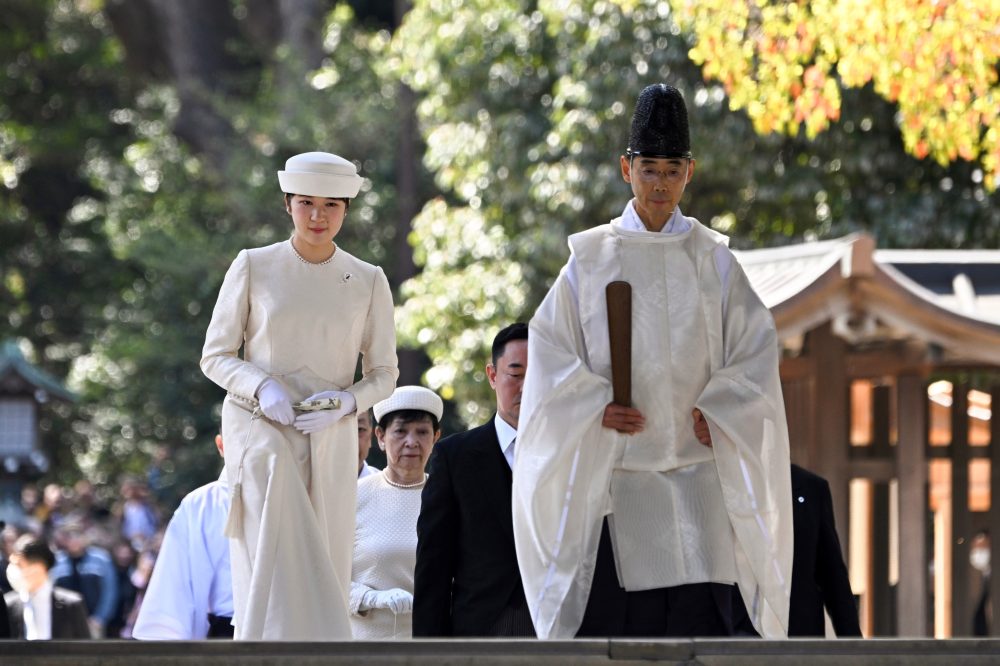
Emperor Naruhito’s 24-year-old daughter, Princess Aiko, enjoys widespread public support and many Japanese citizens would like to see her succeed her father. However, because she is a woman, she is disqualified under the male-only succession rule. That rule directs the line of succession to the emperor’s younger brother and then to his 19-year-old nephew, Prince Hisahito. After Hisahito, the next in line is the emperor’s 90-year-old uncle.
Hisahito is the first male royal baby born in four decades — a reflection of just how male-scarce the imperial family has become. Of the 16 adults currently in the imperial family, with no children among them, only five are men.
Prime Minister Sanae Takaichi and fellow conservatives argue that the male bloodline is “the only source of the emperor’s authority and legitimacy,” a position that forms the foundation of the upcoming legislation.
Under the Imperial House Law, while an emperor’s mother may be a commoner — as is true with the current emperor — only boys born to men of royal blood can be heirs to the throne.
The legislation parliament was expected to approve Friday revises the long-standing law to reinforce that bloodline principle. It would allow the adoption of distant male relatives from former royal branches to father future heirs. The measures would also permit princesses to retain their royal status if they choose to marry commoners.
“It’s a declaration to prevent female monarchs … and to defend the male-lineage at all costs,” said Hideya Kawanishi, a monarchy expert at Nagoya University. “They cannot say it’s male chauvinism, so they call it tradition.”
Japan has had eight female monarchs throughout its history. The most recent was Empress Gosakuramachi, who reigned from 1762 to 1770.
The requirement for paternal male succession was first written into law in the 1890 Imperial House Law, during a period when Japan was promoting patriarchal social structures. That framework was largely preserved in the current 1947 version of the law.
The Friday proposal has sparked public protests from Japanese citizens who believe the government’s push is designed to block Princess Aiko from ever ruling and to entrench discrimination against women.
“It’s very ironic that the first female prime minister herself is the leading proponent of the obsession with male-succession,” wrote prominent feminist scholar Chizuko Ueno in a recent piece, referring to Takaichi.
Ueno also argued the new measures “treat male royals as stallions and put female royals under pressure as ‘childbearing machines’ to produce male offspring.”
After Aiko’s birth, her mother Empress Masako — a Harvard-educated former diplomat and commoner — developed a stress-induced mental health condition, reportedly stemming from criticism over her failure to produce a male heir.
Former Imperial Household Agency chief Shingo Haketa recently told Kyodo News that the monarchy’s future after Hisahito is “extremely unstable,” a consequence of the male-only succession rules and the tradition of dismissing princesses who marry commoners.
Historians note that the male-only system is no longer workable in modern Japan, which is already grappling with a rapidly aging and shrinking population. Historically, the system functioned because concubines produced roughly half of all emperors — a practice that continued until about a century ago, when it ended under Naruhito’s great-grandfather, Emperor Taisho.
A government proposal in 2005 would have allowed female monarchs, but it was abandoned after Prince Hisahito was born.
Naruhito’s two male heirs are his 60-year-old brother, Crown Prince Akishino, who is only six years younger than the emperor and has reportedly indicated he would be too old to serve, and Hisahito, Akishino’s 19-year-old son. Third in line is Naruhito’s uncle, Prince Hitachi, who is 90 years old.
The more contentious of the two proposed measures would allow unmarried male descendants — aged 15 or older — of distant imperial relatives to be adopted into the royal family, but only if they come from the paternal line.
Imperial Household Agency official Yoshimi Ogata told a recent parliamentary session that 51 members from 11 branch families gave up their royal status in 1947, largely to reduce the postwar financial burden on the monarchy. Ogata noted these individuals are at least 36 generations removed from Emperor Naruhito, having branched off from a shared male-line ancestor roughly 600 years ago.
Many see the government’s efforts as extreme. “Who wants the son of an adoptee who nobody knows to be emperor instead of Aiko?” asked Yoshinori Kobayashi, a cartoonist who has been campaigning for Aiko’s succession.
There are also practical concerns about whether former royals would even want to return to what is described as “an enclave without human rights” — a highly regimented lifestyle in which royals have no say over their careers or where they live.
“I wonder if anyone would raise a hand,” said 81-year-old Asahiro Kuni, whose family gave up its royal status when he was just 3 years old, in comments to TBS television. “I imagine many people, by age 15, have some idea about their future. It’s cruel to tell them … to change the course of their life.”
Kuni, who built a career as an engineer at a major Japanese company, said he would advise his own family to decline if the palace came calling. “You are asked to sacrifice your life for the happiness of the people. I can’t tell my family to choose such a difficult life.” He has also expressed support for female monarchs in other Japanese media interviews.
Princess Aiko, known for her warm smile, enthusiasm, and quick wit, remains a favorite with the public.
Five unmarried princesses — including Aiko and her popular 31-year-old cousin Kako — could be affected by the other key revision to the Imperial House Law. That change would allow them to keep their royal status and continue carrying out official duties after marrying commoners, though their spouses and children would not be recognized as royals.
Aiko’s older cousin Mako gave up her royal title and relocated to New York following her marriage to a college boyfriend — a commoner who now works as a lawyer. That decision was widely interpreted as her effort to escape the constraints of imperial life.
Scholar Ueno has called the system inhumane and is urging the remaining princesses to follow Mako’s lead and leave while they have the chance.
Kawanishi warned that Hisahito, any future adoptees, and their wives will face immense pressure to produce male heirs.
“The emperor is a symbolic figure, and I don’t see why women cannot serve in the role,” said 78-year-old Junichiro Tsujimaru, a sushi chain founder.
Also 78, Yoshio Iwase argued that Aiko, as the emperor’s own daughter, is the rightful successor. “I think it’s fine because there used to be female emperors in the past,” he said.
There is concern that the government’s actions could undermine the legacy of former Emperor Akihito, whose reign was marked by efforts to make amends for the suffering caused during World War II, which was fought in his father’s name. Akihito, who stepped down in 2019, also worked to make the historically distant monarchy more accessible to ordinary people — a path his son Naruhito and his family have continued to follow.
Akihito is reported to support Aiko’s succession. While he avoided directly addressing the 2005 government proposal, he commented that female royals play a vital role in the monarchy and that the institution exists to serve the happiness of the people — a statement widely interpreted as backing for female monarchs.
In June, Naruhito himself expressed hope that discussions about the measures would reach a conclusion that “will gain understanding of the people” — a carefully worded remark that palace observers interpreted as a subtle signal of his own reservations.