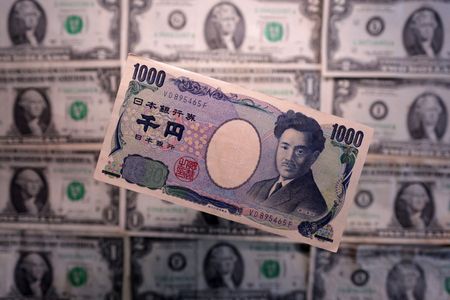

Currency markets showed mixed signals Tuesday as the Japanese yen maintained stability following what experts believe was government intervention last week, while the U.S. dollar strengthened as investors flocked to safer assets amid growing Middle East tensions.
The yen traded at 157.22 against the dollar, remaining near its strongest position in two months after experiencing several sharp rallies since Thursday. Market sources indicated Japanese authorities spent approximately $35 billion to support their currency, though experts question whether this will provide lasting relief for the struggling yen.
Meanwhile, the dollar index, which tracks the U.S. currency against six major currencies, held steady at 98.452 after climbing 0.3% Monday. The euro remained weak at $1.1693, while the British pound traded at $1.353.
“While we have seen a clear shift toward risk aversion, we are yet to see the kind of outsized moves that would likely accompany a full escalation in hostilities,” said Nick Twidale, chief market strategist at ATFX Global in Sydney.
The currency movements come as fresh military strikes between U.S. and Iranian forces in the Gulf Monday renewed market anxiety, testing an already fragile ceasefire and dampening investor appetite for riskier assets.
Energy markets continue driving much of the uncertainty, with the closure of the Strait of Hormuz – a critical pathway for roughly 20% of global oil shipments – creating supply disruptions that have kept crude prices elevated since the conflict began in late February. Brent crude futures traded at $113.8 per barrel Tuesday, down 0.6% after surging 6% the previous day.
Australia’s currency held relatively stable at $0.7168 as traders awaited the Reserve Bank of Australia’s policy announcement, where officials are expected to implement their third consecutive rate increase to combat inflation running above the central bank’s 2%-3% target since mid-2025.
Currency analysts remain watchful of the yen’s movements, particularly as it approaches the politically sensitive 160 level against the dollar. Japan’s currency has faced years of pressure from the country’s ultra-low interest rates and growing differences with higher-yielding markets elsewhere.
Deepali Bhargava from ING’s Asia-Pacific research team noted that the suspected intervention has only temporarily adjusted trading ranges without addressing the fundamental pressures weighing on the yen.
Charu Chanana, chief investment strategist at Saxo, expects continued volatility in a 155-160 range, with Japanese authorities likely preventing any decisive break above 160 rather than engineering a complete reversal.
“Near term, USDJPY may stay volatile in a wider 155–160 range, with authorities likely leaning against a clean break above 160 rather than engineering a durable yen reversal,” Chanana explained.
The yen’s future performance remains closely linked to oil price movements and the resolution of Middle East hostilities, according to market watchers.
“A lot hinges on oil price,” said Vasu Menon, managing director of investment strategy at OCBC. “If it rises or remains elevated, then the yen could come under pressure once again.”