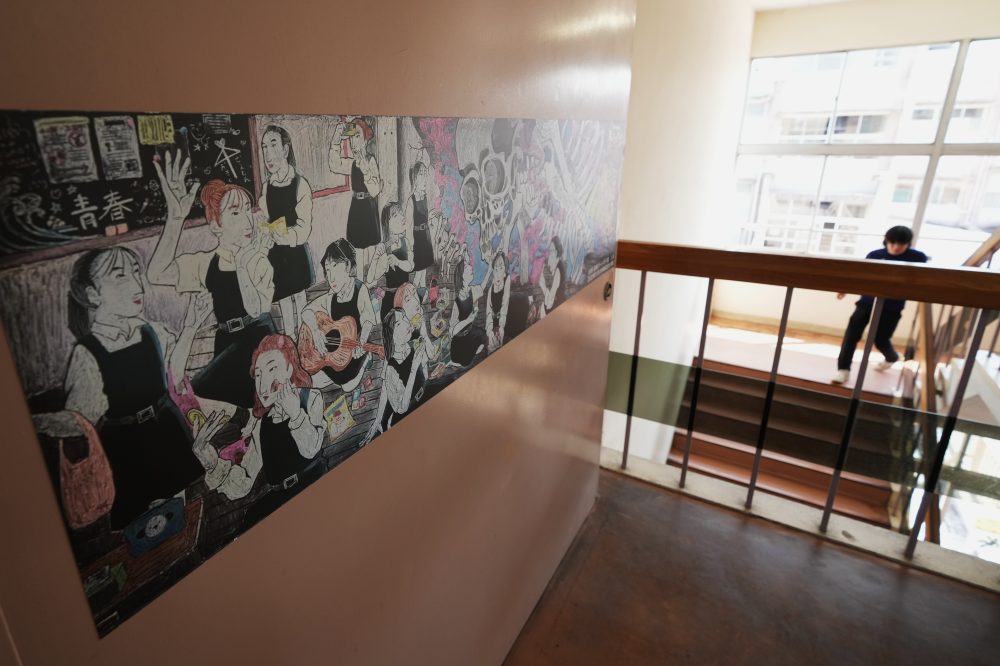

In Japan, the ordinary classroom blackboard has become something extraordinary — a canvas for young artists wielding colorful chalk instead of paint.
Every year, high school students across Japan compete in the Kokuban Art Koshien, a national chalk art championship. The name blends the Japanese word for blackboard, “kokuban,” with the name of the legendary stadium where high school baseball championships are held. Around 300 high schools and junior high schools submit entries, with most of the artwork created during summer break.
The pieces — many of them breathtaking in detail and often featuring dreamlike imagery — are team efforts. Groups ranging from just a couple of students to dozens work together, making each piece both an artistic and collaborative achievement.
Subject matter varies widely: dinosaurs, dogs, and whales share space with popular manga scenes, reimaginings of Hokusai’s Mount Fuji, the Mona Lisa, and imaginative takes on everyday life — including, in one case, a classroom set entirely underwater. Some works even depict someone drawing on a blackboard.
Kazunari Minamishima, an art teacher at the Saitama Prefectural High School of the Arts whose students have participated in the contest, believes it resonates with young people because it allows more experimentation than traditional art forms like oil painting or sculpture. “It’s still a work in progress,” he said.
The competition was launched in 2015 by Nichigaku Co., a Tokyo-based company that manufactures blackboards. Because the blackboards themselves cannot be easily transported, judging is done by reviewing photographs of the finished works. Winners are announced each November.
Blackboard art wasn’t invented by the contest — it had already existed in Japanese schools. In fact, it was a remarkable recreation of Leonardo da Vinci’s “Last Supper” on a school blackboard, created by an unknown artist, that first caught Nichigaku’s attention.
“Back then, there was graffiti, but there was no genre called blackboard art,” said Nichigaku President Tomohiro Yoshida.
While the contest doesn’t directly drive blackboard sales — schools already own them — Yoshida noted with pride that some participants have gone on to become professional artists.
The techniques involved are surprisingly sophisticated. Chalk powder dusted across the board creates an effect reminiscent of scattered stardust. Blending with fingers or tissue paper produces shadows and softer tones. A skilled artist can even capture the glassy sheen of a dragon’s eyeball. One award-winning piece used chalk powder dissolved in water and applied in the splatter style of Jackson Pollock.
Any school in Japan is eligible to enter, including international schools. Nichigaku hopes to eventually expand the contest beyond Japan’s borders.
Unlike spray-painted graffiti common in Western cultures, chalk art on a blackboard can simply be erased — and students always seek permission from their schools before creating their pieces, reflecting Japan’s culture of order and respect.
Kento Misumi, who entered the contest as a high school student and now works at Nichigaku, remembers the experience vividly. “The challenge of trying to sort out the conflicting opinions of my two collaborators is the biggest memory about taking part in blackboard Koshien, as opposed to doing your own artwork,” he said.
Misumi recalled spending several days with friends on a single drawing, and demonstrated chalk technique by sketching an apple on a blackboard. “I want young people today to go through the experience,” he said.
That same spirit of collaboration was on full display at Kumagaya Girls’ High School, located north of Tokyo in Saitama Prefecture, where a group of students huddled together to brainstorm their entry. It was their first time competing, though older students at the school have entered and won prizes in prior years.
“I see it as a chance to deepen my relationships with my schoolmates,” said student Chiho Ninomiya. “It’s our first time so I’m not sure we will be able to do a good job. But even if we don’t win, it’d have been worth it as long as we become better friends while doing it.”
The group discussed ideas including playful takes on famous paintings by Renoir, reimagined alongside images of high school students in their uniforms with skirts catching the breeze.
Ninomiya noted that working with chalk on a blackboard is a completely different experience from using pencils or paint — the students are still learning, drawing, smudging, and wiping as they go.
There is an emotional cost when the carefully crafted images are eventually erased. But supporters of the contest say that’s part of the point — the experience teaches students about impermanence, the fragility of creative work, and the courage to keep creating. In this art form, the moment the work disappears is considered the moment it is truly finished.