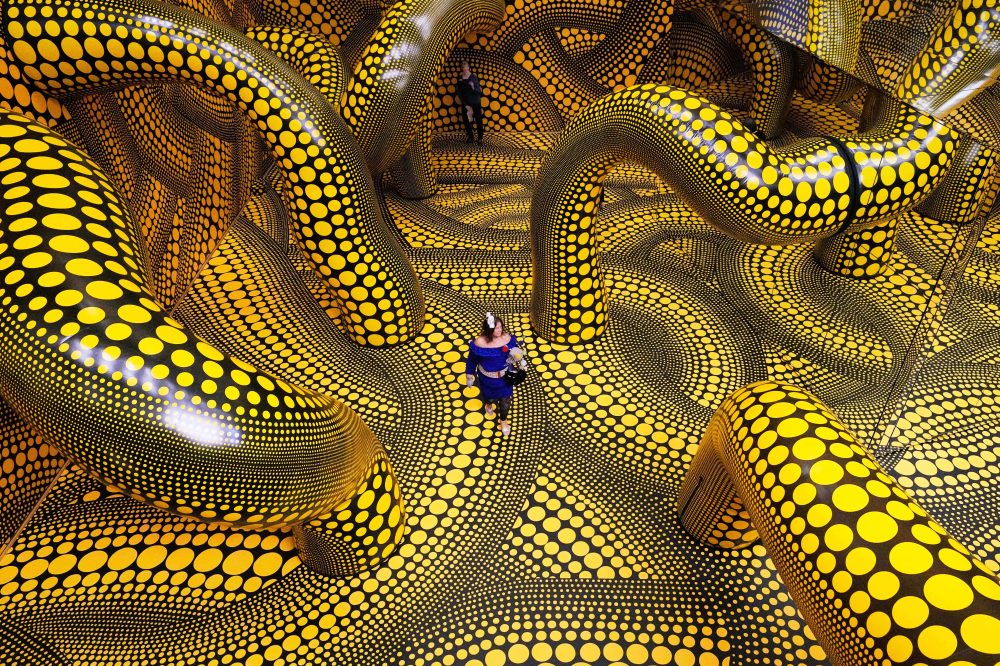

COLOGNE, Germany (AP) — Visitors to a prestigious German museum can now walk through a mirrored chamber filled with colorful polka dots, explore towering flower sculptures positioned near Cologne’s historic cathedral, and navigate through massive tentacle-like installations that create a captivating journey through art and space.
The distinguished Museum Ludwig in western Germany is marking its golden anniversary by launching an extensive exhibition featuring the work of celebrated Japanese artist Yayoi Kusama, opening Saturday for a nearly five-month run showcasing more than 300 pieces.
This comprehensive journey through the artistic evolution of the 97-year-old creator spans from her earliest sketch in the mid-1930s to a specially created “Infinity Mirror Room” designed exclusively for this exhibition.
Kusama, who celebrates her 97th birthday this month, has gained widespread popularity on social media through her vibrant color palettes and flowing forms that express her wonder about existence. Her personal journey took her from traditional post-war Japan to New York City, where she became involved with the Flower Power movement and Vietnam War protests during the 1960s, before returning to Japan in 1973.
Exhibition curator Stephan Diederich describes the show, running until August 2nd, as “very diverse, wide-ranging, and depicts an immensely rich, creative life spanning more than eight decades, still looking ahead.”
The display includes pieces from her “My Eternal Soul, 2009-2021” collection, featuring a mosaic of paintings, alongside “The Universe as Seen from the Stairway to Heaven” — constructed from mirror, glass and acrylic materials. At the museum’s entrance stands her internationally recognized 2009 “Pumpkin” sculpture, crafted from fiber-reinforced plastic and polyurethane paint, on loan from Museum Voorlinden in the Netherlands.
The rooftop installation showcases painted-bronze works titled “Flowers That Speak All about My Heart Given to the Sky” from 2018, while “I’m Here, but Nothing,” originally conceived in 2000, transforms everyday household items using fluorescent stickers and ultraviolet lighting.
“Kusama is undoubtedly one of the most significant artists of our time,” Diederich stated. “Her mirror rooms, balloon installations and polka dots have achieved cult status and are now iconic.”
Her diverse artistic creations frequently draw inspiration from the natural world. She spent her childhood surrounded by the greenhouses and farmland of her family’s extensive seed business in Matsumoto, Japan. During her youth, Kusama experienced intense hallucinations, many featuring spreading polka dots or flowers, and has battled ongoing psychological challenges.
“In my more than 70 years as an artist, I have always been in awe of the wonder of life,” she said in a statement. “More than anything, this strong sense of the life force in artistic expression is what has supported me and gave me power to overcome feelings of depression, hopelessness and sadness.
“I have been guided by my belief in this power,” Kusama said.
According to Diederich, Kusama has spent recent years living quietly in a Tokyo medical facility and worked with the exhibition team through intermediaries. Despite health limitations, she continues creating art daily and has maintained active involvement in planning this show.