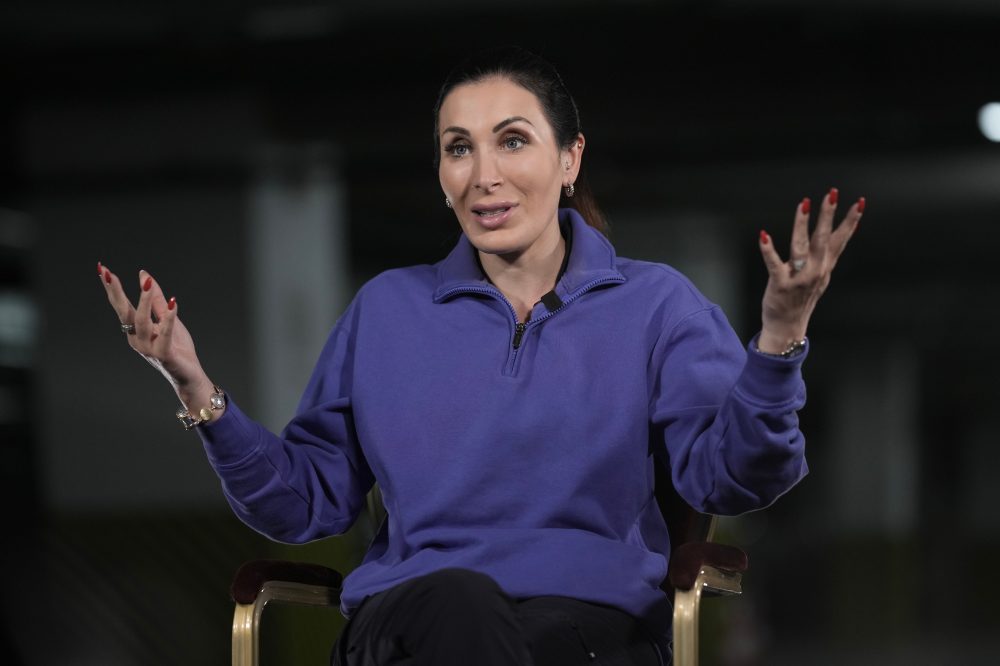

Dalia Gubbay had attended Milan’s April 25 Liberation Day march on many occasions. There had always been some tension when supporters of the Jewish Brigade reached the city center, she recalled, but the hostility had typically been limited to brief confrontations. This year, she said, everything felt different.
The Jewish Brigade — whose volunteers fought alongside Allied forces in World War II — was being honored during Italy’s annual commemoration of liberation from fascism. Gubbay, who serves as vice president of the Jewish Community of Milan, said demonstrators encircled Jewish participants carrying Israeli and Jewish Brigade flags, shouted insults at them, and ultimately forced them out of the procession under police escort.
One woman looked directly at Gubbay and called her a murderer. Nearby, a man draped in an Israeli flag sat down in the street and refused to leave, shouting that he was Jewish and would not be moved. Gubbay said she wept when the group finally withdrew — not out of fear, but out of anger. “Milan is my city,” she later wrote. “I was born here, and my children were born here.” That afternoon, she said, it felt as though the city had turned its back on them.
Less than three months later, the Jewish community discovered an anonymous Google form asking members of the public to report Israeli tourists, Jewish visitors, hotels, businesses, property purchases and projects allegedly tied to what the form’s creators called “Zionist tourism” and “Zionist neo-colonization” in Italy.
The questionnaire spread through social media and messaging groups connected to Milan, though it requested information from across the country. It asked respondents to provide locations, supporting sources and details about local organizations already working on what it described as the phenomenon. The form stated that all information would be shared confidentially with the Global Sumud Movement, a pro-Palestinian activist network that denied any involvement in creating, commissioning or even knowing about the form when it surfaced in press reports.
The questionnaire was removed following the intervention of Gen. Pasquale Angelosanto, Italy’s national coordinator for the fight against antisemitism. The individuals who created it have not been publicly identified.
For Italy’s Jewish leaders, the form did not appear out of nowhere. It came after years of increasingly aggressive campaigns targeting people and institutions labeled as Zionist, along with a series of incidents involving Jewish students, tourists, businesses and public commemorations.
This was not the first recent effort to compile a list of alleged Zionists in Italy. In August 2024, the fringe Nuovo Partito Comunista Italiano released a lengthy online document naming Jewish community figures, politicians, journalists, businesspeople, companies and other organizations it accused of belonging to a “Zionist bloc.” The group indicated the research was unfinished and could grow.
The publication was condemned across much of Italy’s political spectrum. The Jewish Community of Rome described it as a proscription list that exposed individuals by name and professional affiliation. Senate President Ignazio La Russa cautioned that publicly identifying people in that manner could put their safety at risk.
There is no evidence linking the communist organization to the Milan form, or suggesting the two projects were coordinated. Nonetheless, both followed a similar approach: categorize people based on a real or assumed connection to Israel, document their identities or whereabouts, and encourage others to act against them.
The Google form went a step further. Rather than focusing mainly on public figures and institutions, it sought information about ordinary travelers, the locations where Israelis were staying, property deals and businesses connected — accurately or not — to Jewish or Israeli activity.
Walker Meghnagi, president of the Jewish Community of Milan, warned that gathering such information could provide practical assistance to anyone intending to commit violence. Community representatives notified Italian authorities and reached out to journalists and politicians shortly after the questionnaire came to light.
Gubbay said the community’s secretary-general shared the form in a board group and made clear the matter could not be ignored. Meghnagi used his government contacts to escalate the issue, while Gubbay reached out to the press. By the following day, the form had been taken offline.
The swift response offered some reassurance to community leaders, but not enough to convince them the underlying problem had been addressed.
Benjamin Birely, a PhD candidate and researcher at L’Orientale University in Naples and the creator of the social media account @holylandspeaks, said he was more surprised by the public’s shock over the questionnaire than by its existence. He had already come across the earlier online database listing people described as Zionists, complete with names, cities and business details. “This website was taken down, but there will be another one,” Birely told The Media Line.
His own experience in Naples illustrates how the language used in such lists can be directed against a real, identifiable person. Birely arrived in the city in the fall of 2024 to begin his doctoral research. During his first month, he said, he found the words “Intifada until victory” painted on the entrance to one of L’Orientale’s main buildings.
The neighborhoods surrounding L’Orientale and the nearby Federico II University were filled with anti-Israel posters and graffiti, he said. Some promoted organizations or language associated with violent resistance rather than expressing a general call for Palestinian rights.
Birely had expected Naples to have a strong left-wing and pro-Palestinian political culture. What he had not anticipated, he said, was the hostility he encountered after other students and university community members learned he was Israeli.
The situation grew worse after pro-Palestinian activist Vincenzo Fullone published a video apparently describing Birely as a “soldier without a uniform” and alleging he had been dispatched by the Israeli government to shape debate at L’Orientale. Birely denied both claims and said he plays no role in the Israeli military.
Shortly afterward, Link Orientale, a student organization represented in several university bodies, published material calling him a “PhD candidate in genocide,” according to Birely. He said Fullone’s video and the student group’s posts triggered a wave of hostile messages and threats from people who knew his university department and where he lived. “The only reason I’m being accused of being a soldier and of genocide is simply because I’m a Jew with an Israeli passport,” Birely said.
Before the public campaign began, Birely had repeatedly encountered a question he said has become central to how Israelis are treated in Italy: “Are you a Zionist?”
He said owners or staff at restaurants, cafés and shops sometimes posed the question after learning he had moved from Israel. In several instances, he said, answering yes would have meant being told to leave. To sidestep confrontation, he sometimes responded that he opposed the war, opposed the Israeli government and supported peace.
In much of Italy’s current political conversation, Birely said, “Zionist” is no longer used as a descriptive term for someone who supports Jewish national self-determination. It has become an accusation associated with murder, racism and genocide. “When people say ‘Zionista,’ it is just the new way of saying ‘Ebreo,’” he said, using the Italian word for Jew.
Gubbay described a parallel dynamic in Milan. Italian Jews, she said, are routinely expected to publicly distance themselves from Prime Minister Benjamin Netanyahu’s government before being welcomed in social or political spaces.
“If I’m not with Bibi, I’m OK,” she said, describing the condition imposed on Jewish participants rather than expressing her own political views. “But why should I have to say something like this? They don’t ask Russians, Chinese or Iranian people to dissociate themselves from the government of another country.”
Birely argues that Italy’s current climate cannot be explained by the Gaza war alone. He points to three historical and political traditions that he believes have merged with the anger generated by the conflict.
The first is Italy’s incomplete reckoning with its fascist past. Italy was governed for two decades under Benito Mussolini’s regime and enacted racial laws in 1938 that stripped Jews of fundamental rights. Thousands of Italian Jews were later deported to Nazi concentration camps. Birely said postwar Italy built much of its national identity around resistance to German occupation and the heroism of the partisans, while failing to fully confront the role that Italians and Italian institutions played in persecuting Jews.
The second factor, he said, is the persistence of older Catholic imagery involving Jewish guilt. Italy is now broadly secular, and the Catholic Church formally rejected the accusation of collective Jewish responsibility for the death of Jesus during the Second Vatican Council in 1965. Even so, Birely said Christian symbolism remains culturally powerful. He pointed to religious imagery used during the Gaza war, including a statement he attributed to Cardinal Pizzaballa, the Latin patriarch of Jerusalem, that “Christ is … buried under the rubble” in Gaza. He also cited Italian nativity scenes depicting Jesus wrapped in a keffiyeh and public art presenting him as Palestinian. “This taps into these old cultural ideas about Jews being something sinister,” Birely said. “Just as the Jews killed Jesus, now Jews are killing babies in Gaza.”
The third element is Italy’s political left, which was shaped for decades by a communist movement larger than any other in Western Europe. Birely said some of the language promoted during the Soviet period — particularly the portrayal of Zionism as racism or colonialism — remained embedded in the country’s political vocabulary. He said those ideas can still be heard in universities, trade unions and local activist groups, where hostility toward Israelis is sometimes defended as anti-Zionism rather than recognized as discrimination.
That tension now extends beyond demonstrations and campus politics. It has entered the debate over how Italy should define contemporary antisemitism and whether public institutions should adopt the International Holocaust Remembrance Alliance’s working definition.
Jewish organizations say clearer standards are needed when anger toward Israel spills over onto Jewish communities or individual Israelis. Critics worry such standards could be applied too broadly and restrict legitimate criticism. Gubbay said criticism of Israel — including criticism of its government — is not inherently antisemitic. The line, she said, is whether an argument addresses policy or whether it uses a person’s Jewish identity or Israeli nationality as grounds for exclusion.
She pointed to plans for a luxury resort in Perledo, near Lake Como, involving Israeli architect Yehiel Tsubery. Local environmental groups have raised hydrogeological concerns that remain under review by the relevant authorities. Gubbay said those objections deserve to be examined on their merits. Her concern was with activists who labeled the development a “Zionist resort” and opposed Tsubery’s involvement on the grounds that he was born in what they called an illegitimate state.
A comparable dispute emerged in Valsesia, a mountainous area of Piedmont where Israeli families have purchased or are considering purchasing abandoned homes through an initiative called Project Baita. Gubbay described the families as doctors, engineers, teachers and parents seeking quieter lives in Italian communities struggling with depopulation. Opponents characterized their arrival as the establishment of an Israeli “colony.”
That choice of words was not accidental, she said. It transplanted the political language used to describe Israeli settlements into Italian villages where families were legally buying homes, enrolling children in local schools and contributing to the local economy. “Baita means home,” Gubbay noted. “Valsesia is not becoming a colony. It is becoming a place where the sound of children walking to school can be heard again.”
The controversy eventually escalated beyond words. A mayor in the area received a threatening letter containing a bullet after expressing support for the arrival of Israeli families.
Another project near Perledo drew protests from activists who described it as part of a Zionist takeover of the region. For Jewish leaders, these cases demonstrate how Israeli involvement in routine property development can be reframed using the vocabulary of occupation and settlement, regardless of the actual location or legal context.
The pressure is also affecting everyday family life in Milan. Gubbay said some parents now instruct their children not to wear a kippah, display ritual fringes, or speak Hebrew in public. Jewish schools and synagogues operate under police protection — something she praised but said is increasingly difficult to explain to young children.
She described an incident in which three Orthodox Jewish children, ages 13, 11 and 9, were stopped and searched by a security guard at a Milan store after saying they were Israeli. According to Gubbay, the guard searched their pockets and wallet but found no stolen merchandise.
Days later, she said, an older brother returned to the store with his pregnant wife and young child. The same guard allegedly searched him as well and continued to detain the family after finding nothing. When the man began recording the encounter, store management demanded the footage be deleted before allowing the family to leave, according to Gubbay.
In a separate incident, two young Argentine Jews wearing kippot were attacked near a Milan supermarket, Gubbay said. One suffered a broken nose, and both chose to leave Italy shortly afterward.
The source material for this article did not include police reports or responses from the businesses involved in those incidents. Gubbay presented them as examples of a fear that has become routine among Jewish families, even in the absence of any national controversy or organized protest.
That fear is now influencing decisions about education and emigration. Gubbay’s daughter, Rebecca, is 18 and will soon need to decide where to attend university. She was born in Milan, has close family there, and had expected to build her life in Italy.
After witnessing the exclusion of Jewish participants from the April 25 march and absorbing what Gubbay described as a constant stream of antisemitic content on social media, Rebecca began questioning whether she could attend an Italian university without concealing her identity. Studying in Israel is another option, but leaving would mean separating from much of her family. Gubbay said many young Italian Jews are now facing similar choices.
The concern has grown beyond whether an anonymous online form can be removed or whether authorities will denounce the next list. It is now about whether Jews born in Italy will continue to believe they can live openly in the country. “Rebecca is Italian. She was born in Milan,” Gubbay wrote. “Do we really want to watch our young people leave and hand them a world we promised would never exist again?”