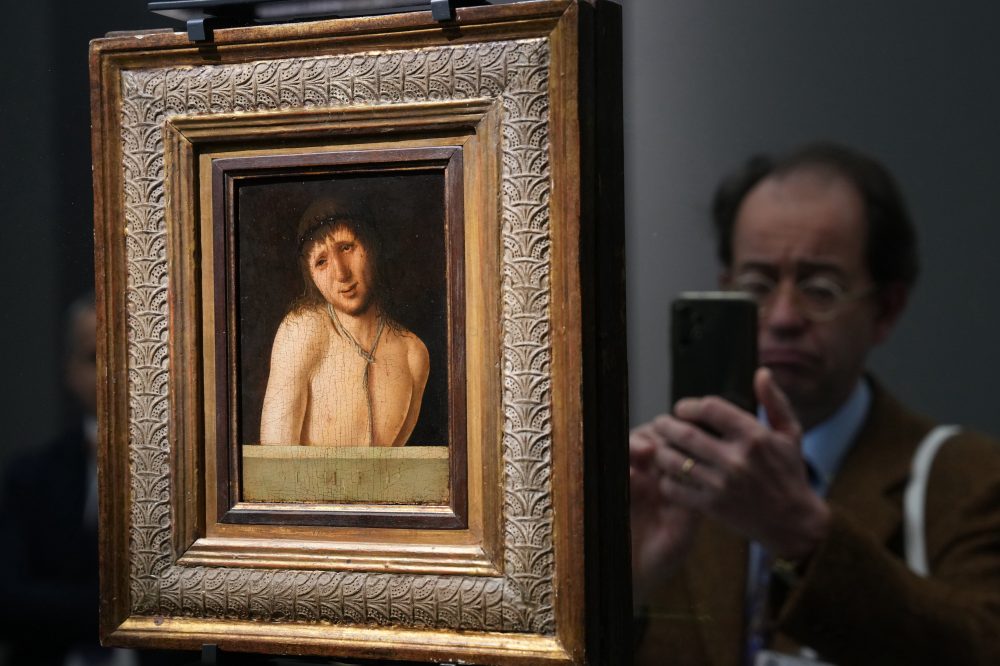

Italy’s Culture Ministry displayed a newly acquired Renaissance devotional work by Antonello da Messina at the Senate on Thursday, with the nation’s culture chief announcing plans to accelerate similar art purchases.
The ministry spent $14.9 million at Sotheby’s auction house in New York to acquire the piece called “Ecce Homo,” following closely after spending 30 million euros (approximately $35 million) on a Caravaggio portrait from a private collector that was featured in a major exhibition in the capital last year.
“It is true that there is a policy to step up these acquisitions,” Culture Minister Alessandro Giuli told The Associated Press from his office following the artwork’s unveiling. “We want people to understand how important it is for us to bring works of great artistic and public significance back to Italy and make them available to the world as well as to Italians.”
Minister Giuli traveled to New York this week to finalize the transaction with Sotheby’s for the double-sided devotional piece painted on wood, measuring 20.3 cm (7.9 inches) by 14.9 (5.8 inches).
The front displays the “Ecce Homo” image showing Jesus wearing a crown of thorns with a rope around his neck, capturing the biblical moment when Pontius Pilate presents Jesus to the crowd before crucifixion. The reverse side depicts Saint Jerome the Penitent.
Created around 1470, the religious artwork was transported in a leather pouch by its previous owner for many years and regularly used during prayer sessions. The repeated devotional kissing by the owner has worn away Saint Jerome’s facial features.
According to Giuli, Italian officials learned about the piece just as it was heading to auction and decided to intervene.
“Our pockets are not deep, as the Culture Ministry budget is not even 0.3 percent of the national budget, but it is large enough to purchase works of art,” Giuli explained, noting that these acquisitions don’t affect funding for other government programs, which operate on separate budget lines.
The Renaissance masterpiece will first be exhibited at the National Museum of Abruzzo in L’Aquila before traveling to additional Italian venues, ensuring maximum public access for citizens across the country.
This purchase follows Italy’s acquisition two weeks earlier of a rare Caravaggio portrait, representing one of the government’s largest single artwork investments. That baroque painting shows Maffeo Barberini, a nobleman who eventually became Pope Urban VIII.