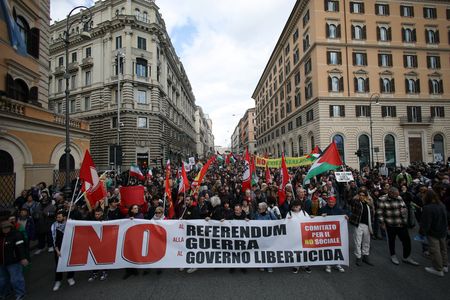

Italian Prime Minister Giorgia Meloni confronts a significant political challenge as citizens prepare to cast ballots in a referendum that could reshape the country’s judicial system and alter the political landscape before next year’s national elections.
The March 22-23 vote centers on whether to divide the roles of judges and prosecutors, creating separate governing bodies for each profession with members selected through a lottery system instead of elections. This would fundamentally restructure Italy’s High Council of the Judiciary, known as the CSM.
What began as a debate over court administration has evolved into a fierce political battle, with Meloni’s administration championing the ‘Yes’ position while opposition parties rally behind ‘No’ votes. Unlike many referendums, this one requires no minimum voter participation to be considered valid.
Political experts believe most citizens will base their decisions on party loyalty rather than understanding the complex legal issues involved, following an intense campaign filled with questionable assertions from both sides.
“Only a small minority of Italians knows much about the issue. Many will look instead to party and coalition leaders, who are all trying to mobilise their voters to win,” explained Fabrizio Masia, who leads the EMG polling organization.
Recent surveys conducted before the mandatory two-week campaign silence showed an extremely tight race, with reform opponents appearing to gain traction as some conservative voters seemed increasingly disengaged.
Meloni has publicly stated she will not step down if voters reject the proposal, a declaration many interpret as strategy to reduce opposition turnout among those hoping to force her from office.
Her governing alliance, which brings together the Brothers of Italy, the League, and Forza Italia parties, maintains stronger overall support than the fragmented left-wing opposition still working to unite the Democratic Party with the 5-Star Movement.
“A ‘no’ win could give fresh momentum to efforts to build a centre-left bloc, also causing trouble within Meloni’s ranks,” Masia noted.
Conversely, approval of the reforms would provide Meloni with crucial political capital as she approaches the final phase of her term while managing challenges from the expanding Middle East conflict and Italy’s sluggish economic performance.
“A government victory would strengthen its longer-term political project, also in view of the 2027 election,” said Emanuele Massetti, who teaches political science at Trento University.
The judicial system has remained contentious in Italian politics since former Prime Minister Silvio Berlusconi, who passed away in 2023, faced numerous legal proceedings related to his business operations and frequently criticized judges for alleged political motivations.
Massetti characterized the referendum as the most recent development in an ongoing clash between conservative politicians and the court system, with public opinion split along ideological lines since Berlusconi’s era.
The campaign has also created tension between Meloni and the magistrates’ union ANM, which argues the changes would undermine judicial autonomy and invite greater political meddling.
Government officials dismiss these concerns, contending the reforms are necessary to eliminate partisan politics from CSM member selection following corruption scandals that revealed secret negotiations over high-level prosecutor positions.
“The reform aims to make the justice system more modern, fair, accountable and independent, free from political pressure and from the factionalism that has damaged its credibility and authority,” Meloni stated in an interview with Il Dubbio newspaper this week.