
For Hillel Neuer, executive director of UN Watch, the challenge facing Israel starts long before any vote is cast or report is published. It begins, he says, with the culture inside the United Nations itself.
“I remind myself every time I walk in the UN that I’m entering a dystopian universe, not unlike 1984, as described by George Orwell, where there’s doublethink and doublespeak, and the truth is often erased and rewritten,” Neuer told The Media Line in Jerusalem.
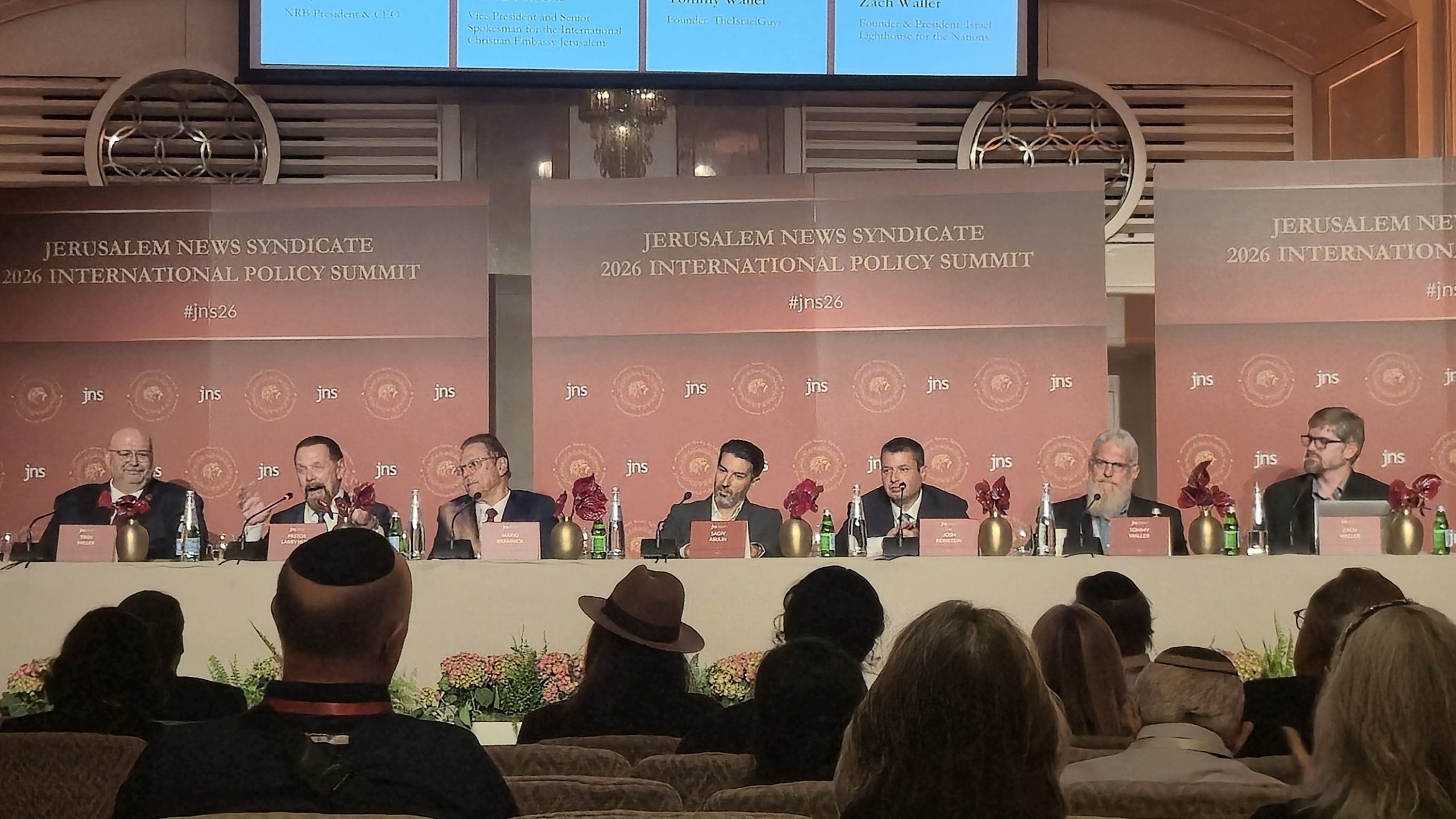
More than two and a half years after the Hamas-led attacks of October 7, 2023, a growing number of Israeli officials, legal advocates, policy researchers, former military figures, and Christian supporters of Israel are describing the country’s diplomatic and legal exposure as a battlefront of its own. At the JNS International Policy Summit held in Jerusalem this week, speakers repeatedly returned to a central theme: Israel’s military struggle is now deeply connected to a parallel contest playing out in the UN, the International Criminal Court (ICC), the International Court of Justice (ICJ), Western university campuses, and social media — all arenas where the language of legitimacy is being fought over.
The concern, as summit speakers framed it, goes beyond simple criticism of Israel. The argument is that international institutions, legal bodies, and public narratives can feed into each other — transforming reports into headlines, headlines into political pressure, and political pressure into court filings, mandates, and boycotts.
Asher Fredman, executive director of the Misgav Institute of National Security, asked what was driving what he described as “this campaign of accusations against Israel, claims against Israel, legal steps against Israel.” His conclusion was direct: “The United Nations is a central engine and catalyst of this campaign,” Fredman told The Media Line. He argued that too many policymakers still view the UN as a venue for symbolic gestures rather than as a system that actively shapes budgets, mandates, commissions, and legitimacy itself.
That analysis forms the foundation of a Misgav Institute report co-authored by Fredman and former Israeli Ambassador to the UN Gilad Erdan, which calls on the United States to move away from attempting to reform the UN and instead adopt a strategy of “Disengage, Withdraw, and Replace.”
Fredman said Washington should stop automatically funding UN operations and instead support only those functions that clearly benefit American interests. He also argued that Israel has made a comparable error by focusing heavily on bilateral relationships while treating UN votes as little more than diplomatic theater. “People don’t understand that the UN is actually really important, because the UN often gets to the very core legitimacy of a country, and that leads to legal proceedings, that leads to boycotts, that leads to blacklists,” he said.
The same concern emerged most sharply during the summit’s legal discussions, where a central strategic question was whether Israel should continue fighting within international institutions or concentrate more energy on challenging those institutions’ authority from the outside. That debate has grown more urgent since the ICC issued arrest warrants in November 2024 for Prime Minister Benjamin Netanyahu and former Defense Minister Yoav Gallant, while Israel has continued to contest the court’s jurisdiction over its actions.
International lawyer Ron Soffer described the ICC as “a strategic threat to the State of Israel” — noting that, unlike UN bodies that issue condemnations, the ICC can pursue actual arrest warrants. Alan Baker, a former Israeli ambassador to Canada who participated in the Rome Statute negotiations, said Israel’s decision to stay out of the court had been the right call. “We didn’t make a mistake,” he said.
Others at the summit argued that Israel and its supporters should stop expecting legal arguments alone to carry the day. “The ICC is not a court, it does not function as a court, and we can have the cleverest legal arguments. It will not help,” said Eugene Kontorovich, professor of law and director of the Center for the Middle East and International Law at George Mason University’s Antonin Scalia Law School. He contended that pressure and sanctions would prove more effective than persuasion.
Not everyone agreed with that position. Yael Vias Gvirsman, founder and CEO of October 7 Justice Without Borders — which represents hundreds of direct victims of the October 7 attacks before courts including the ICC — argued that Israel should not surrender the legal arena to its opponents. The question, she said, is not whether the ICC is inherently good or bad, but “what place we choose to fill in this space.”
That disagreement extended to the International Court of Justice, where South Africa’s genocide case against Israel remains in its written phase. In May 2026, the court set November 22, 2027, as the deadline for South Africa to submit its reply to Israel’s written pleading.
Kontorovich called the South Africa case “a legal October 7th” and warned that because Israel accepted ICJ jurisdiction under the Genocide Convention, the court now has a platform that could be invoked in every future Israeli military conflict. Jonathan Turner, chief executive of UK Lawyers for Israel Charitable Trust, countered that disengagement cannot be the only answer. “We can say, until we’re blue in the face, that its advisory opinions are not binding,” Turner said — but without Israel and its allies presenting facts before the court, the world will never hear the rebuttal.
Vias Gvirsman took the same view on the ICJ, arguing that Israel should use precedent and evidence to challenge South Africa’s case. “If we want to respect ourselves, we have a good case; let’s bring it to the court,” she said.
The debate became most concrete around the United Nations Relief and Works Agency for Palestine Refugees in the Near East, known as UNRWA. In the United States, efforts to hold the agency legally accountable have already hit a wall: a federal district court in New York ruled in 2025 that UNRWA, as a subsidiary organ of the UN, enjoys immunity in American courts and dismissed the case against it. Israel, meanwhile, has separately pursued domestic legislation to strip the agency of that immunity within its own borders.
In that US litigation, Joseph H. Tipograph of Heideman Nudelman and Kalik argued that UNRWA is “not a refugee agency” in the traditional sense because, in his view, it perpetuates refugee status across multiple generations. “If UNRWA is immune, it can do what it wants,” Tipograph said.
A parallel effort has unfolded in Israel. Nitsana Darshan-Leitner, founder of Shurat HaDin, said her organization pushed for legislation removing UNRWA’s immunity in Israel after representing the family of a victim whose body, she said, was transported into Gaza by UNRWA officials using a UNRWA vehicle. When the attorney general later filed a position in court, Darshan-Leitner said, the new Israeli law had already narrowed the space for argument. The attorney general’s position, as Darshan-Leitner described it, was that her “hands are tied” because Israeli law no longer recognizes UNRWA’s immunity in that case.
For Neuer, UNRWA sits at the heart of the broader UN problem. He argued that the agency has evolved into an institution that keeps the conflict alive through education, employment, and a political narrative centered on the right of return. UN Watch reports issued over the past two years allege deep Hamas infiltration of UNRWA staff unions and schools. UNRWA has rejected the broader allegation that it knowingly enables terrorism, saying it acts on neutrality violations when evidence is provided. “If we want to have peace in this region, de-radicalization begins and ends with UNRWA,” Neuer said.
Neuer also addressed the question of the UN’s future leadership. While arguing that the next secretary-general will have limited impact — because what he sees as anti-Israel machinery is embedded in mandates, bureaucratic culture, and member-state politics — he singled out former UN human rights chief Michelle Bachelet for criticism. “She already was the UN Human Rights Chief, and she had a very poor record,” he said, arguing she gave China, Russia, and other authoritarian governments too much latitude. More broadly, he said the UN should operate more like an emergency room performing triage, adding, “We don’t need a UN if all they’re going to do is appease dictatorships. We need someone, we think, to speak out for victims, especially in non-democracies.”
Israeli leaders echoed those themes. Foreign Minister Gideon Sa’ar framed the challenge in diplomatic terms, saying Israel must push back against language that transforms accusations into accepted political categories while simultaneously building new alliances. Referring to a European commissioner who had labeled Israel an apartheid state, Sa’ar said such language could not be treated as routine criticism. “We also, as a country, must draw red lines,” he said. At the same time, he argued Israel cannot devote all of its energy to “blocking initiatives against Israel,” and pointed to new Israeli embassies, efforts to expand the number of embassies located in Jerusalem, and what he described as his ministry’s “Latin America year” in 2026 as examples of proactive diplomacy.
President Isaac Herzog called on Israel to “employ truth to counter the bias, distortions, and double standards spread constantly in the media, online, and across the halls of the United Nations.” Prime Minister Benjamin Netanyahu framed the effort as another dimension of a long war, calling the battle against delegitimization and antisemitism the “Eighth Front” and declaring, “We will fight on the Eighth Front as well.”
US Ambassador to Israel Mike Huckabee delivered his message in the language of faith and history. After outlining President Donald Trump’s stance on Iran, Hezbollah, Hamas, and the Houthis, Huckabee described the US-Israel alliance as rooted in something deeper than modern politics, saying America is tied “more to Mount Sinai than it is to Athens or Rome.”
At a separate Christian-Israel Alliance Forum chaired by Josh Reinstein, president of the Israel Allies Foundation, the focus shifted from courts and UN agencies to faith networks, media outreach, and public advocacy. Troy Miller, president and CEO of the National Religious Broadcasters, said the issue is “not just about a battle that’s anti-Semitic or anti-Zionism,” but part of a broader struggle over Western civilization, Christian persecution, and the values that will shape the international order. “If we end up divided and fighting this separately, we’re going to fail,” he said.
Sagiv Asulin, a former senior Mossad officer and expert on influence operations and strategic perception at the Jerusalem Center for Security and Foreign Affairs, put the challenge in starker terms. Israel, he said, is winning militarily on many fronts but “losing terribly” in the arena of public perception and information warfare. After October 7, he said, he found himself thinking not just about that day but about “the paradigm of October 8th” — how quickly anti-Israel demonstrations and narratives appeared on Western campuses and streets.
The media dimension was addressed directly by Katie Huch, creative director at New Beginnings Church and Larry Huch Ministries, who said younger audiences are being shaped by platforms where anti-Israel content vastly outnumbers pro-Israel content. “Social media is a problem, but it’s also a tool, and we can use it to our advantage,” she said, calling for both digital engagement and efforts to bring young Christians to Israel firsthand.
David Parsons, senior vice president and spokesman for the International Christian Embassy Jerusalem, made the same case through the lens of tourism and public diplomacy. “Christians come and leave as goodwill ambassadors of this country,” he said.
Military and political voices pushed the argument further. Col. Richard Kemp said Israel cannot expect to win the information war when audiences begin from the assumption that Israel is illegitimate. Jonathan Conricus, a former Israel Defense Forces international spokesman, said Israel has invested far too little in the information space. “If you leave a vacuum for your enemy, he will populate it,” Conricus said.
Former Prime Minister Naftali Bennett was perhaps the bluntest voice on the subject. Israel, he said, has allowed its public image in the United States to deteriorate and cannot count indefinitely on the personal goodwill of any single president. “If Israel were a PR firm, I definitely would not hire us,” Bennett said.
Even Neuer, one of the summit’s sharpest critics of the UN, acknowledged that Israel can damage its own cause. While he said UN bias against Israel persists regardless of which government is in power, he specifically called out inflammatory rhetoric by National Security Minister Itamar Ben-Gvir as counterproductive. When Israeli ministers use language that appears to celebrate suffering, he said, “you lose almost all of your friends.”
For Fredman, the path forward involves concrete steps: linking bilateral relationships to multilateral behavior, conditioning UN funding, exposing hostile networks, and dramatically increasing investment in strategic communications. “Israel for years has not only been greatly under-investing in its strategic communications and public diplomacy, but on the level of creating people-to-people ties and cooperation with civil society, it has not received resources,” he said.
For Vias Gvirsman, any strategy must also preserve moral boundaries. In her closing remarks, she described law as a form of power — but power that must reflect “sanctity of life” and “human dignity.” The question, she said, is “how do we fight a battle we cannot lose” without surrendering identity and values in the process.
That tension may well define Israel’s next chapter. Its leaders say the country has shifted the military balance against Iran, Hezbollah, and Hamas. Its lawyers, advocates, and supporters argue that the institutional battle remains far harder to win. In the UN, the ICC, the ICJ, and the broader court of public opinion, Israel is working not only to defeat individual accusations but to prevent those accusations from becoming the standard language through which governments, courts, and media evaluate it.