
Israeli forces conducted an attack on Thursday targeting a structure in the southern outskirts of Lebanon’s capital, marking the first such operation near Beirut in several weeks during an ongoing ceasefire that has not prevented combat between Israeli forces and Hezbollah in southern Lebanon.
Military officials from Israel confirmed they executed a targeted operation in Beirut without providing further specifics.
According to two Israeli security sources, the operation aimed at Ali al-Husseini, identified by them as the leader of the missile unit within the Imam Hussein Division, a group that Israeli authorities claim has ties to Hezbollah and Iran.
Neither Hezbollah nor Iran provided immediate responses regarding the attack. A security source from Lebanon reported that the operation involved two precision-guided missiles directed at a structure in the southern outskirts of Beirut.
The operation further weakened an already deteriorating ceasefire that Washington announced on April 16, designed to end the conflict between Israel and Iran-supported Hezbollah that began on March 2.
Combat between these long-standing adversaries has persisted, primarily focused in southern Lebanon. Except for an attack on Beirut’s southern outskirts in early May that resulted in the death of a Hezbollah commander, the capital and surrounding areas had avoided fresh attacks during the truce period.
According to Israeli officials, military forces had refrained from conducting operations in Beirut for three weeks following requests from the administration of U.S. President Donald Trump. However, Israeli surveillance aircraft continue to operate over Beirut daily.
The two Israeli security sources indicated that Thursday’s operation followed what they termed “very intense dialogue” with the Trump administration over recent days.
Significant Israeli attacks struck communities and villages in southern Lebanon overnight and continuing into Thursday, after Israel designated a new section of the region “a combat zone.”
Israeli military authorities instructed residents to evacuate any communities south of the Zahrani River, located approximately 40 kilometres (25 miles) north of Israel’s border with Lebanon.
Combined with a border area under military occupation, Israel’s evacuation directives over the past three months cover roughly 2,000 square kilometers of Lebanon – approximately one-fifth of the nation’s total area.
An Israeli attack Thursday morning resulted in six deaths, including two children and their parents, near the southern community of Adloun, according to Lebanon’s health ministry.
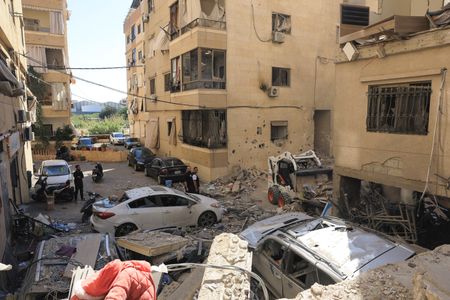
A separate attack on the port city of Sidon claimed five lives, including two women. Sidon sits outside the area marked as a combat zone by Israeli forces, and the attack occurred without advance warning.
Taghrida Ramadan, a resident of Sidon, spoke to Reuters about being awakened from sleep by the strike that hit a building opposite her home.
“We looked around and found the rubble on us – stones from the strike, because it was nearby and directly facing us,” Ramadan said. Though her residence sustained damage, her family members avoided serious harm.
A later Israeli attack on Thursday killed two Syrian citizens, including a child, in the city of Tyre, which sits within the zone Israel ordered evacuated.