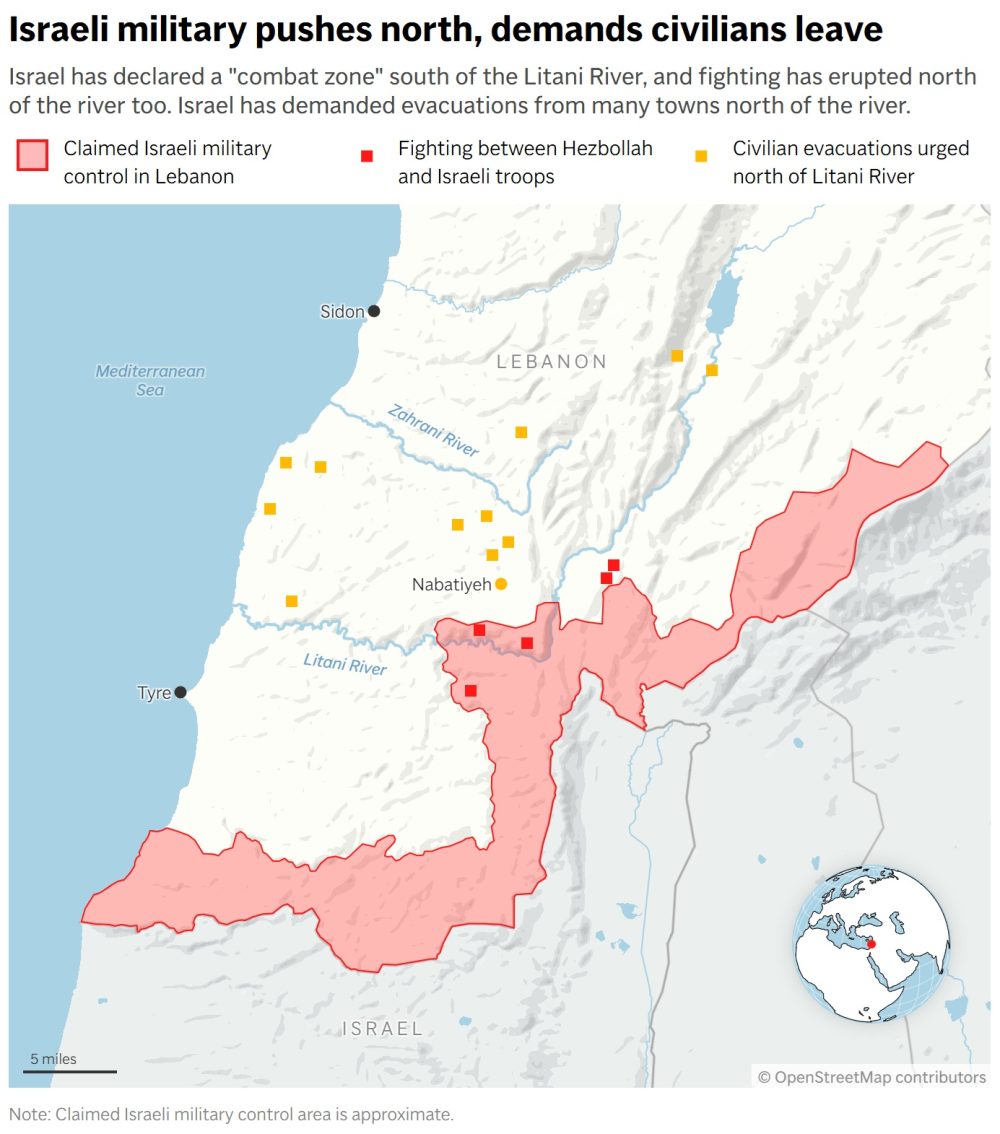

Israeli military forces conducted airstrikes and artillery bombardments near a historic medieval fortress in southern Lebanon on Saturday, as combat continued in communities surrounding the southern city of Nabatieh.
The Israeli military issued evacuation orders for more than twelve communities in southern Lebanon, occurring one day after Lebanese and Israeli military representatives conducted their first face-to-face discussions in decades at the Pentagon.
Lebanon’s president and prime minister met Saturday to address the situation in southern Lebanon, later releasing a statement saying they would increase their diplomatic efforts to halt Israeli destruction and bulldozing of residences and historic locations, as well as the evacuation orders.
According to Lebanon’s state-operated National News Agency, Israeli aircraft and artillery targeted areas surrounding the medieval Beaufort fortress, located approximately 15 kilometers from the Israeli border with commanding views over much of southern Lebanon. Israeli forces occupied this strategic fortress for 18 years before withdrawing from Lebanon in May 2000.
For several days, Israeli ground forces have been moving through communities near the fortress, including Yohmor and Zawtar al-Sharqieh close to Nabatieh, after crossing the strategic Litani River, which Israeli military has treated as an informal border.
Extensive territories to the south remain under Israeli military occupation, despite a U.S.-mediated ceasefire agreement from April 17.
The National News Agency documented airstrikes across various sections of southern Lebanon, including the village of Ansar where three people were killed. A drone attack on a roadway connecting Ebba village with Nabatieh injured two Lebanese soldiers, according to an army statement.
Hezbollah reported that its fighters launched rockets at Kiryat Shmona, northern Israel’s largest city on the Lebanese border. The organization stated the attack was retaliation for airstrikes that killed civilians in Lebanon. Hezbollah subsequently announced it also fired rockets toward the northern city of Safed.
Among Friday’s casualties in southern Lebanon was a Syrian family — Qais al-Bakir, his pregnant wife and their six children — who perished in an Israeli airstrike on the coastal village of Adloun, north of Tyre.
The family, members of Syria’s minority Alawite sect, had escaped to Lebanon from the central province of Hama following Bashar Assad’s fall in Syria in December 2024. Some Alawite sect members have faced revenge attacks from Islamist groups that ousted the former president.
The family was residing at a sheep farm and received no advance warning of the village strike, according to Ali al-Bakir, brother of the deceased man. He said the family intends to transport the bodies for burial in their Syrian hometown.
“He worked in farming and all he cared about was to feed his children,” his brother said.
The current Israel-Hezbollah conflict began March 2, when Hezbollah launched rockets into northern Israel two days following Israeli and U.S. attacks on Iran.
The war has resulted in 3,350 deaths in Lebanon and displaced over 1 million people.
In the Gaza Strip, a Palestinian nurse died in an Israeli strike Saturday, hospital officials reported, marking the latest death from Israeli fire since an unstable ceasefire stopped major combat in the territory last year.
The late Saturday morning strike targeted a Hamas-operated police checkpoint in the central city of Deir al-Balah. At least three others sustained injuries, according to the city’s Al-Aqsa Martyrs hospital, which treated the victims.
Israeli military representatives did not immediately respond to requests for comment.
The deceased nurse was identified as Jamal Abu Aoun, who was employed at Yafa Hospital in Deir al-Balah. His funeral took place at noon in the Al-Aqsa Martyrs hospital courtyard.
He represents the most recent Palestinian fatality in the coastal territory since a fragile October ceasefire agreement sought to end a more than two-year conflict between Israel and Hamas in Gaza.
Although major fighting has decreased, the unstable ceasefire has witnessed nearly daily Israeli fire. Israeli forces have conducted repeated airstrikes and regularly fire on Palestinians near military-controlled areas, killing at least 929 Palestinians, according to Gaza’s health ministry.
The ministry, operating under the Hamas-led government, keeps detailed casualty documentation considered generally reliable by United Nations agencies and independent experts. However, it does not provide breakdowns between civilians and militants.
Militants have conducted shooting attacks on troops, and Israel claims its strikes respond to those and other violations. Four Israeli soldiers have died since the ceasefire.