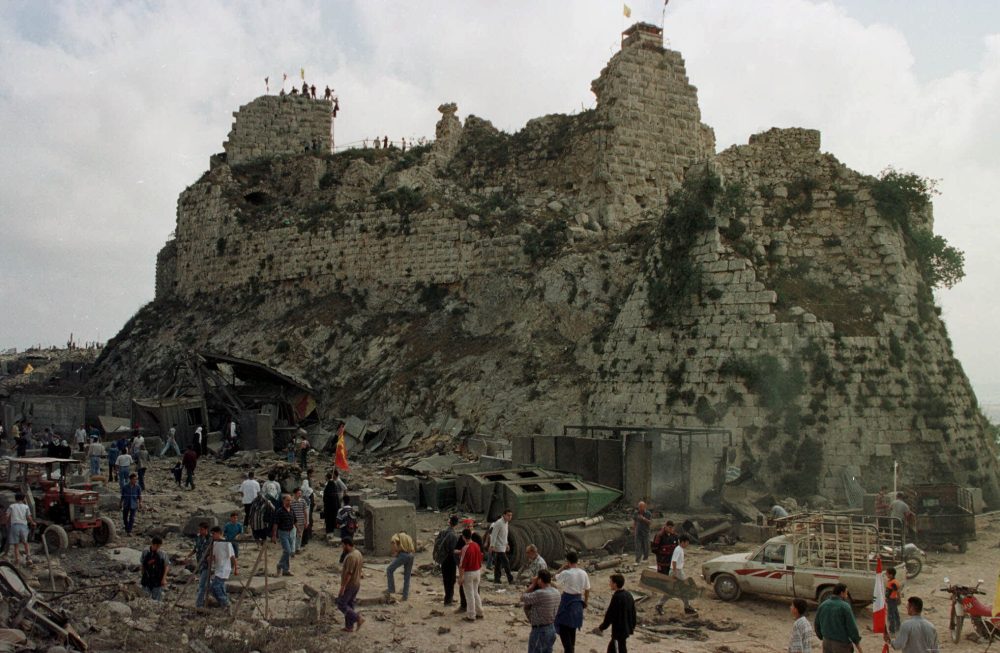

Israeli military forces have seized control of a historic mountaintop fortress in southern Lebanon, representing their most significant penetration into the nation in more than 26 years, according to military officials who announced the development Sunday.
The takeover of Beaufort castle, located close to Nabatiyeh city, followed several days of aerial bombardments and fierce combat in surrounding communities where Israeli forces engaged Hezbollah fighters across the challenging terrain.
This fortress seizure represents a significant milestone in the ongoing Israel-Hezbollah conflict, which started March 2 when Hezbollah launched rockets toward northern Israel just two days following U.S. and Israeli strikes against Iran, Hezbollah’s primary supporter.
Since then, Israel has initiated ground operations, taking control of numerous Lebanese communities and settlements near the border. Hezbollah has responded by firing thousands of rockets and unmanned aircraft at Israeli forces in southern Lebanon and northern Israel.
The Israeli advance occurred even with a temporary ceasefire established since April 17 and just before upcoming direct negotiations scheduled for June 2 and 3 at the State Department between Lebanon and Israel.
Avichay Adraee, the Israeli military’s Arabic spokesperson, shared an image on X displaying Israeli soldiers walking near the fortress, while Defense Minister Israel Katz announced on X that forces had planted an Israeli flag above the castle. Israeli forces previously took the castle in 1982 and maintained control until their Lebanon withdrawal in 2000.
The Beaufort stronghold, positioned high above Lebanon’s verdant hills and commanding views of the Litani River, has served as a crucial military position for numerous forces across nearly 1,000 years.
Constructed as a Crusader fortress around the 12th century atop earlier defensive structures, it has housed the Crusaders, Saladin’s Jerusalem army, Mamlukes, Ottomans, the French mandate, the Palestinian Liberation Organization and the Israeli military until 2000, when it underwent partial restoration and welcomed tourists. The Crusaders called it Beaufort, meaning “beautiful fortress” in Old French.
The 1982 seizure of the castle from the Palestine Liberation Organization represented a significant triumph for the Israeli military under Defense Minister Ariel Sharon’s leadership, who subsequently became the nation’s prime minister. During that period, the Israeli army advanced northward and took control of Beirut.
Throughout the earlier Israel-Hezbollah conflict in 2024, UNESCO provided enhanced protection to 34 cultural locations in Lebanon, including Beaufort Castle, to protect it from harm.
The fortress sits several kilometers north of the Israel border and provides commanding views of extensive areas of southern Lebanon and northern Israel. In Arabic, it’s known as Al-Shaqif castle, derived from an ancient Syriac term describing the imposing rocky terrain.
Israeli military officials stated they began an operation several days earlier in the Beaufort Ridge and Suluki valley areas to the south, aiming to eliminate Hezbollah infrastructure and remove immediate threats to Israeli citizens.
The military announcement indicated forces are prepared “to expand the operation if needed.”
Beaufort holds symbolic significance throughout the region, particularly in Israel, where it became one of the most recognized locations under Israeli control during the 18-year occupation. A prominent Israeli war film titled “Beaufort” examines moral dilemmas and the pointlessness of conflict during the final period before military withdrawal.
Recently, Israel has broadened its Lebanese operations, deploying forces beyond the Litani River, which previously functioned as an unofficial border, while ordering residents to evacuate large portions of southern Lebanon.
Israel has declared the region from the Litani to the Zahrani River a military combat zone. While some inhabitants have departed due to recent intensive strikes, many people continue living in area towns.
Israeli forces have been moving forward for days through villages surrounding Beaufort castle. They now stand approximately 5 kilometers (3 miles) from Nabatiyeh city, a significant southern Lebanon hub, and have ordered all residents to evacuate, along with inhabitants of the coastal city of Tyre, the nation’s fourth-largest city, and nearby areas.
Neither Hezbollah nor the Lebanese government provided immediate responses regarding the Israeli advancement.
Hezbollah claimed responsibility for two overnight attacks against Israeli forces and a Merkava tank in Bayada, a southwestern border town. Recently, the organization has reported fighting Israeli troops in multiple towns north of the river near Nabatiyeh and the strategic fortress.
Lebanon’s state-operated National News Agency documented airstrikes across various southern Lebanese villages, reporting casualties without providing detailed numbers. On Saturday, Hezbollah launched multiple rocket volleys into northern Israel, targeting Kiryat Shmona, the region’s largest city.
Hezbollah’s deployment of difficult-to-detect fiber optic drones has proven lethal against Israeli military forces, who face challenges responding effectively. Israeli military data shows nearly 200 civilian alerts across northern Israel warning of drones and missiles within the last 24 hours.
The current fighting between Israel and Hezbollah has resulted in 3,350 Lebanese deaths and displaced over 1 million people.
Israeli Prime Minister Benjamin Netanyahu’s office reports at least 25 Israeli soldiers and one defense contractor have died in or near southern Lebanon, including one fatality on Saturday. Two civilians have also been killed in northern Israel.