
BEIRUT — Lebanese health officials report dozens killed and hundreds injured after Israeli military forces launched extensive airstrikes across central Beirut Wednesday afternoon, targeting crowded business districts and residential neighborhoods without advance notice. The bombardment came just hours following the announcement of a ceasefire agreement between the United States, Israel and Iran.
Israeli officials maintain the truce arrangement excludes their ongoing conflict with the Iran-supported militant organization Hezbollah operating in Lebanon, though Pakistani mediators assert the agreement covers all hostilities.
According to Israeli military officials, the operation represented their most extensive coordinated assault during the current conflict, with forces targeting over 100 Hezbollah positions across Beirut, southern Lebanon and the eastern Bekaa valley within a 10-minute timeframe.
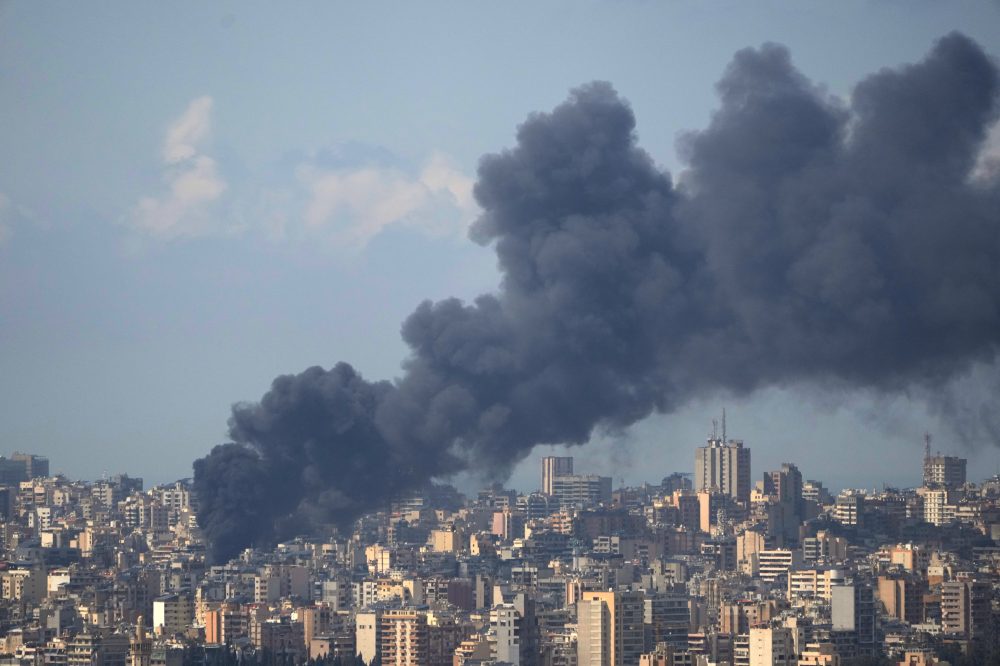
Dark plumes of smoke rose above multiple sections of the Mediterranean coastal capital. The sound of explosions cut through the noise of traffic during what had been a busy afternoon under clear skies. Emergency vehicles rushed toward burning sites as apartment complexes sustained damage and rescue workers examined destroyed cars.
Multiple airstrikes targeted crowded business districts, creating widespread fear among people in the streets. Lebanon’s National News Agency documented attacks across at least five separate neighborhoods throughout central and coastal sections of Beirut.
In an Associated Press interview, Lebanon’s Minister of Social Affairs Haneed Sayed criticized Israel’s extensive bombing campaign, describing it as a “very dangerous turning point.”
“These hits are now at the heart of Beirut … Half of the sheltered (internally displaced persons) are in Beirut in this area,” she explained, noting she had recently driven through the affected zones.
Sayed indicated Lebanon’s government stands prepared to begin discussions with Israel aimed at ending the violence, reiterating an offer previously extended by the president. Israeli officials have not provided a response.
“There are calls and efforts being made as we speak,” Sayed stated.
In a public statement, Prime Minister Nawaf Salam criticized Israel for intensifying attacks precisely when Lebanese leaders were attempting to negotiate a peaceful resolution, condemning strikes on civilian locations showing “utter disregard for the principles of international law and international humanitarian law — principles it has, in any case, never respected.”
Israeli military representatives claimed they focused on missile launching sites, command headquarters and intelligence facilities while charging Hezbollah with using civilians as protective cover.
“The State of Lebanon and its civilians must refuse Hezbollah’s entrenchment in civilian areas and its weapons build-up capabilities,” military officials declared.
Local residents and municipal leaders disputed claims that targeted buildings served military purposes.
“Look at these crimes,” stated Mohammed Balouza, a Beirut municipal council member, speaking from a strike location in the central Corniche al Mazraa district, an area mixing commercial and residential properties. An apartment complex behind a well-known shop selling nuts and dried fruit had been damaged. “This is a residential area. There is nothing (military) here.”
Israeli forces had infrequently targeted central Beirut areas since the current Israel-Hezbollah conflict began March 2, typically focusing strikes on southern and eastern Lebanon along with Beirut’s southern suburbs.
Prior to the latest wave of attacks, a Hezbollah representative informed the AP that the organization was allowing mediators time to negotiate a Lebanese ceasefire, but “we have not announced our adherence to the ceasefire since the Israelis are not adhering to it.” The official requested anonymity due to lack of authorization for public statements.
The Hezbollah representative indicated the group would reject returning to pre-March 2 conditions, when Israel conducted almost daily Lebanese strikes despite a nominal ceasefire remaining from the previous major Israel-Hezbollah war that concluded in November 2024.
“We will not accept for the Israelis to continue behaving as they did before this war with regards to attacks,” he explained. “We do not want this phase to continue.”
Hezbollah had launched cross-border missiles days following U.S. and Israeli attacks on Iran, igniting a regional conflict. Israel responded with extensive Lebanese bombardment and ground invasion operations.
Israeli military leadership announced Wednesday they would continue to “utilize every operational opportunity” for Hezbollah strikes. Lt Gen. Eyal Zamir stated the goal involves protecting Israel’s northern residents, who have experienced heavy fire.
Israeli bombing campaigns have resulted in over 1,530 Lebanese deaths, including more than 100 women and 130 children. Israeli military officials report killing hundreds of Hezbollah fighters. More than one million Lebanese people have been displaced.
Early Wednesday, following the Iran ceasefire announcement, many displaced individuals sleeping in street tents throughout Beirut and the coastal city of Sidon began gathering belongings to prepare for home returns.
This occurred before Israeli Prime Minister Benjamin Netanyahu pledged continued military operations in Lebanon.
At an extensive displacement facility along Beirut’s waterfront, families confused by contradictory statements expressed bewilderment and hopelessness.
“We can’t take this anymore, sleeping in a tent, not showering, the uncertainty,” said Fadi Zaydan, 35. He and his parents had prepared to return to the southern city of Nabatieh before Netanyahu’s remarks halted their plans.
“But we’ll be targeted if we go home,” Zaydan explained. His family chose to temporarily remain in Sidon, somewhat closer to their home.