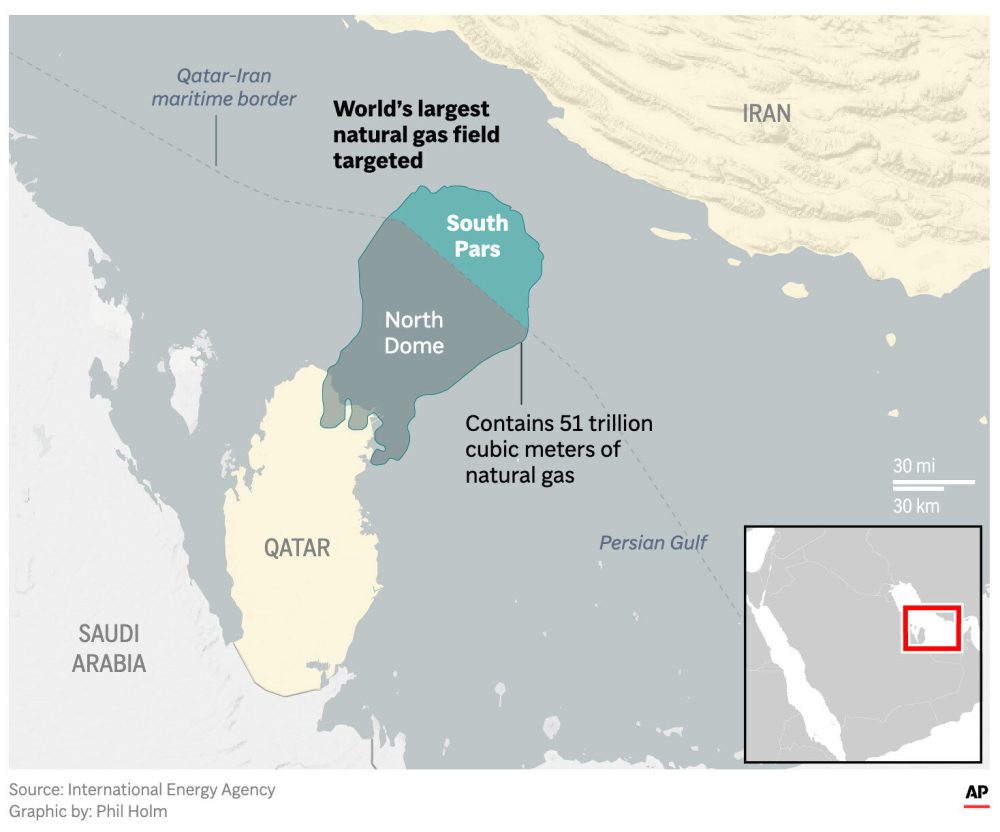

FRANKFURT, Germany (AP) — Israeli forces have launched their second assault on Iran’s South Pars natural gas facility and its connected petrochemical operations — a crucial energy infrastructure that powers Iranian homes while generating significant export revenue.
On Monday, Israel’s defense minister confirmed that Israeli forces struck a major petrochemical facility at Asaluyeh, the land-based industrial component of the gas field located beneath the Persian Gulf waters.
Defense Minister Katz described the “powerful strike” as targeting what he termed “the largest petrochemical facility in Iran … responsible for about 50% of the country’s petrochemical production.”
Such strikes against South Pars carry significant consequences, as demonstrated when Israel’s previous March 18 assault led Iran to retaliate against energy infrastructure throughout other Middle Eastern nations, escalating regional tensions and creating widespread concern.
Following the March incident, U.S. President Donald Trump stated that Israel would refrain from future South Pars attacks, though he warned via social media that continued Iranian strikes on Qatar’s energy infrastructure would prompt American retaliation to “massively blow up the entirety” of the facility.
The South Pars natural gas field represents Iran’s primary domestic energy source in a nation that frequently faces electricity generation challenges. This underwater gas field — the world’s largest — spans both Iranian and Qatari territories, known as South Pars on Iran’s side and the North Field on Qatar’s side.
Natural gas plays a vital role in Iranian society, powering electricity generation and home heating systems. Iran ranks as the world’s fourth-largest natural gas consumer, trailing only the United States, China, and Russia, according to Columbia University’s Center on Global Energy Policy, despite having a significantly smaller economy. Unlike other Middle Eastern nations, Iran depends heavily on gas heating due to its colder climate, with much of this usage receiving government subsidies that discourage conservation efforts.
Beyond domestic energy needs, the petrochemical facility generates crucial export income. The extracted gas produces essential chemical components including ethylene, propylene, methanol, ammonia, and urea, which manufacturers use to create plastic pipes, packaging materials, textiles, household items, and fertilizers. Major importing nations include Turkey, China, India, and various Southeast Asian countries, according to Iranian mining and petrochemical export company Irminex. Iran’s petrochemical sector maintains competitive advantages through reduced raw material costs thanks to direct South Pars gas access.
Israeli Prime Minister Benjamin Netanyahu claims these revenues support Iran’s paramilitary Islamic Revolutionary Guards Corps. “Today we destroyed the largest petrochemical plant in Iran,” Netanyahu stated. “In other words, we are systematically destroying the money machine of the Revolutionary Guards.”
Despite possessing substantial energy reserves on paper, Iran has experienced power shortages due to gas supply disruptions. Last July, public facilities were forced to close during a heat wave that overwhelmed the electrical grid.
Therefore, South Pars attacks potentially threaten both civilian welfare and export earnings simultaneously.
Qatar, with its 3 million residents, has invested billions developing the field for liquefied natural gas production, previously exporting from its Ras Laffan facility before wartime shutdowns. This profitable operation made Qatar responsible for approximately one-fifth of global LNG supplies before conflict forced Ras Laffan’s closure.
Iran’s situation differs dramatically with its 93 million population. International sanctions and insufficient investment have prevented LNG export terminal development. Instead, Iran channels its gas through domestic pipeline networks for cooking, home heating, electricity generation, and industrial raw materials. Iran exports relatively modest amounts — roughly 9 billion cubic meters — compared to Qatar’s previous 120 billion cubic meters.
Consequently, South Pars petrochemical operations provide Iran with alternative methods to monetize its vast gas reserves.
Iran previously planned three Persian Gulf coastline LNG export projects, including partnerships with Total Energies and Shell. However, nuclear program sanctions have blocked these initiatives by preventing necessary technology imports and investment. A third Asaluyeh site reportedly nears completion after nearly two decades of construction.