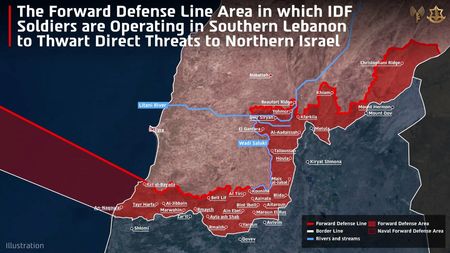

Israel’s military has unveiled a map for the first time showing its deployment positions within Lebanese territory on Sunday, placing numerous largely deserted Lebanese communities under Israeli control following the implementation of a ceasefire agreement with Hezbollah.
Lebanese officials and the Iran-supported Hezbollah organization have not yet responded to the map’s release. The ceasefire agreement between Israel and Lebanon, which had U.S. backing, was finalized on Thursday to halt hostilities between Israeli forces and Hezbollah.
The agreement resulted from the first face-to-face negotiations in decades between the two nations on April 14, designed to facilitate wider diplomatic discussions between the United States and Iran while allowing Israeli troops to maintain their positions within southern Lebanese territory.
The deployment boundary shown on the map extends from east to west, penetrating 5-10 kilometers into Lebanese land from the border, where Israeli officials have indicated plans to establish what they term a buffer zone.
Israeli troops have demolished Lebanese communities in this region, stating their objective is safeguarding northern Israeli settlements from Hezbollah assaults. Similar buffer zones have been created by Israel in Syria and Gaza, where it maintains control over more than half of that territory.
“Five divisions, alongside Israeli Navy forces, are operating simultaneously south of the forward defence line in southern Lebanon in order to dismantle Hezbollah terror infrastructure sites and to prevent direct threats to communities in northern Israel,” the military said in a statement accompanying the map.
When questioned about whether displaced residents who fled Israeli bombardments would be permitted to return home, military officials refused to provide comment.
Some Lebanese civilians have gained access to certain villages located on or beyond Israel’s established boundary, though Israeli forces continue blocking most people from reaching areas south of that line, according to a Lebanese security official.
Israeli Defense Minister Israel Katz stated on Sunday that border residences used by Hezbollah would face demolition and that “any structure threatening our soldiers and any road suspected of (being planted with) explosives must be immediately destroyed”.
Lebanon became involved in the conflict on March 2 when Hezbollah launched attacks supporting Tehran, triggering an Israeli military campaign that Lebanese officials report has resulted in over 2,100 deaths, including 177 children, while displacing more than 1.2 million people.
Hezbollah has not released its casualty numbers. Sources connected to the organization indicate at least 400 of its fighters had been killed by late March.
The group has launched hundreds of rockets and drones toward Israel. These attacks resulted in two Israeli civilian deaths while 15 Israeli soldiers have been killed in Lebanon since March 2, according to Israeli reports.