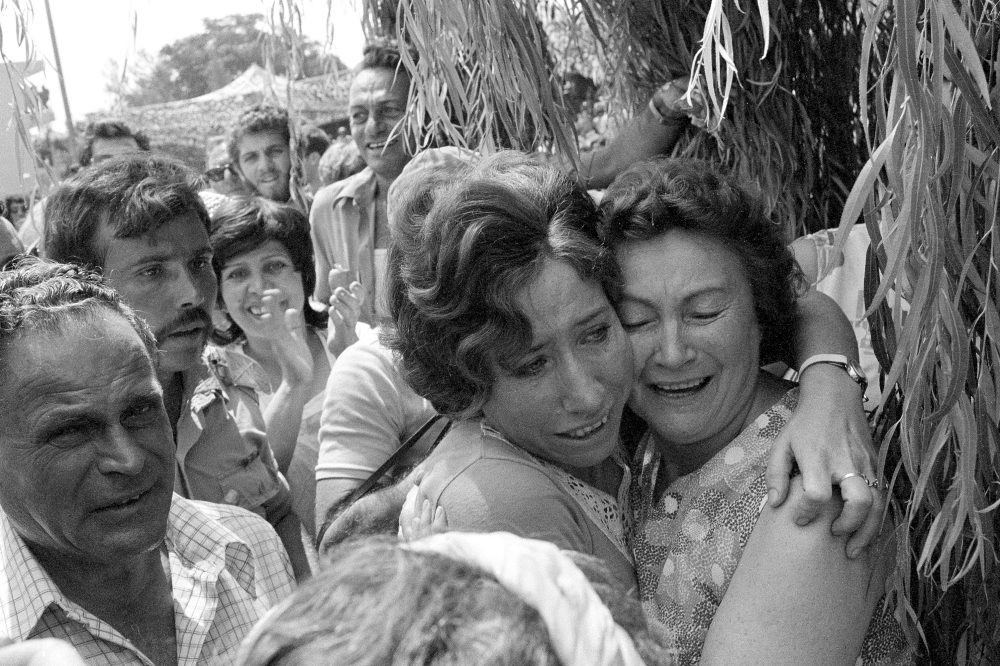

JERUSALEM — Israel has declassified a large collection of previously secret government documents offering a detailed look at the decision-making process behind one of history’s most celebrated hostage rescue missions — the 1976 raid on Entebbe Airport in Uganda.
The operation involved dozens of Israeli commandos who stormed the airport where Palestinian and German militants, supported by Ugandan forces, were holding 106 passengers from a hijacked Air France flight that had originated in Tel Aviv and was bound for Paris. The entire rescue was completed in under an hour, with few casualties among the soldiers and hostages — the majority of whom were Israeli or Jewish — cementing its place as one of the most daring military operations ever carried out.
The documents were made public ahead of the raid’s 50th anniversary on July 3, and come at a time when Israel continues to deal with the fallout from the hostage situation that began after Hamas-led militants attacked the country on October 7, 2023. That attack claimed roughly 1,200 lives and resulted in 251 people being taken to Gaza as hostages.
The newly released files add depth to what was already known about the crisis team assembled by then-Prime Minister Yitzhak Rabin and reveal how Israeli officials wrestled with the choice between negotiating with the hostage-takers and launching a high-risk long-distance military strike requiring commandos to fly thousands of miles over multiple unfriendly nations.
At first, Rabin’s team took a firm stance against any negotiations with the two groups responsible for the hijacking — the Popular Front for the Liberation of Palestine and West Germany’s Revolutionäre Zellen. The hijackers had seized the Air France aircraft when it made a stopover in Athens, and demanded the release of prisoners held in several countries. They also threatened to begin killing hostages if their deadline passed without results.
However, as the standoff stretched across six days and pressure from hostages’ families intensified, Israeli officials gradually softened their position on talks, according to a summary provided by the Israel State Archives.
One internal memo from Rabin’s crisis team captured the urgency of the moment: “The zero hour is approaching … We believe that a supreme effort must be made and break the ultimatum,” the team wrote, giving the go-ahead to negotiate on certain terms.
While the Entebbe raid has long been viewed as a turning point in which Israel chose military force over diplomacy, the newly released files paint a more nuanced picture. Officials only moved toward a military solution after diplomatic efforts hit a dead end and confidence in the planned operation increased.
The documents show Israel pursued a dual strategy — supporting France-led negotiations with Ugandan President Idi Amin while simultaneously constructing scale models of the airport and preparing transport aircraft to fly to Kenya and then on to Uganda for a nighttime assault.
When the commandos struck, they rescued all but three hostages who were killed in the crossfire. Every hijacker and dozens of Ugandan soldiers were killed in the battle. The sole Israeli commando lost in the operation was Yonatan Netanyahu, the older brother of future Prime Minister Benjamin Netanyahu.
The raid drew sharp condemnation from Idi Amin and the Organization of African Unity — the predecessor to today’s African Union — who argued that Israel had violated Uganda’s sovereignty at a time when Uganda claimed to be actively working toward a peaceful resolution.
For Israel, the mission was widely regarded as a triumph, particularly coming just four years after all nine Israeli athletes taken hostage at the 1972 Summer Olympics in Munich died during a German-led rescue attempt. Even so, Israeli leadership recognized that military victories alone could not resolve the broader conflict.
Rabin himself reflected on this in one of the memos made public Friday. “Let us not deceive ourselves,” he wrote. “It was an extraordinary operation and achievement. However, the problem is not over. Terrorism continues to operate. What other problems terrorism will pose to us and what lessons we must learn from this matter, it is too early to say. We have finished one battle, but the war continues.”