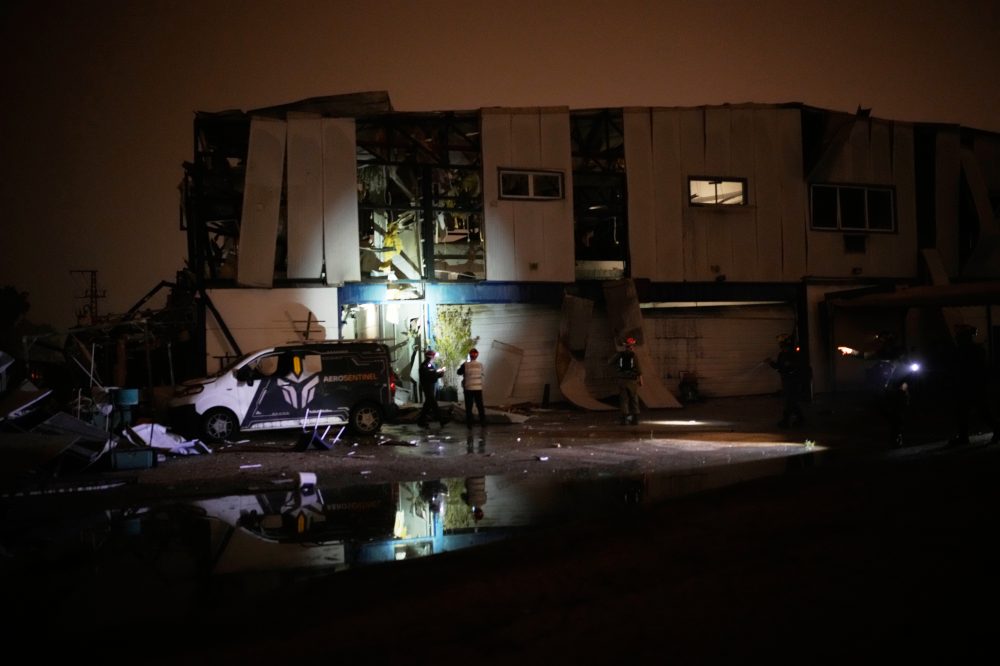

Drone attacks launched by Iran caused multiple fires to break out at Kuwait’s Mina al-Ahmadi oil refinery on Friday, according to officials.
Kuwait Petroleum Corp., the state-owned company, confirmed the assault in an official statement and reported that emergency crews were actively battling the resulting flames.
No casualties occurred during the incident, according to the corporation.
The Mina al-Ahmadi facility is one of three oil refineries that Kuwait operates and has been targeted several times during the ongoing conflict.
These processing facilities play a crucial role in Kuwait’s petroleum industry since crude oil wells must cease operations without functioning refineries to process their output.
The process of bringing refineries back online after attacks requires extensive time due to safety protocols, leaving oil wells inactive until the facilities resume operations.
The assault occurred as Iran launched attacks on multiple targets throughout the Middle East region while facing retaliatory strikes from American and Israeli forces early Friday. The conflict has now entered its fifth week with no signs of slowing.
Both Bahrain and Kuwait experienced early morning bombardments from Iranian forces, while Israel issued alerts about incoming missile threats, despite U.S. and Israeli assertions that Iran’s military infrastructure has been severely damaged.
Iran’s ongoing assault on regional energy facilities and its control over the Strait of Hormuz—a vital shipping lane for 20% of global oil and natural gas during peacetime—has caused petroleum prices to surge dramatically, affecting economies worldwide.
Brent crude oil, the global benchmark, reached approximately $109 per barrel early Friday, representing a more than 50% increase since February 28 when the conflict began with U.S. and Israeli strikes on Iran.
President Donald Trump has stated that reopening the blocked waterway is not America’s obligation, instead challenging other nations dependent on fuel shipments through Hormuz to “build some delayed courage” and “take it.”
The U.N. Security Council is scheduled to consider a Bahraini proposal on Saturday that would permit defensive measures to protect ships navigating the strait. The original draft would have authorized countries to “use all necessary means” to secure the passage, but Russia, China, and France—all possessing veto authority—have opposed authorizing military force.
French President Emmanuel Macron, speaking Thursday in South Korea, dismissed American expectations that the Strait of Hormuz could be reopened through military action as unrealistic.
“A military operation would take an infinite amount of time and would expose anyone passing through the strait to coastal threats from (Iran’s) Revolutionary Guard,” Macron stated. He emphasized that reopening the strait “can only be done in coordination with Iran,” through diplomatic negotiations following a potential ceasefire.
British-organized discussions involving more than 40 nations have emphasized diplomatic rather than military solutions for securing the strait. These countries, excluding the United States, have called for increased diplomatic pressure on Iran and potential economic sanctions.
The conflict has claimed more than 1,900 lives in Iran and 19 in Israel. Over two dozen people have perished in Gulf nations and the occupied West Bank, while 13 American military personnel have been killed.
In Lebanon, where Israel has launched a ground offensive against the pro-Iranian Hezbollah organization, more than 1,300 people have died and over one million have been displaced. Ten Israeli soldiers have also lost their lives in that theater.