
Conflicting messages emerged this week regarding U.S.-Iran relations, with a high-ranking Iranian military official declaring that armed conflict with America cannot be avoided while President Donald Trump maintained optimism about reaching a diplomatic solution in the coming days.
Mohammad Jafar Asadi, who serves as deputy head of Iran’s central military command known as Khatam al-Anbiya, dismissed any possibility that his country would comply with American demands, according to reports from Iranian state television.
“The United States demands our total surrender, and the Iranian nation will never surrender,” Asadi stated. “Without surrender, war is inevitable.”
These comments stand in stark contrast to President Trump’s optimistic outlook regarding ongoing diplomatic discussions.
During a Monday telephone conversation with ABC, President Trump predicted that a peace deal with Iran could be finalized “over the next week.” He emphasized that reaching an agreement through negotiations would be more desirable than pursuing military action.
“It’s not an easy thing for them. It’s actually not easy from our standpoint either. But we’re getting what we need to get,” President Trump explained.
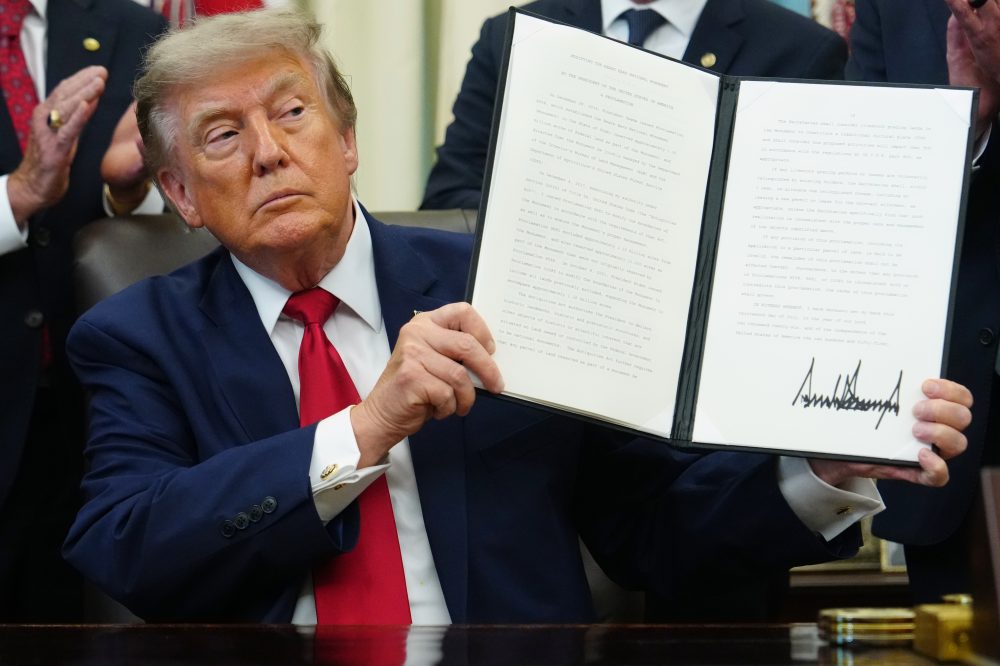
The president noted that while he had previously suggested on May 24 that a memorandum of understanding was close to completion, he has not yet signed off on the document because “I still have to get a few more points.”
These divergent positions emerged as hostilities persist between Washington and Tehran in the strategically important Strait of Hormuz region.
Iran’s Revolutionary Guard announced Monday that it had fired a cruise missile at the MSC Sariska V, describing the targeted ship as having connections to both the United States and Israel. The organization claimed this attack served as payback for an American strike against the Iranian commercial vessel Lian Star in the Gulf of Oman. Maritime officials from Britain reported that the MSC Sariska V suffered damage from a major explosion in waters near Iraq.
This latest incident occurred as military confrontations between Iran and the United States have intensified around the crucial shipping corridor. Both nations have conducted military operations in recent days, with disagreements centered on control of the Strait of Hormuz, a waterway that handles 20% of global oil and gas transportation.