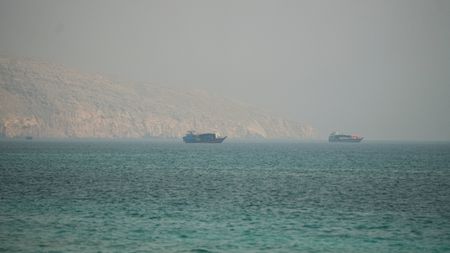

Iran announced Sunday that it has closed the Strait of Hormuz following an incident in which a vessel traveling an unauthorized route was struck and stopped, with Iranian authorities warning that any act of aggression in response would trigger a “severe” counteraction.
The Navy of Iran’s Islamic Revolutionary Guard Corps released a statement saying a ship that had “jeopardized maritime security by switching off its systems was struck and brought to a halt,” though no details were provided identifying the vessel.
According to the IRGC, multiple ships attempted to pass through the waterway along an “unauthorised route” and ignored repeated warnings to change course. The strait, Iran declared, would remain closed “until further notice” and until “the end of U.S. interference in this region.”
The IRGC Navy added that acts of aggression against Iran “will be met with a severe response, and new enemy bases in the region will be targeted.”
Senior U.S. officials told reporters on Friday that Washington is demanding Iran publicly commit to halting attacks on ships in the strait and guarantee that all shipping lanes remain open with no fees charged to vessels passing through.
U.S. President Donald Trump stated Friday that the U.S. and Iran had agreed to keep diplomatic talks going despite a spike in hostilities earlier in the week — though he also declared the ceasefire officially over.
A senior Iranian source informed Reuters that Iran, the U.S., Qatar, and Pakistan had agreed to engage in negotiations through a call that mediators were working to set up for Saturday, while Iran’s Foreign Minister Abbas Araqchi was in Oman.
Whether those efforts succeeded was not immediately known. Araqchi and Omani Foreign Minister Sayyid Badr Albusaidi met in Oman to discuss, in the words of an Iranian foreign ministry statement, “appropriate mechanisms for the safe passage of ships through the Strait of Hormuz.” Oman’s state news agency later reported that negotiators from both countries would press forward with discussions “at the technical and political levels.”
Oman is serving as a mediator in a broader conflict that has rattled the Gulf region and driven up prices worldwide since the U.S. and Israel launched airstrikes on Iran on February 28. Before the war began, roughly one-fifth of the world’s oil supply moved through the Strait of Hormuz. Iran’s effective blockade of the waterway has sent energy prices soaring, contributing to global inflation.
CNN reported Saturday that Oman had put forward a draft proposal for managing traffic through the strait, which would allow free navigation through Oman’s southern corridor in its own territorial waters. Under the plan, ships traveling through the northern corridor in Iranian territorial waters would need to obtain advance approval from Iran, though no tolls would be required. The White House and State Department did not immediately respond to requests for comment on that report.
Earlier in the week, three Qatari and Saudi commercial tankers came under fire, which prompted the U.S. to strike Iranian targets. Iran then responded with its own strikes against U.S. military sites in Gulf states.
Araqchi blamed the United States for breaking the ceasefire agreement. The U.S. revoked a license permitting the sale of Iranian crude oil on Tuesday, following the tanker attacks. “There can only be mutual compliance,” Araqchi wrote on X on Friday.
While Iran has not officially claimed responsibility for the ship attacks, analysts say Tehran uses such incidents as leverage during negotiations.
The renewed hostilities cast fresh uncertainty over an interim agreement meant to end the conflict and pushed oil prices higher — a politically sensitive development for Trump with November congressional elections approaching.
“The Islamic Republic of Iran has asked us to continue ‘talks.’ We have agreed to do so, but the United States has stated to them, in no uncertain terms, that the Cease Fire is OVER!” Trump wrote on his Truth Social platform Friday.
Iran’s new supreme leader, Ayatollah Mojtaba Khamenei, issued a written statement Saturday vowing vengeance for the death of his father and predecessor, who was killed on February 28. The statement was released in connection with funeral ceremonies held Thursday for former leader Ayatollah Ali Khamenei — ceremonies the new leader did not attend. “We pledge to avenge the blood of the martyred leader and all the martyrs,” the message read.
Trump posted Friday that he had directed the U.S. military to be ready to fire thousands of missiles at Iran if Tehran moved to assassinate him. The Wall Street Journal and other American outlets reported this week that Israel had shared intelligence with Washington indicating Iran had recently developed a plan to kill Trump.
At Thursday’s funeral ceremonies, large crowds filled a courtyard, with some mourners carrying banners bearing the words “We Will Kill Trump.”