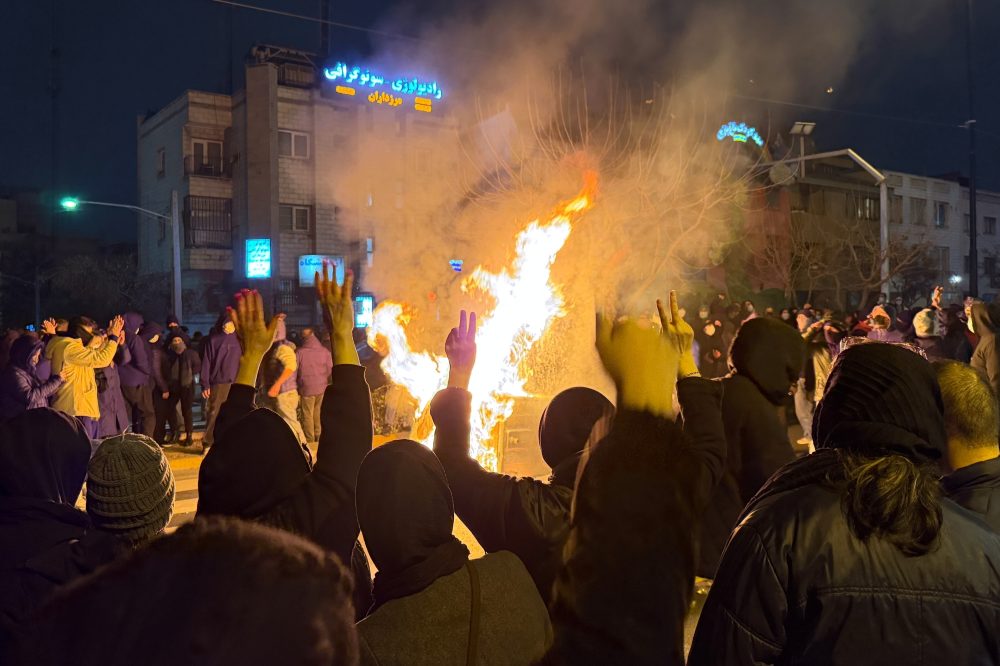

From her apartment balcony in Tehran, an Iranian teacher called out into the night air: “Death to the dictator!” and “Death to the murderer, Khamenei!” Her voice joined a chorus of similar cries echoing from windows and rooftops throughout her middle-class neighborhood.
When a few voices responded with pro-government slogans supporting Iran’s Islamic Republic, neighbors quickly silenced them. “Shut up! Choke on it!” they yelled back, overwhelming the government supporters, the teacher told The Associated Press. She requested anonymity due to safety concerns.
Citizens throughout Iran continue to grapple with trauma, sorrow and terror following the violent suppression of widespread demonstrations – marking the most lethal government response during 86-year-old Supreme Leader Ali Khamenei’s reign. The crackdown resulted in thousands of deaths and tens of thousands of arrests.
Despite the brutal response, resistance endures. Social media footage and protester interviews reveal deep-seated fury toward Iran’s leadership. However, three demonstrators contacted by the AP also described feelings of hopelessness about achieving change after hundreds of thousands courageously took to the streets, only to face overwhelming government violence. All protesters requested anonymity to avoid punishment or detention.
The situation grows more complex with America’s military threats against Iran. U.S. naval vessels and combat aircraft have been deployed to the region while nuclear negotiations continue between the two nations.
Nighttime rooftop chanting represents one form of ongoing resistance, echoing tactics from previous protest movements.
Another manifestation appears during memorial services for those killed 40 days prior. These ceremonies – called “chehelom,” meaning “the 40th” in Persian – traditionally honor any deceased person. During periods of civil unrest, however, these gatherings take on political significance.
This week commemorates 40 days since January 8 and 9, when the deadliest violence occurred. Multiple online videos show 40-day ceremonies across Iranian towns and cities. Some gatherings attracted hundreds of participants who frequently erupted in anti-government chanting.
Many ceremonies take on celebratory tones, with friends and family members of deceased protesters singing and scattering flowers – deliberately contrasting the somber atmosphere the state promotes at official events. Most participants avoid using “shaheed” (martyr), a term with Islamic religious meaning, instead choosing “javid nam,” a Persian expression meaning “Long live the name.”
AP-verified videos from this week captured hundreds gathered at the central cemetery in Abdanan, a small western Iranian town, chanting “Death to Khamenei” and raising their fists during the chehelom for Alireza Seydi, a 16-year-old killed January 8. The footage shows security forces firing from armored vehicles, releasing clouds of apparent tear gas that scattered the crowd.
During Iran’s 1979 Islamic Revolution that overthrew the shah and established the current government, 40-day memorials for killed protesters frequently became rallies that security forces attempted to crush, creating new casualties – which would then be commemorated 40 days later with fresh protests.
Social media reports indicate security forces are working to prevent people from attending some chehelom ceremonies.
“For every person killed, a thousand more stand behind him,” several hundred people chanted Tuesday in the eastern city of Mashhad during the chehelom for Hamid Mahdavi, according to AP-verified video. When police officers bothered some people honoring Mahdavi, a firefighter shot dead during January protests, the crowd responded: “Shameless! Shameless!”
The government conducted its own chehelom for the deceased, with the Revolutionary Guard issuing a statement portraying them as casualties of violence by foreign-supported armed “terrorist” organizations that exploited “legitimate public demands.” The statement described the 40-day commemoration as “a chance to renew commitment to national unity.”
“More than sad, people are angry. Everyone is so angry. Everyone is waiting for some kind of explosion,” said a Karaj resident from the city near Tehran.
He participated in street demonstrations on January 8 and 9 and reported that five relatives and family friends died when security forces fired on protesters.
The Human Rights Activists News Agency has documented over 7,000 deaths and believes the actual number is much higher. Iran’s government provided its sole death count on January 21, claiming 3,117 people died while characterizing many protesters as “terrorists.”
“I don’t know anyone around me who doesn’t know someone who was killed, or someone who was arrested or wounded,” the 26-year-old Tehran teacher said. Two of her acquaintances died and her co-worker’s husband was arrested, she reported.
Iranians also face a rapidly deteriorating economy as their currency loses value dramatically.
Prices increase daily, the Karaj resident explained. “We are getting near an economic collapse,” he said. “Buying fruit has become a luxury.”
A north Tehran resident working in tourism who joined last month’s protests noted that with the Persian New Year approaching in March, the bazaar would typically bustle with shoppers, but not currently.
“It’s a combination of grieving, lack of money and inflation,” he said, describing people in the capital as experiencing “mass depression.”
The somber atmosphere has affected Iran’s usually dynamic cultural scene. One prominent actress announced she would no longer accept new roles “in this land that smells of blood.”
Alireza Ostad Haji, who officiates a popular television strongman competition, expressed condolences to “all mourning families” in an Instagram post and resigned from two national athletic committees. He wept while discussing former bodybuilding champion Masoud Zatparvar, who was killed. “He was not a terrorist, he was a protester,” he stated.
Many fear that street demonstrations cannot create change when confronted with the state’s massive use of force.
Both the Karaj resident and the Tehran tourism worker expressed support for Reza Pahlavi, son of the deposed shah, who has positioned himself as a leader of Iran’s fractured opposition from exile. Pahlavi has promoted protests and urged the U.S. to attack Iran.
Measuring Pahlavi’s support throughout Iran remains impossible. However, during January’s protest wave, chants supporting him became common – a significant shift from the past when the shah’s son received little attention domestically or was viewed as disconnected.
Some are taking previously unthinkable steps – expressing hope for American military action.
“Every night, every hour, I wish I could hear (U.S.) strikes,” the tourism worker said. “We cannot fight anymore with our fists against machine guns.” He said many friends who demonstrated with him in January refuse to protest again due to state violence.
The teacher, while having joined previous protests, stayed home in January because she opposed expressions of Pahlavi support.
However, she said some friends who also reject the shah’s son participated in January protests and even chanted “Long live the shah!”
“People have become very tired, and they see no alternative,” she explained.
She worries a U.S. attack would bring war, civil conflict and additional bloodshed.
“I am afraid there will be more massacres,” she said.