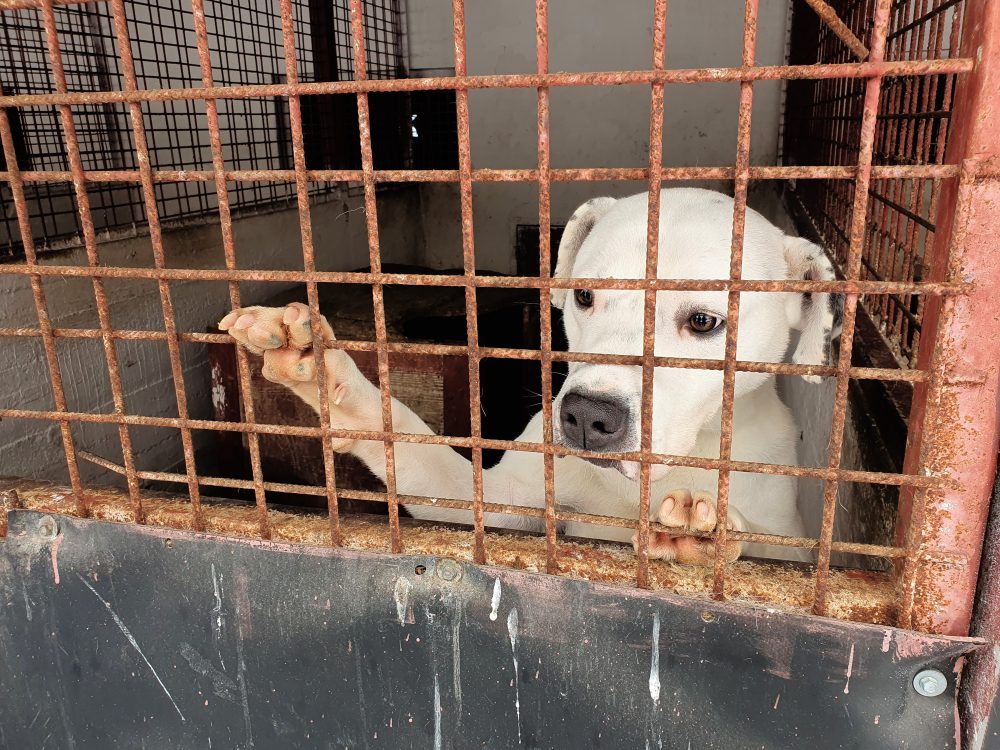

BUCHAREST, Romania — Disturbing footage shows dogs drinking from frozen water bowls and eating dried waste in concrete enclosures at a facility in eastern Romania.
These images were captured during a covert investigation by Vier Pfoten, an international animal welfare organization also called Four Paws, which examined conditions at Romania’s government-funded stray dog facilities.
During a 10-day period from Jan. 8-18, investigators visited nine facilities across the nation, recording what the organization characterizes as “high death rates and disturbing conditions” that represent “systemic neglect.”
The welfare organization discovered cramped enclosures, animals with untreated injuries, and numerous dogs housed in areas without protection from harsh winter weather.
With approximately 500,000 stray dogs, Romania maintains one of Europe’s largest homeless canine populations. Thousands of these animals live in government facilities where they await adoption or, sometimes, euthanasia.
Manuela Rowlings, who specializes in stray animal issues at Four Paws, explained to The Associated Press that their findings demonstrate these problems are widespread and require comprehensive reform.
“Public shelters are horrible places in Romania,” she stated. “It’s simply places where dogs are locked up and where they wait to die, and they do not even receive the minimum care or minimum standards.”
“Enclosures were frequently soiled with feces and overcrowded, leading to aggression and fighting among the dogs,” the Four Paws report states. “One dog even appeared to have bitten off parts of his own tail due to the highly stressful environment.”
During their visit to a government facility in western Arad County, considered among the better locations they examined, Four Paws discovered bare concrete flooring, no bedding or heating systems, and a complete absence of enrichment activities or toys. Despite these conditions, the organization commended staff members for their efforts to enhance the environment and promote adoptions.
The investigation criticized numerous facilities for making adoption processes difficult and noted that public records requests showed poor transparency regarding funding, animal intake numbers, and euthanasia statistics.
Romania’s National Sanitary Veterinary and Food Safety Authority, which supervises animal welfare and shelter operations, did not respond to the AP’s requests for comment.
Data obtained by the welfare organization shows that in 2024, only 134 of 644 dogs brought to a facility in northeastern Galati County found homes, while 28 were legally euthanized and 412 died from “other causes.”
“There is nothing that can be reported to the authorities, because it is not illegal to keep dogs in very, very poor conditions in the shelters,” Rowlings said.
Following the death of a 4-year-old boy killed by stray dogs in Bucharest in 2013, Romania enacted legislation leading to mass roundups of homeless animals, with those not adopted within 14 days facing euthanasia.
Animal protection advocates have consistently maintained that widespread spaying and neutering programs offer the most effective long-term solution.
Hilde Tudora, Director of Animal Protection at Ilfov County Council, explained to the AP that comprehensive sterilization programs fail because the stray dog situation has become a “money-making machine,” with taxpayer funds often supporting private facilities.
“Private companies have swelled up with public money, and then it turned into a business,” she said. “There must be dogs, because if you castrate en masse, there’s no more merchandise … No one really wants to solve the problem.”
Proposed legislation introduced last November would classify animals as “living beings with rights and freedoms” and shift focus from euthanasia to sterilization and microchipping programs.
Andrei Baciu, a parliamentarian from the National Liberal Party, said Romania has spent over 1.3 billion euros ($1.5 billion) in the last three decades on euthanizing stray dogs.
“From a single pair of unsterilized dogs can appear, in just six years, over 67,000 puppies,” he said in a Facebook post. “Capturing and euthanizing them would cost around 13.4 million euros ($15.6 billion). With the same money, we could sterilize 268,000 dogs.”