
DEIR AL-BALAH, Gaza Strip — A quick glance reveals only scattered stone remnants of the community that Yusuf Abu Hamam’s relatives were compelled to abandon when he was a baby in 1948.
The community, al-Joura, was destroyed by Israeli forces during that period. It has since disappeared beneath residential areas of the southern Israeli city of Ashkelon and a national park’s grounds.
The area where Abu Hamam’s family settled — and where he lived most of his years — now also sits mostly in ruins. Structures in the Shati Camp in northern Gaza have been demolished and destroyed by Israeli bombing and demolitions throughout the last 2½ years of conflict.
On Friday, Abu Hamam and millions of Palestinians observe the 78th anniversary of the Nakba, meaning “catastrophe” in Arabic, which refers to the mass displacement and exodus of approximately 750,000 Palestinians from present-day Israel during the 1948 conflict surrounding Israel’s establishment. This marks the third Nakba remembrance since the Gaza war started.
The 78-year-old Abu Hamam, among a shrinking group of Nakba survivors, believes the present conflict represents an even worse disaster.
More than six months following an October ceasefire, he and Gaza’s remaining 2 million inhabitants are packed into fewer than half of the 25-mile coastal territory along the Mediterranean, encircled by an Israeli-controlled area covering the remaining land.
“There is no country left,” Abu Hamam said, speaking next to his home, which was heavily damaged by Israeli shelling earlier in the war. “A square kilometer and a half extending from the sea, this is what we are living in … It’s indescribable, unbearable.”
For Palestinians, the Nakba represented losing most of their ancestral land. Approximately 80% of Palestinians residing in the region that became Israel were forced from their residences by the emerging state’s forces before and during the conflict. The fighting started when Arab armies attacked after Israel’s creation as a Jewish homeland following the Holocaust. Palestinians who stayed received Israeli citizenship.
Following the conflict, Israel declined to permit Palestinian refugees to return to maintain a Jewish majority within its boundaries. Palestinians became what appears to be a permanent refugee population now totaling around 6 million, with most residing in refugee camps in the Israeli-occupied West Bank, Lebanon, Syria, Jordan and Gaza.
Approximately 530 Palestinian communities in what became Israel were demolished, according to the Palestinian Bureau of Statistics.
Abu Hamam’s birthplace was among them. Al-Joura was captured by Israeli forces as they advanced against Egyptian troops in November 1948. Soldiers received orders to demolish every residence in al-Joura and surrounding communities to prevent their Palestinian residents from returning, according to military records referenced by Israeli historian Benny Morris.
Refugees expanded the population of the small coastal territory that became the Gaza Strip. They remained in temporary camps, managed by a newly established U.N. agency for Palestinians, UNRWA, which supplied assistance and education. Those camps, including Abu Hamam’s Shati Camp, developed into crowded urban areas over decades, before many were destroyed during the recent Gaza conflict by Israeli bombardment.
The forebears of Ne’man Abu Jarad and his wife, Majida, were already residing in what would become the Gaza Strip in 1948. Both remember family stories about refugees arriving on foot from northern areas, like the community Abu Hamam originated from.
Although they escaped the initial Nakba, there was no avoiding what Majida now terms “our Nakba.”
Their community has been completely destroyed. During the past year, Israeli bulldozers and controlled explosions have demolished almost every structure in the northern Gaza towns of Beit Lahiya and Beit Hanoun. A new Israeli military installation sits approximately 700 meters (765 yards) from where the Abu Jarads’ residence once existed, based on satellite images.
Also destroyed is the southern Gaza city of Rafah, formerly housing a quarter million residents, and other communities and areas in the Israeli-controlled portion of the Gaza Strip. The military states it is eliminating positions used by Hamas and preparing the region for rebuilding. Satellite images reveal nearly every building reduced to debris.
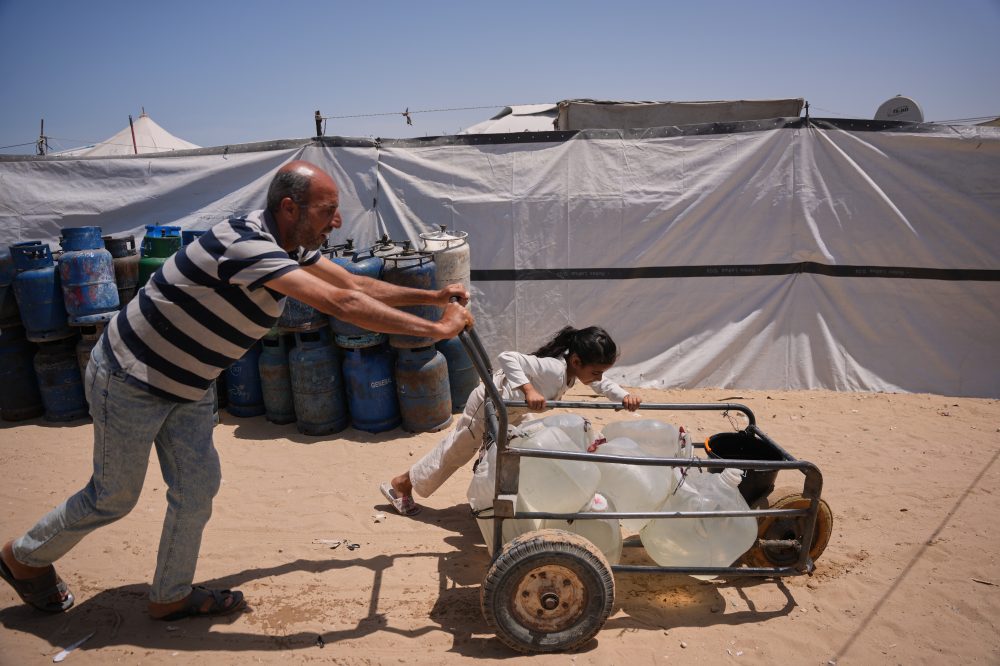
During the last 31 months of conflict, the Abu Jarads and their six daughters have been forced to relocate more than twelve times while escaping Israeli bombing and military operations. They presently reside in a camp in the southern city of Khan Younis. Their tent provides minimal protection from harsh winter winds or summer heat, Majida explained.
Their daughters have been absent from school for more than two years.
“The Nakba of ’48, I don’t think it can be compared to our Nakba,” Majida said. “In ’48, they say people were displaced once and settled in one place, and they are still there until now. But our Nakba, honestly, is more severe because our displacement has happened multiple times. There is no stability.”
Approximately 90% of Gaza’s more than 2 million residents have lost their residences, based on U.N. estimates, with most now living in massive tent camps with rodent problems and sewage pools. They depend on aid for survival.
Israel’s military campaign has resulted in over 72,700 Palestinian deaths, according to local health authorities. It began following Hamas’ Oct. 7, 2023, assault on southern Israel that resulted in approximately 1,200 deaths. Militants also captured 251 hostages.
In the northern West Bank, tens of thousands of Palestinians are experiencing their 15th month of displacement, after Israeli forces ordered them from their refugee camps during an operation targeting militant organizations.
Since that time, troops have destroyed or severely damaged at least 850 buildings throughout the refugee camps of Nur Shams, Jenin and Tulkarem, based on satellite imagery analysis by Human Rights Watch published in December.
The 1948 Nakba also resulted in Palestinians losing their historical records, as those fleeing found it difficult to preserve documents and belongings connecting them to their homes.
One of the most extensive collections of Palestinian documents from the Nakba period belongs to UNRWA.
UNRWA personnel, who evacuated their Gaza offices after Israel ordered northern evacuation, were forced to abandon the agency’s comprehensive archive.
The staff then began a rescue operation for the most essential documents — birth, death and marriage certificates and refugee registration cards, according to Juliette Touma, a former senior UNRWA official.
Without these documents, Palestinians could forfeit their rights and refugee status. Staff members filled their personal luggage with papers and transported them through checkpoints and out of the territory, Touma explained.
The ongoing conflict has taken from Palestinians in Gaza what remained of their personal histories. Majida’s parents’ residence in Beit Hanoun was demolished, along with family photographs.
“There is nothing left,” she said.
Abu Hamam also states everything has been lost.
“When this war came, it devoured trees, stones and people,” he said. “Entire families were erased from the civil registry. Hundreds of families are still buried under the rubble.”