
CONCORD, N.H. — Paper may be the traditional gift for a first wedding anniversary, but it turns out it’s also a fitting choice for a 250th birthday — particularly when you’re packing a time capsule meant to honor American independence.
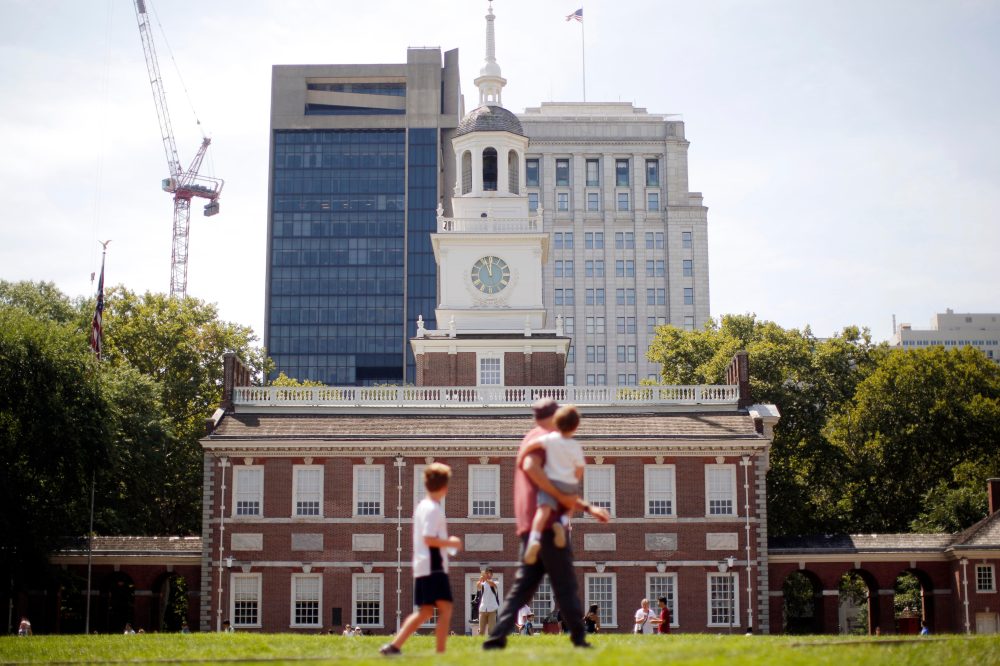
A 2016 law established the nonpartisan America250 commission and required that a time capsule be buried in Philadelphia on July 4, 2026, with instructions not to open it until 2276 — a full 250 years later. Just last week, the massive 900-pound cylindrical capsule was officially sealed, marking the end of years of design work, construction, collaboration with states, and careful review of submitted items.
“Once it was closed, it was a little bit anti-climactic, and then it was kind of really emotional,” said Michael Berilla, who leads the fabrication technology office at the National Institute of Standards and Technology and headed the team responsible for designing and building the capsule.
Berilla’s office, which falls under the Department of Commerce, has previously built protective encasements for historical documents — though those are typically kept indoors under tightly controlled conditions. A time capsule buried underground faces a very different threat: water. That concern drove much of the design process.
The capsule is cylindrical rather than box-shaped, since corners and square edges are prone to cracking over time. A second outer cylinder will surround it, creating an air barrier that pushes water away. The capsule’s lid is also lined with a soft metal that compresses when sealed.
“When you smash it shut with the lid, that metal goes into all the cracks and spaces and makes an airtight, watertight seal,” Berilla explained.
The contents inside were stored at 35% relative humidity — moist enough to prevent materials from drying out and crumbling, but dry enough to avoid creating moisture-related damage. The capsule will be placed 10 feet underground, shielding it from temperature swings and storm damage.
“Philadelphia would have to be six feet underwater in order for this time capsule to even possibly take on water,” Berilla said. “And if Philly is six feet underwater, you’ve got way bigger problems in the world.”
The capsule holds contributions from all three branches of the federal government, items tied to ongoing America 250 events and programs, and submissions from all 50 states, five U.S. territories, and the District of Columbia. Most items are housed in small archival boxes, while paper documents occupy a separate compartment. According to a list published on the America250 website, archival-grade paper was among the most popular choices, with states sending in hundreds of letters, postcards, posters, poems, and other printed materials.
States took very different approaches to their submissions. New Hampshire looked back, contributing a brochure tracing major moments in the state’s Revolutionary War history. California looked ahead, submitting the response it received when it asked an AI chatbot: “Write me a prediction of what California will be like 250 years from July 4, 2026.” According to the AI, highways will disappear, grizzly bears will return, and California will eventually break away to join Oregon, Washington, and British Columbia in forming a “Pacific Federation.”
Some states went above and beyond. Utah included 100 cards highlighting historical figures from the state, along with 13 coins, eight documents, eight pins, two granite disks, and a booklet. Arizona used nano-etching technology to engrave the full text of both the Declaration of Independence and the U.S. Constitution onto a stainless steel coin. Other contributions were more unusual — Maine submitted a bone from the endangered North Atlantic right whale, while Arkansas sent an actual diamond.
Tom Medema, a retired National Park Service official who served as project manager for the time capsule, said the range of submissions was remarkable.
“I’m glad there wasn’t really a prescription for it,” he said. “I know that was hard for them, but in the end, it was just up to them to represent themselves.”
Items that could deteriorate or metals that might rust were not permitted. Maryland’s attempt to include Old Bay seasoning was turned away, and a piece of Native American beaded artwork originally backed by elk hide had to be resubmitted on a fabric backing instead.
Medema noted that some submissions reflect difficult chapters in American history, as well as challenges the country faces today. Even so, the overall spirit of the project remained hopeful.
“There’s great hope in what this capsule represents and the messages that are put in it,” he said. “Something about this capsule has been truly uplifting for everyone who’s been involved in it.”
This is not the first time Americans have buried a national time capsule connected to the signing of the Declaration of Independence. A so-called “Century Safe” filled in 1876 was opened by President Gerald Ford in 1976. That same year, an official Bicentennial time capsule was created; it is currently held at the National Archives and scheduled to be opened in 2076. A separate time capsule is also being planned for the U.S. Capitol Visitor Center.
To make sure the America 250 capsule is actually located in 2276, the National Park Service has incorporated details about it into succession plans that will be handed down over the generations. A capstone marking the burial site will also be installed above it.
For Berilla, reflecting on what America looked like 250 years ago brings one word to mind: resilience.
“And when I think forward to the future, I hope that’s what they see from us,” he said. “That, yes, we had it hard compared to them, but more importantly, we were diverse. We were interesting. We were creative. We worked together.”
The capsule includes a photo of his team along with a letter he wrote on their behalf. “Greetings from the living, breathing hearts and hands of 2026,” Berilla wrote. “We will have long since returned to dust, but our devotion, pride, and unwavering hope for what our world could become are alive right here inside this steel. We built this for you.”