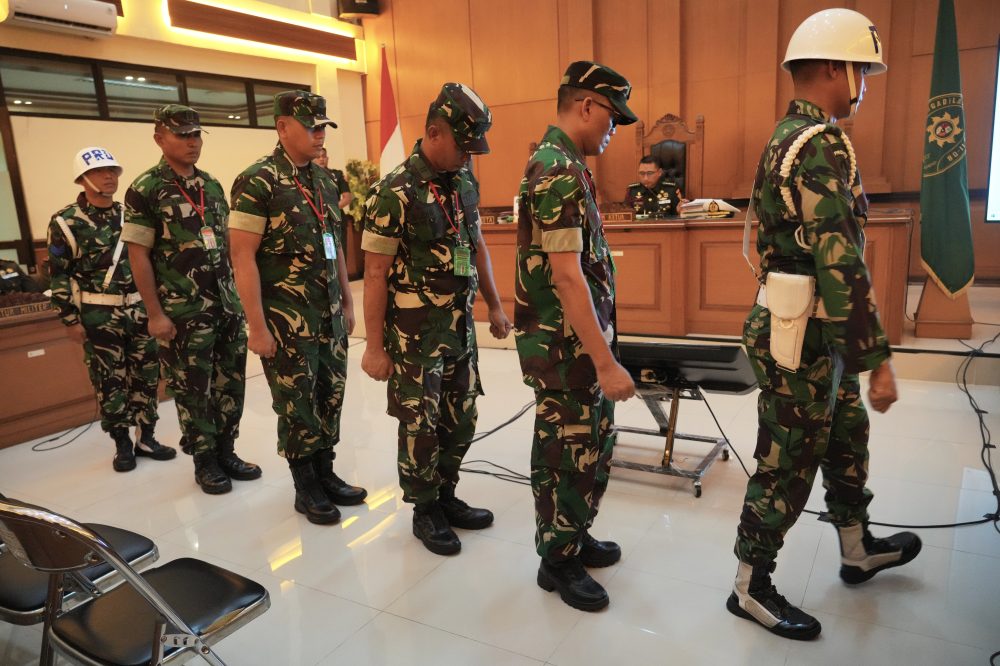

JAKARTA, Indonesia — Four members of Indonesia’s armed forces were convicted Wednesday by a military tribunal for carrying out an acid assault against a well-known human rights lawyer, receiving prison terms ranging from 18 months to three years in a case that has heightened questions about military oversight and sparked fresh condemnation from advocacy organizations.
The convicted personnel include three naval marines — Sgt. Edi Sudarko, First Lt. Budhi Hariyanto Widhi Cahyono, and Capt. Nandala Dwi Prasetya — along with air force officer Lt. Sami Lakka. All four worked for the intelligence division of Indonesia’s National Armed Forces, known as TNI. Their convictions stem from a March assault on Andrie Yunus, a civil rights attorney and senior member of the Commission for the Disappeared and Victims of Violence, called KontraS.
The 27-year-old Yunus sustained serious burns and lasting injury to his right eye when attackers threw hydrochloric acid at his face as he traveled by motorcycle through central Jakarta. The incident occurred after he had finished recording a podcast discussing the military’s role in Indonesia’s government.
At Jakarta Military Court, the three-judge panel imposed a three-year sentence on Sudarko, two and a half years for Cahyono, while Prasetya received two years and Lakka got 18 months. Sudarko, believed to have organized the recruitment of the other three servicemen, and Cahyono, who proposed using acid in the attack, were also dismissed from TNI.
Presiding military judge Fredy Isnartanto stated: “The defendants, as TNI service members, betrayed their duties by deliberately throwing acid at Andrie Yunus. Their actions damaged the image of the Indonesian military and demonstrated clear arrogance. The attack inflicted trauma and suffering on the victim and caused permanent damage to his eye.”
Advocacy organizations quickly condemned both the verdict and case management, contending it neglected to examine potential involvement from higher-ranking officials.
Amnesty International Indonesia stated that the comparatively lenient prosecution requests strengthened worries the proceedings could become a “show trial,” demanding that anyone who might have commanded or funded the assault be identified and tried in civilian courts.
The National Commission on Human Rights of Indonesia, or Komnas HAM, initiated a comprehensive probe and discovered evidence suggesting the attack was a deliberate and organized effort, possibly involving additional people beyond the four accused. The commission identified several rights violations, including violations of security rights, protection from torture, and access to justice.
Prosecutors had earlier requested two and a half year sentences for all four military members, claiming the defendants operated independently rather than under orders, driven by frustration over Yunus’ work. They characterized the assault motivation as personal, intended to “teach him a lesson” for his military criticism.
Yunus has gained recognition for his work fighting impunity in Indonesia, focusing on security sector reform and civil rights protection. He participated actively in demonstrations last year against proposed changes to Indonesia’s military legislation that would broaden the armed forces’ involvement in civilian matters. Associates report he has experienced ongoing intimidation related to his advocacy.
During the trial that started in late April, Yunus declined to attend or provide testimony, citing continued medical treatment from skin graft procedures and distrust of the military court system, according to the Advocacy Team for Democracy, or TAUD, a civil society organization representing Yunus.
Last week, judges at the civilian South Jakarta District Court partially approved Yunus’ pretrial request, including directing Jakarta Police to maintain their investigation to guarantee justice and human rights protection.
The district court panel also acknowledged pressure from Komnas HAM on police to pursue the investigation further to reveal other perpetrators, including civilians. Both Komnas HAM and the Civil Society Coalition assert that over a dozen individuals participated in the attack.
This incident has renewed worries about military accountability and recalls previous unsolved attacks on activists, including the 2004 killing of Munir Said Thalib, a prominent human rights advocate and KontraS founder who died from arsenic poisoning during a flight to Amsterdam.