
TOCANTINIA, Brazil — The sound of flames crackling across the landscape echoed like distant rainfall on a recent morning within the Xerente Indigenous Territory in Brazil’s Tocantins region. Yet local Indigenous residents remained calm, making no attempt to extinguish the blaze.
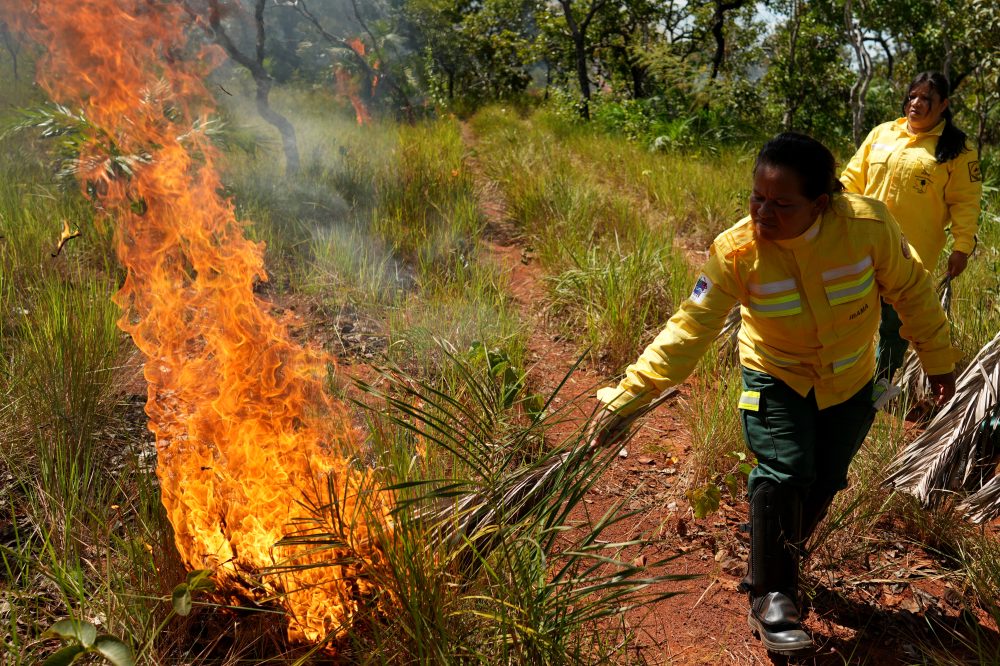
These flames were deliberately set as part of a coordinated wildfire prevention strategy developed by the Xerente people working alongside environmental authorities ahead of the driest months of August and September.
The Xerente community calls the Cerrado home, a vast savanna spanning central and northern Brazil. Each year, their villages confront the risk of massive forest fires, a threat expected to intensify with El Niño’s arrival, which extends drought conditions and elevates regional temperatures.
Following years of facing discrimination, Indigenous leaders now collaborate with government agencies to implement traditional wisdom in preventing major wildfires.
During recent operations, combined teams from IBAMA, Brazil’s environmental protection agency, and trained Indigenous personnel entered the savanna. Ground crews employed age-old methods of starting fires using drip torches or dried palm leaves. Meanwhile, a smaller unit deployed incendiary spheres from a government helicopter targeting pre-mapped locations.
When any fire showed signs of spreading beyond control, response teams acted immediately. The outcome created a mosaic of burned patches throughout the savanna designed to safeguard the ecosystem in coming months.
“They know the region, the climate, the vegetation, and the best times to set fires. We began seeking traditional knowledge, learning from them and adapting it to our objectives, aligning with their use of fire,” said Marco Borges, an IBAMA agent coordinating fire prevention in Tocantins. “We’ve learned they are actually our best teachers.”
Brazilian authorities previously implemented a “zero-fire” approach, viewing any small burn as a danger requiring immediate suppression and prohibition under all conditions. This strategy eventually lost support as officials adopted new land management methods combining traditional wisdom with scientific research. In 2014, the government initiated partnerships with Indigenous communities for controlled burning operations.
Fire plays a natural role in savanna forest development like the Cerrado, with various species benefiting from regular burns, according to Leandro Maracahipes, a biologist and Yale University researcher.
Historically, fires occurred naturally through lightning strikes at the beginning of rainy seasons between October and April. However, human activities have caused more destructive fires during peak drought periods of August and September, often connected to pasture clearing near Xerente lands, which are encircled by soy and cattle operations.
During early dry periods, when vegetation remains partially moist, small controlled burns help eliminate combustible grass accumulation. These burned zones form protective barriers around settlements, water sources and vulnerable areas, shielding them from wildfires during extreme drought.
“Totally excluding fire leads to a buildup of fuel that feeds high-intensity burns. Such fires can kill even resilient trees and make firefighting nearly impossible as flames spread rapidly across the landscape, including into forests,” Maracahipes said.
When official vehicles reached Xerente territory to commence operations, approximately 30 Indigenous people waited in formation outside a wood-and-thatch structure serving as their association headquarters.
They arranged themselves in two parallel rows, forming a pathway. On one side, a group dressed in official fire brigade gear: bright yellow shirts, green pants and protective boots. On the opposite side stood primarily shirtless men, their bodies decorated with traditional painted designs, some wearing shoes while others had flip-flops. Facing one another, they performed traditional songs while stomping rhythmically.
At the pathway’s end, Chief Lazaro Xerente, 68, the senior leader of his community, waited shirtless with painted torso and wearing a feathered headdress. He expressed gratitude for officials’ presence while also voicing concerns.
“People say, ‘Oh, it’s the Indigenous people who are causing fires,’ when in fact, since I was born, and long before me, my ancestors have always protected the forest,” he said in his native language with translation by Bolivar Rodrigues Xerente of Brazil’s Indigenous affairs agency FUNAI.
Following major fires that generate media attention, misleading images of Indigenous people frequently spread across Brazilian social media, incorrectly attributing blame to them and officials for destruction. In truth, every burn undergoes careful planning by fire departments.
The mission started with teams assembling around an extended wooden table inside a tent to outline daily burning activities, merging satellite information with Indigenous territorial knowledge to pinpoint areas needing management.
Several Xerente received government employment for two-year periods and obtain training plus monthly wages, while others participate as volunteers. The initiatives receive partial funding through a collaboration between Bunge Foundation and IBAMA supporting training and equipment for up to 40 Indigenous brigades across five states in the Cerrado and Amazon.
In areas like the Cerrado and Amazon, El Niño typically produces elevated temperatures and extended drought, establishing conditions where wildfires flourish. During the latest occurrence from 2023 to 2024, Brazil experienced record fires consuming more than 30.8 million hectares (76.1 million acres) in 2024, an expanse exceeding Italy’s size, according to MapBiomas, a nonprofit monitoring deforestation and fire.
The Amazon suffered the greatest impact, representing nearly 60% of burned territory. The Cerrado placed second with almost 10 million hectares (24.7 million acres) affected.
Brazil’s Environment Ministry reported tracking El Niño effects since early this year, positioning more than 4,000 brigade members nationally. Under President Luiz Inácio Lula da Silva, the government created a national fire management policy in 2024 to coordinate authorities and civil society, including controlled burning with Indigenous communities.
Humidity reduces wildfire intensity, which typically helps shield the Amazon.
“However, in extreme years like the approaching El Niño, tropical forests become more susceptible to fire,” Maracahipes said, noting that the Amazon should maintain protection through a zero-fire policy.
Yet in the Cerrado, fire serves as an effective land management resource.
“When applied with technical expertise, fire can significantly contribute to environmental conservation,” said André Lima, secretary for deforestation control and land-use planning at the Ministry of the Environment. “In prescribed or controlled burns for agricultural production, for example, it can help prevent major disasters.”
Bolivar Rodrigues Xerente of FUNAI explained that his Indigenous elders taught him that traditional knowledge and modern science resemble a bird’s two wings.
“A bird with two wings can navigate the wind, but with only one wing, it can’t,” he said. “Technology, without traditional knowledge in the Indigenous communities, doesn’t work.”