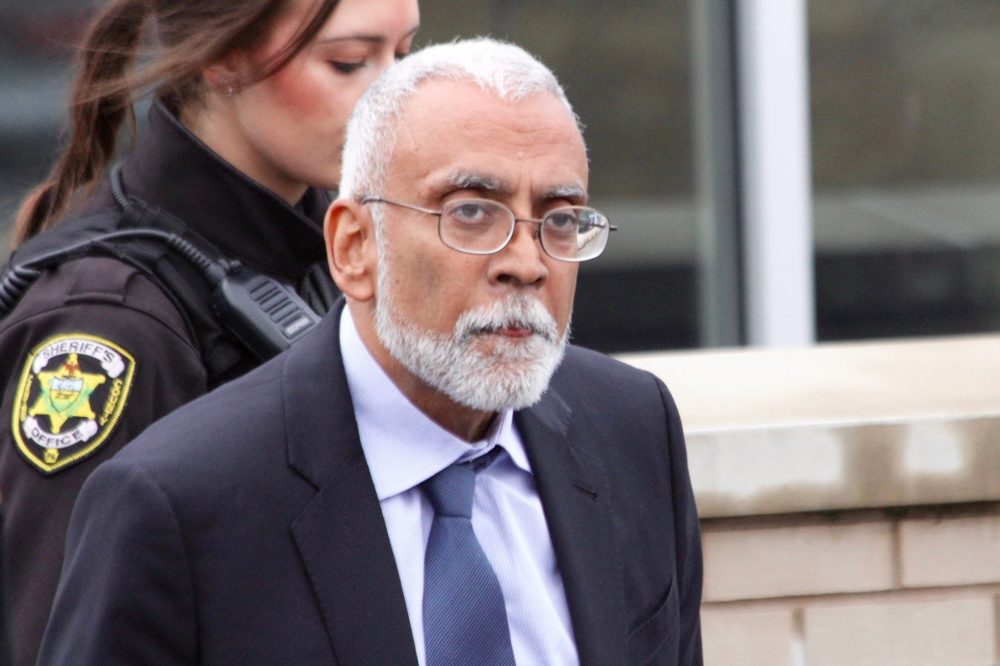

HARRISBURG, Pa. — A federal immigration judge has blocked the deportation of an Indian citizen who spent more than 40 years behind bars before his murder conviction was thrown out, opening the door for his possible freedom.
The ruling came Thursday following a four-hour proceeding where Subramanyam Vedam maintained his innocence in the 1980 fatal shooting of Thomas Kinser while facing questioning from a Department of Homeland Security attorney. Vedam joined Wednesday’s hearing via video link from the Moshannon Valley Processing Center in Philipsburg, Pennsylvania.
“I was young and stupid and did a lot of dumb things back then,” Vedam testified. Federal authorities are seeking to remove the 64-year-old to India, a country he departed as an infant in 1962.
U.S. Immigration Judge Adam Panopoulos determined that Vedam had demonstrated genuine rehabilitation and posed no threat to community safety. The judge highlighted Vedam’s work helping fellow prisoners learn to read and his strong family connections, including nieces who have never experienced him as a free person.
Vedam “has grown as a person” and “began to dedicate himself to enriching other people’s lives and ultimately his own through academic study and enrichment,” Panopoulos stated Thursday.
However, a DHS attorney noted that deportation remains possible due to separate drug distribution convictions.
Born in Mumbai, Vedam, nicknamed Subu, arrived in America at 9 months old. He was raised in State College, Pennsylvania, where his father taught physics. As a lawful permanent resident, he was close to obtaining U.S. citizenship when authorities arrested him.
The Department of Homeland Security has 30 days to file an appeal. Vedam’s legal team plans to request his release on bond.
Defense attorney Ava Benach said Vedam wishes to reside with family in Sacramento, California, and has received acceptance into Oregon State University’s doctoral program in applied anthropology.
In late 2023, State College prosecutors chose not to pursue a new trial after a Centre County judge found that crucial ballistics evidence had been withheld during Vedam’s original proceedings. ICE officers detained Vedam in October just as he was about to be released.
Vedam informed Panopoulos that he rejected plea agreements during his initial trial and that prosecutors presented similar deals during his second trial. Both cases resulted in first-degree murder convictions.
“I never stopped saying I was innocent of this charge,” Vedam declared to the judge. He has remained incarcerated since March 31, 1982.
Vedam and Kinser had attended high school together and were both 19 when Kinser vanished. Kinser was last observed alive after driving Vedam to purchase drugs in December 1980. Authorities discovered Kinser’s vehicle outside his State College residence, and hikers found his body in a remote sinkhole more than nine months later. He had suffered a gunshot wound to the head. The weapon was never recovered.
Initially arrested on drug-related charges, Vedam was later charged and found guilty of Kinser’s killing.
Trial jurors learned that Vedam had bought a stolen .25-caliber weapon and bullets around Kinser’s disappearance but were not told that an FBI analysis indicated Kinser’s wound was too small for ammunition of that caliber.
In an October 2 statement explaining his decision against retrial, Centre County District Attorney Bernie Cantorna described it as “a compelling circumstantial case” but acknowledged that a third trial would be challenging due to the elapsed time. Cantorna referenced “the reality that 44 years is a sufficient sentence for a murder committed by someone who was nineteen years old.”
The prosecutor observed that Vedam had first denied buying or possessing a .25-caliber firearm, then claimed during his second trial that he acquired the gun after Kinser’s disappearance. Cantorna also noted that the FBI connected “distinguishing marks” on a bullet shell found near Kinser’s remains to a casing from where the gun dealer said Vedam had tested the weapon.
Although exonerated in Kinser’s death, Vedam’s no-contest pleas to LSD distribution charges still threaten his immigration status. During Wednesday’s proceeding, DHS attorney Tammy Dusharm questioned Vedam about additional arrests, including drunk driving and theft charges.
Dusharm argued to the judge that Vedam should not remain in the United States, given that he “was using and dealing drugs, driving under the influence, committing theft-related offenses.” She also challenged Vedam’s claims that he sold LSD only occasionally.
“I find it fairly incredible that it would appear that every single time he sold drugs, he did so to an undercover officer,” Dusharm remarked.