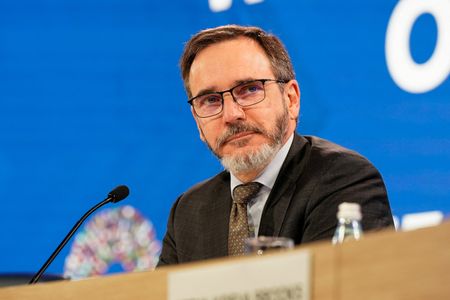

WASHINGTON — The outgoing top economist at the International Monetary Fund is warning that the world economy faces serious downside risks, particularly if a fragile ceasefire between the United States and Iran collapses.
Pierre-Olivier Gourinchas, who is departing the IMF to return to the University of California, Berkeley next week, spoke with Reuters on Friday ahead of his exit. He noted that coordinated releases from strategic petroleum reserves helped prevent an even sharper spike in oil prices following the outbreak of war in the Middle East. However, he cautioned that those reserves are now largely depleted, leaving countries with far less flexibility should the conflict escalate again.
The concern grew more immediate on Friday when President Donald Trump blamed Iran for an attack on a ship near Oman, calling it a violation of their ceasefire agreement — underscoring just how tenuous the preliminary peace deal remains.
Gourinchas said that thanks to rapid reserve releases and production adjustments by refiners, only about 3% of global oil was removed from the market, far less than the 10% to 15% that had initially been feared. But he made clear that a breakdown in the ceasefire would leave countries with fewer tools to soften the blow of further supply cuts.
On the question of upcoming IMF economic forecasts, Gourinchas hinted that the global lender may return to offering a single baseline forecast when it releases updated projections on July 8 — after he has already returned to academia. In April, the IMF opted to publish three separate growth scenarios rather than one baseline figure, partly because of the sweeping tariffs introduced by President Trump against imports from most countries. It was the second time during Gourinchas’ tenure that the Fund bypassed a traditional baseline forecast.
IMF spokeswoman Julie Kozack had left open on Thursday whether the organization would stick with the three-scenario approach or revert to a more conventional single forecast. Last month, with the Strait of Hormuz still closed and oil prices topping $100 per barrel, she had indicated the global economy was drifting from a more optimistic “reference forecast” — which assumed a quick end to the conflict and 3.1% growth in 2026 — toward an “adverse scenario” projecting only 2.5% growth.
Gourinchas explained that both 2025 and 2026 lacked enough historical precedent to support a reliable single forecast, which is why economists needed to “be humble” and instead map out a range of possible outcomes. That said, he acknowledged such an approach should remain the exception.
“We don’t want to do it too often,” he said, while admitting that uncertainty and risks remain elevated.
Beyond the energy sector, Gourinchas pointed to significant shifts happening in global trade. He highlighted the European Union’s recent completion of trade agreements with both Latin America and India — deals that had been in the works for decades but were suddenly finalized within the past year.
“All of a sudden, in less than one year, they’re both signed. This is not a coincidence. You can’t afford not to deepen trade relations with other countries out there,” he said, noting that many of these emerging agreements notably exclude the United States.
He also offered a broader observation about the long-term effectiveness of tariffs and economic sanctions as policy tools, suggesting their power tends to fade over time.
“There is a view that having these kinds of choke points or this critical leverage is really important, but I think what we are seeing is how quickly the global economy tries to find ways around them,” he said.
“You do have leverage in the short term, and then actors on the other side respond. They are not passive, they find ways to either circumvent, accelerate their own innovation, develop new trade ties with other partners, and basically those tools become blocked,” he added. “In the medium- to long-term, they almost never work.”