
BUDAPEST (AP) — Hungarian voters delivered a stunning blow to Prime Minister Viktor Orbán’s 16-year reign, decisively choosing pro-European candidate Péter Magyar in what many are calling a political earthquake that could reshape the nation’s future.
Magyar, a reformist leader who campaigned on restoring Hungary’s relationship with Europe, secured a commanding victory that has left citizens across the country wondering what comes next after more than a decade of increasingly authoritarian rule.
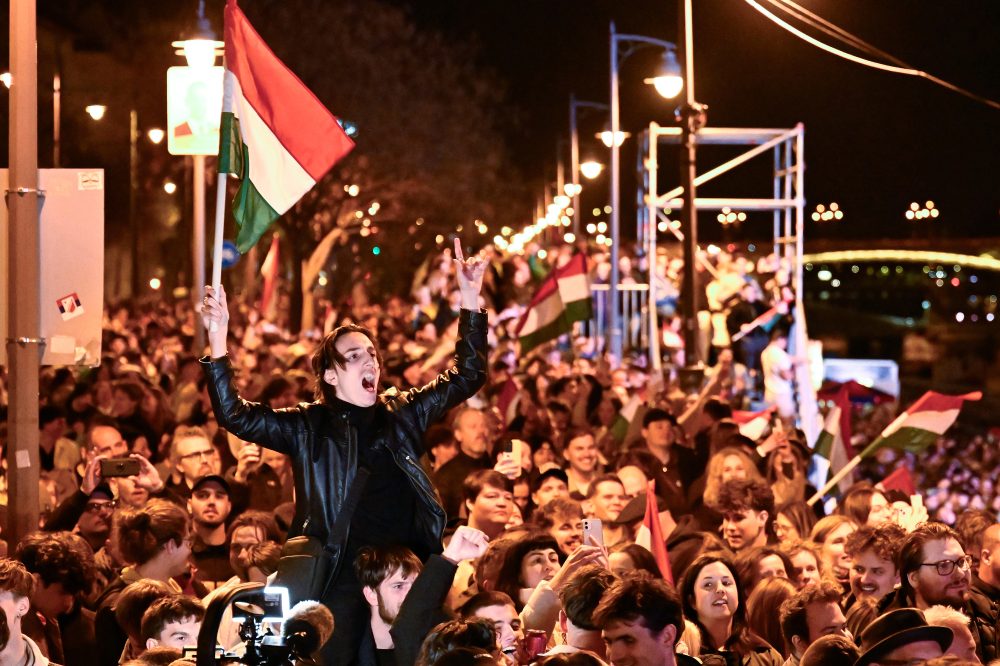
Crowds of jubilant supporters, including many young Hungarians, flooded Budapest’s streets late Sunday to celebrate what they see as a turning point toward greater freedom and a return to European democratic values.
Among the celebrants was Adrien Rixer, who traveled from London specifically to cast his ballot. “Because I really wanted to make my vote count, and I’m over the moon,” Rixer explained during the festivities.
“Finally I can say that I’m a proud Hungarian, finally after 16 years,” he said.
Throughout his campaign, Magyar committed to reversing Hungary’s alignment with Russia and rebuilding relationships with European partners. He told voters that following 16 years of authoritarian leadership and weakened legal institutions under Orbán, he would eliminate corruption and establish a “peaceful, functioning and humane” Hungary.
The specifics of these promised changes remain unclear. Throughout his lengthy tenure, Orbán wielded a two-thirds legislative supermajority that enabled him to enact a new constitution, overhaul election laws, and restructure the court system.
Magyar’s Tisza party achieved precisely that level of control Sunday, capturing 138 out of 199 parliamentary positions, providing extensive power to reverse much of the policy framework that enabled Orbán to influence the courts, distort electoral processes, restrict media freedoms, and target LGBTQ+ rights.
Numerous Hungarians, along with European observers who monitored the election closely, worried that a simple Tisza majority would prove insufficient to genuinely reform Orbán’s established system. Others express concern about the implications of such sweeping authority, questioning whether transferring a supermajority from Orbán to his rival is wise.
“Its hard to see that with two-thirds that it’s going to be a fair government, but we will see,” said celebrant Dániel Kovács. “Lets hope that it’s going to be a promising four years.”
Magyar has criticized Orbán and his administration for poor economic and social service management, along with widespread corruption that he claims has enriched a select group of political allies while neglecting average citizens.
The incoming leader has committed to addressing these alleged violations and intends to establish an Office for the Recovery of National Assets to retrieve what he characterizes as improperly obtained wealth by Orbán’s associates.
A central campaign theme for Magyar involved promising to secure billions of euros in frozen European Union funds that were withheld from Hungary due to corruption and legal system concerns during Orbán’s leadership. He has also committed to adopting the euro currency by 2030 — a move Orbán’s administration consistently opposed.
Budapest resident Imre Végh stated early Monday that Orbán had constructed an “illiberal system” that contradicted Hungary’s core principles.
“We are Europeans and we want to stay in Europe,” he said.