
BUDAPEST, Hungary (AP) — Hungary’s capital witnessed a dramatic political showdown Sunday as Prime Minister Viktor Orbán and his chief rival Péter Magyar organized massive competing demonstrations just four weeks before crucial national elections.
The dueling rallies in Budapest drew hundreds of thousands of supporters for both Orbán’s nationalist Fidesz party and Magyar’s center-right Tisza movement, serving as a critical test of political strength as the campaign reaches its final stretch.
Orbán, 62, who has governed since 2010 and seeks his fifth straight electoral win, confronts his most serious challenge in twenty years as Magyar has rapidly emerged to threaten what appeared to be an unbreakable hold on power by the pro-Russian leader.
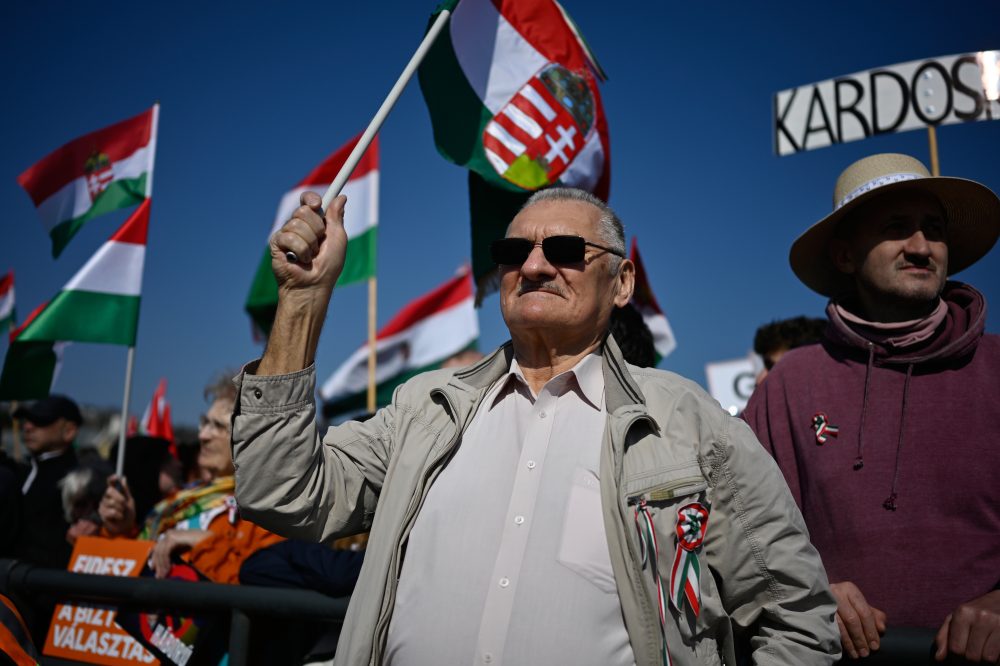
During the pro-government demonstration that concluded with remarks from the prime minister, supporter Anikó Menyhárt explained Orbán’s appeal while crowds assembled on a Danube River bridge. “God, homeland, family,” she stated. “Only this government is able to secure these three things for the future,” she said.
Both political leaders had urged their followers to participate in Sunday’s events, which coincided with Hungary’s March 15 national holiday honoring the country’s 1848 uprising against Habsburg rule. Political analysts closely monitored turnout numbers as a potential indicator of performance in the April 12 elections.
Magyar’s supporters organized their own procession through downtown Budapest later Sunday. Tisza leadership proclaimed it would become Hungary’s “biggest ever political event.”
Economic stagnation, declining public services, and rising living costs — combined with mounting corruption accusations against the government — have contributed to increasing public dissatisfaction with Orbán’s authoritarian leadership approach.
The longtime leader has built his campaign around warnings about threats he claims the European Union and Ukraine pose to Hungary, while Magyar, a 44-year-old attorney and former Fidesz member who departed the party in 2024, has concentrated on improving everyday life for Hungarian citizens.
Through intensive campaigning in Hungary’s rural regions, traditionally Orbán’s political base, Magyar has promoted his plan to rebuild Hungary’s weakened democratic institutions and redirect the nation toward Western allies while distancing it from Moscow.
In a social media video released early Sunday, Magyar declared his party “would like to give back to every Hungarian what the outgoing government has taken away: our belief in our freedom, and the feeling that our homeland truly belongs to every Hungarian.”
Independent polls show Tisza leading Fidesz, with a February Medián survey published by HVG news site indicating Magyar’s party held a 20-point lead among committed voters.
However, the election outcome remains uncertain as Fidesz works to mobilize its substantial rural support base and utilizes its influence over state broadcasters and extensive network of allied media organizations to spread its messaging.
Magyar has cautioned supporters about potential disinformation efforts, responding to media reports suggesting Russian intelligence agencies may attempt to influence the election in Orbán’s favor through manipulated recordings designed to damage his credibility.
Orbán has intensified his anti-Ukraine messaging, claiming Kyiv, the EU, and Tisza are conspiring to remove his administration and install a government more sympathetic to Ukrainian interests.
His campaign’s core argument warns that a new government would financially ruin Hungary by supporting Ukraine against Russia’s invasion — which he has refused to do — and would sacrifice Hungarian youth in combat. The campaign has featured extensive misinformation and heavily relied on artificial intelligence-generated images and videos.
Adding to political tensions, Hungary’s government announced this week it would release a classified national security document that Orbán claims will demonstrate Tisza received improper funding from Ukraine — an allegation Magyar has firmly rejected.