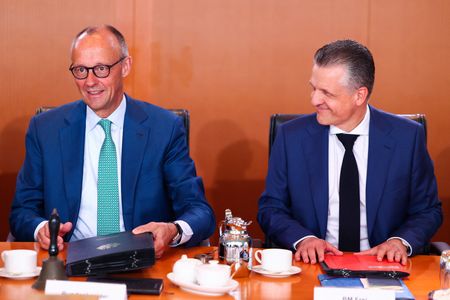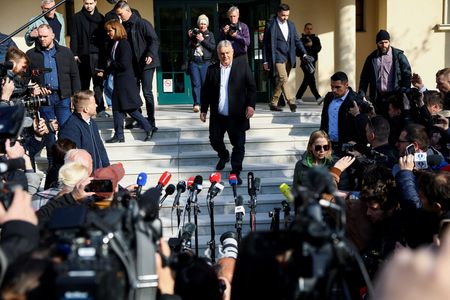

Hungary’s long-serving Prime Minister Viktor Orban has been voted out of office in Sunday’s election, dealing a significant blow to Europe’s far-right political movement.
The nationalist leader, who held power for 16 years, served as a role model for right-wing populist politicians worldwide and received praise from both former U.S. President Donald Trump and Russian President Vladimir Putin.
During his tenure, Orban championed ethnic nationalism, restricted press freedoms and civil society organizations, and opposed immigration, LGBTQ rights, and liberal policies. Among European leaders, he maintained the strongest connections to Trump’s MAGA movement, highlighted by Vice President JD Vance’s recent trip to Budapest to support him.
Hungarian voters’ frustration with economic conditions, government corruption, and limitations on democratic liberties led to Orban’s downfall. His defeat removes both an influential example for European far-right parties seeking power and a well-funded supporter who invested hundreds of millions into promoting these ideologies.
“Orban has been pretty much the figurehead of the European far right for the last few years and even beyond the European far right,” said Gabriela Greilinger, a doctoral researcher based in the United States, focusing on the European far right and democratic erosion.
“He has been the model because he was able to cling to power for so long and really entrench himself and his ideology in the state. And that’s something that most other far-right parties have not been able to do so far.”
Orban’s relationship with the MAGA movement has become problematic for some far-right politicians, as Trump’s controversial policies including threats toward Greenland and conflict with Iran have made him unpopular in Europe.
Alternative for Germany lawmaker Matthias Moosdorf wrote on social media Monday that Orban’s “ostentatious friendship” with the current U.S. administration “hung like millstones around Orban’s neck.”
BLOCKING EU INITIATIVES
Throughout his time in office, Orban frequently used Hungary’s veto authority within the European Union to obstruct aid to Ukraine and sanctions against Russia, earning appreciation from other leaders who wanted to weaken the bloc.
“He was a thorn in the side to the EU and that was a good thing,” said Ben Habib, the leader of the Advance UK party, an anti-immigration party launched in Britain last year.
Following Orban’s loss to pro-EU candidate Peter Magyar, Alice Weidel, co-leader of Alternative for Germany, posted on social media: “His achievements for his homeland and his contributions to Europe continue to inspire us to stand up for a continent of sovereign nations.”
Orban’s impact extended beyond domestic success to his ability to promote his ideas and policies internationally.
Using government resources and business investments, Orban provided more than a billion dollars equivalent to organizations like the Mathias Corvinus Collegium (MCC), a private research institute, and the Danube Institute, which functioned as ideological extensions of his Fidesz party.
“Budapest became a pilgrimage – people were over there all the time from MAGA world, so it was a successful strategy,” said Daniel Fried, a fellow at the Atlantic Council think tank in Washington, D.C.
Political gatherings brought together groups from across Europe and America, including influential organizations in Trump’s current administration such as the Heritage Foundation, America First Policy Institute and Alliance Defending Freedom.
Jacob Ross, a research fellow at the German Council on Foreign Relations, noted the significant presence of Orban-connected institutes in Washington as Trump prepared for his second presidency.
“I was really surprised to see how many Hungarian delegations were there, how active the Hungarian embassy in D.C. was interacting with Heritage,” he said.
Magyar announced Monday that his government would stop using public funds to support organizations like MCC or political party activities.
However, these institutes have already proven effective and will likely continue operating despite funding changes, according to Greilinger.
“Most of these organisations are also there to ensure that these ideas kind of live on even beyond the rule of the leader, or in this case, beyond the rule of Viktor Orban,” she said.
FAR-RIGHT ALLIES REMAIN HOPEFUL
Orban’s European partners expressed confidence that their movement still has momentum, noting that long-serving governments typically face increasing public dissatisfaction.
“We are going to miss the support of the Hungarian government, but let’s see how we move from here,” said Tânger Corrêa, a member of the European Parliament in the Patriots for Europe group, which includes Fidesz.
Corrêa pointed to encouraging polling for France’s National Rally before next year’s presidential race, and noted that his own Chega party became Portugal’s second-largest parliamentary party last year.
“It’s not pleasant that one of our members lost an election,” said Corrêa.
“But it’s life, we move on.”